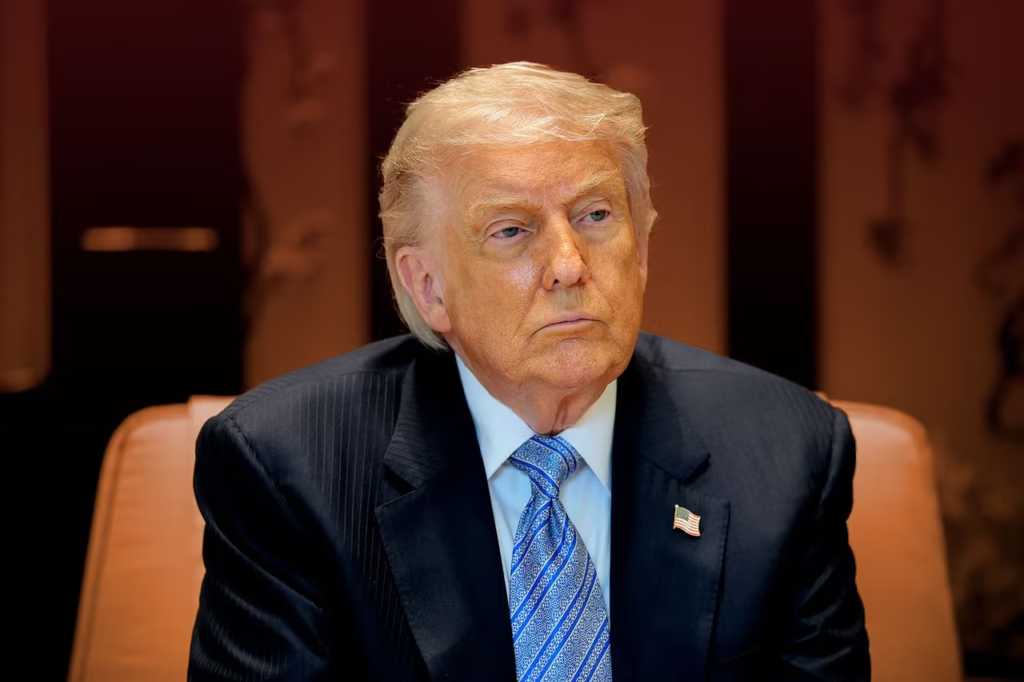
Collins and Murkowski didn’t just vote no on Blanche — they explained why, in detail, on the public record. Their statements are the most substantive Republican critique of an administration DOJ in recent memory. They deserve to be read as a document, not summarized away. ONYX presents the key claims, the context for each, and what they mean for the DOJ’s credibility under its new confirmed leadership.
THE COLLINS ALLEGATIONS — UNPACKED
Collins cited four specific concerns about Blanche’s DOJ tenure:
▸ THE EPSTEIN FILES: Collins cited “the handling of the Epstein files” — a reference to the DOJ’s management of records related to Jeffrey Epstein, whose client list has been a matter of significant public interest. Whether Collins is alleging specific misconduct or referring generally to the DOJ’s decision not to release files that advocates argue should be public is not fully specified in her statement.
▸ SWEEPING IMMUNITY PROTECTIONS: Collins cited “sweeping immunity protections granted to the President, his family, and their businesses” — this refers to DOJ positions in various legal proceedings that have extended immunity arguments beyond established precedent. The IRS settlement (which Blanche partially walked back) is one specific example; there may be others not yet public.
▸ STATEMENTS TO ANTI-ABORTION GROUPS: Collins cited “the statements he made to anti-abortion groups” — Blanche apparently made specific commitments or statements to anti-abortion advocacy organizations that Collins found inappropriate for the nation’s chief law enforcement officer. The specific statements have not been reported in full.
▸ TARGETING SITTING SENATORS: Collins alleged “repeated targeting of individuals ranging from former administration staff to sitting U.S. Senators” — the most alarming specific claim. If the DOJ under Blanche has been conducting investigations or actions directed at members of Congress who are not Trump allies, this is a direct separation-of-powers violation with no modern precedent.
THE MURKOWSKI ARGUMENT — UNPACKED
Murkowski’s statement rests on a cleaner, institutional argument: the AG must be the law enforcement officer of the United States, not the president’s personal attorney. She adds “I was not convinced that Mr. Blanche would check the worst impulses of this administration.”
“Check the worst impulses” is a specific theory of the AG’s role that is worth examining. The argument: the AG is supposed to serve as a check — someone who tells the president when an action is illegal, unconstitutional, or imprudent, and declines to pursue it. Murkowski is saying she doesn’t believe Blanche will perform that checking function.
This is not a generic concern. It is a specific prediction about how Blanche will behave when Trump instructs him to do something legally questionable. Murkowski is saying: he will do it, because he is Trump’s personal attorney, not the country’s chief law enforcement officer.
WHAT CASSIDY SAID — THE COUNTERARGUMENT
Cassidy’s counterargument — that he “ultimately trusted Blanche to give the president candid legal advice” — is the opposite prediction. Cassidy is saying: precisely because Blanche was Trump’s personal attorney, he knows how to speak candidly to Trump in a way that other AGs could not. The personal relationship is the check, not the threat.
Both Murkowski’s and Cassidy’s predictions are coherent theories of how Trump’s personal attorney as AG would behave. Both are unfalsifiable in the abstract. They will be resolved by what Blanche actually does in office when he faces a choice between the president’s preferences and the law.
WHY THESE STATEMENTS MATTER BEYOND THE VOTE
Collins’s statement is now a public, senatorial record. If any of the four things she alleged — Epstein file handling, immunity provisions, anti-abortion commitments, senator targeting — become the subject of investigation or oversight, her statement is the starting point. She has defined what scrutiny looks like.
Murkowski’s framing — “check the worst impulses” — is the analytical lens through which every future DOJ decision will be assessed by both senators and the public: was this the AG checking the president, or executing the president’s preferences?
| CONFIDENCE: HIGH | Collins and Murkowski statements are from their official Senate floor records and written statements. Cassidy statement is on the record. Analysis of what the statements mean is ONYX editorial, clearly labeled. |
| ⚖️ BIAS CHECK — WHO IS SAYING WHAT | |
| Collins | Institutional and rule-of-law Republican; her concerns are specific and documented; she took the political cost willingly |
| Murkowski | More cautious framing; “worst impulses” is a prediction about the future rather than an allegation about the past |
| Conservative Media | Framing both senators as obstructionists; not engaging with the specific allegations |
| Democrats | Treating the Collins “targeting senators” allegation as the most actionable claim; requesting details |
| Legal Community | Finding Collins’s allegations more specific and concerning than Murkowski’s institutional argument; calling for oversight |
SOURCES
▸ Collins floor statement — full text, Senate official record
▸ Murkowski written statement — full text, official record
▸ Cassidy pre-vote announcement — on-record statement