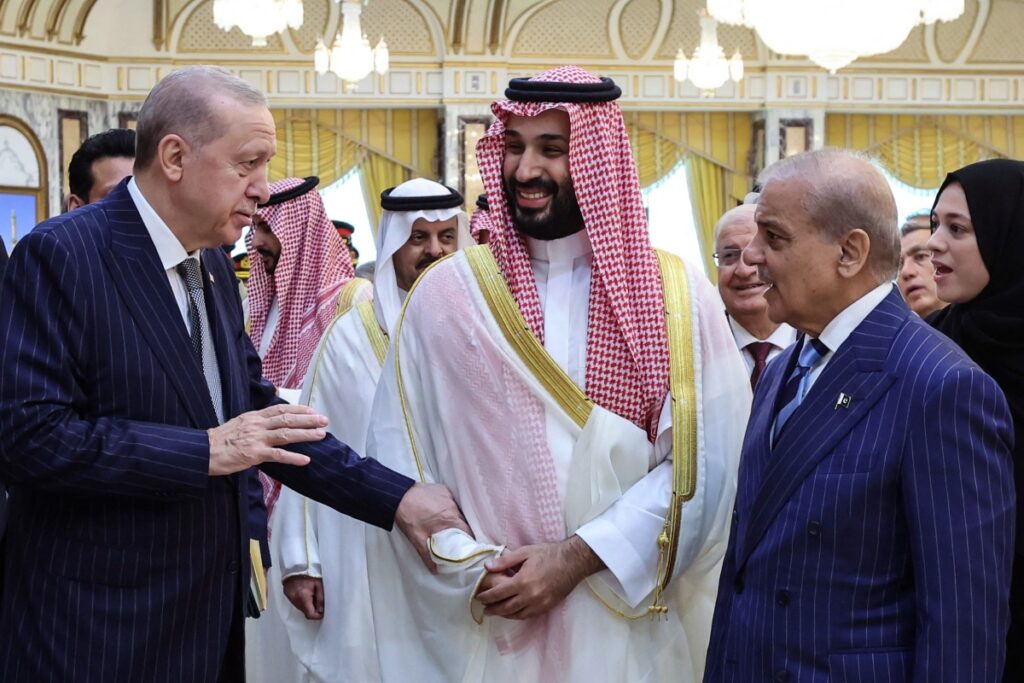
Saudi Arabia, Turkey, and Pakistan signed a trilateral defense pact in Mecca aimed at deterring aggression in the region — one of the most significant new security agreements in the Muslim world in recent years. The pact is being analyzed by regional analysts as a response to the US-Iran war’s exposure of the limits of US military protection guarantees in the Gulf, and as evidence of a shifting security architecture in which major Muslim-majority countries are building their own collective deterrence rather than relying solely on US treaty commitments.
WHY THESE THREE COUNTRIES?
| COUNTRY | SPECIFIC CONTRIBUTION TO THE PACT |
| Saudi Arabia | Financial resources and Gulf security leadership; Custodian of the Two Holy Mosques gives the signing location religious legitimacy; primary target of Iranian missile threat |
| Turkey | NATO membership gives the pact a connection to the Western alliance structure; largest military in the Muslim world by active personnel; Erdogan’s diplomatic activism is a strategic asset |
| Pakistan | Nuclear-armed state — the only Muslim-majority country with confirmed nuclear weapons; military professionalism; geographic position between Iran and India |
The specific combination of these three countries creates a pact with unique characteristics: Saudi economic power, Turkish military capability and NATO connection, and Pakistani nuclear deterrence. No single element makes the pact decisive. The combination creates a meaningful deterrence architecture.
IRAN’S REACTION
Iranian analysts quoted by Al Jazeera said the pact “signals a shifting perception of the US role in the region.” This framing is significant: Iran is interpreting the pact not as an anti-Iranian alliance (though that is its clear implication) but as evidence that regional powers no longer believe US security guarantees are reliable. The US-Iran war’s impact on US Patriot stockpiles, its consumption of US diplomatic attention, and the uncertainty around the ceasefire deal have together communicated something to regional actors: US military backing has limits.
Whether that Iranian interpretation is correct — whether the Saudi-Turkey-Pakistan pact represents a loss of confidence in the US or simply a desire for additional layers of security alongside the US relationship — is a question that regional actors are asking in real time. The pact does not exclude the US. It supplements it.
THE SIGNING IN MECCA — WHY THE LOCATION MATTERS
The choice of Mecca as the signing venue is deliberately symbolic. Saudi Arabia, as the Custodian of the Two Holy Mosques, carries unique legitimacy in the Muslim world. Signing a defense pact in Mecca — in the holiest city in Islam — frames the agreement not just as a political or military arrangement but as a collective commitment with religious dimension. Erdogan and Pakistani officials accepting Mecca as the venue signals their recognition of Saudi Arabia’s unique role in the Islamic world.
It also sends a message about the geography of the new security architecture: not Washington, not Brussels, not Riyadh in its ordinary political capacity — Mecca, the spiritual center. This is deliberate diplomatic choreography from Riyadh.
WHY THIS MATTERS
The Saudi-Turkey-Pakistan pact is one of the most significant structural consequences of the US-Iran war. It represents three major US partners building an independent security architecture specifically because the Iran war demonstrated that US military protection has limits. This does not mean these countries are leaving the US orbit. It means they are hedging — adding their own collective deterrence to the US relationship rather than relying solely on it.
For the US: the pact is a mixed signal. On one hand, it strengthens the security of three important US partners. On the other hand, a multilateral Muslim-world defense pact that functions independently of US command structure creates a new actor in the regional security environment that the US must coordinate with rather than direct.
For China: a Saudi-Turkey-Pakistan security pact is partly a response to the same uncertainty about US reliability that is also drawing some of these countries closer to China economically. The pact does not represent a turn toward China — but it represents a turn away from exclusive US dependency.
WHAT HAPPENS NEXT
▸ Formal pact ratification by all three legislatures — Pakistan’s parliament and Turkish Grand National Assembly must ratify
▸ Joint military exercises announced as a first visible implementation step (expected within 90 days)
▸ Other Muslim-majority states may seek to join or align with the pact — Jordan, the UAE, and Malaysia are mentioned in analysis
▸ US response will be diplomatic — expect Washington to characterize the pact as “complementary” to existing alliances while privately assessing its long-term implications
▸ Iran will attempt to use the pact to argue it faces a regional anti-Iranian coalition — legitimizing its own defensive posture
| CONFIDENCE: HIGH | Saudi-Turkey-Pakistan pact signing in Mecca is documented from Al Jazeera. Analyst assessments of the pact’s significance are from Al Jazeera reporting. Specific contributions of each country (financial, military, nuclear) are established facts about each country’s capabilities. Iran’s reaction is from quoted Iranian analysts. |
| ⚖️ BIAS CHECK — WHO IS SAYING WHAT | |
| Saudi Arabia | Leading the pact diplomatically; using Mecca signing to maximize legitimacy; framing as defensive and deterrent, not offensive |
| Turkey / Erdogan | Sees geopolitical opportunity; pact builds on his “mediator” role established during the Iran war period |
| Pakistan | Benefits from formalized security relationship with wealthier Gulf partner; the nuclear dimension is implicit but real |
| Iran | Threatened; will argue the pact is an anti-Iranian coalition; will use it to justify its own security posture |
| US | Publicly supportive; privately assessing long-term independence implications; no veto over allies’ multilateral security arrangements |
| China | Watching; the pact’s emergence alongside China’s growing Gulf economic relationships creates a complex mosaic |
SOURCES
▸ Al Jazeera — Saudi-Turkey-Pakistan trilateral defense pact, Mecca signing, August 2026
▸ Iranian analyst commentary — “shifting perception of US role” — Al Jazeera sourcing
▸ Each country’s military capabilities — established public record
QUESTIONS YOU MAY STILL HAVE
Q: Does Pakistan’s nuclear arsenal now cover Saudi Arabia and Turkey?
A: That is the implication that makes the pact significant, but neither Pakistan nor its partners have stated this explicitly. Pakistan’s nuclear doctrine is officially non-proliferation-committed. However, the inclusion of Pakistan in a defense pact with explicit deterrence language creates an implicit extended deterrence relationship that is intentionally ambiguous.
Q: Does this threaten the US-Saudi relationship?
A: No — Saudi Arabia remains deeply dependent on US military equipment, training, and intelligence. The pact supplements rather than replaces the US relationship. But it does signal that Saudi Arabia is building redundant security relationships, which is geopolitically significant.