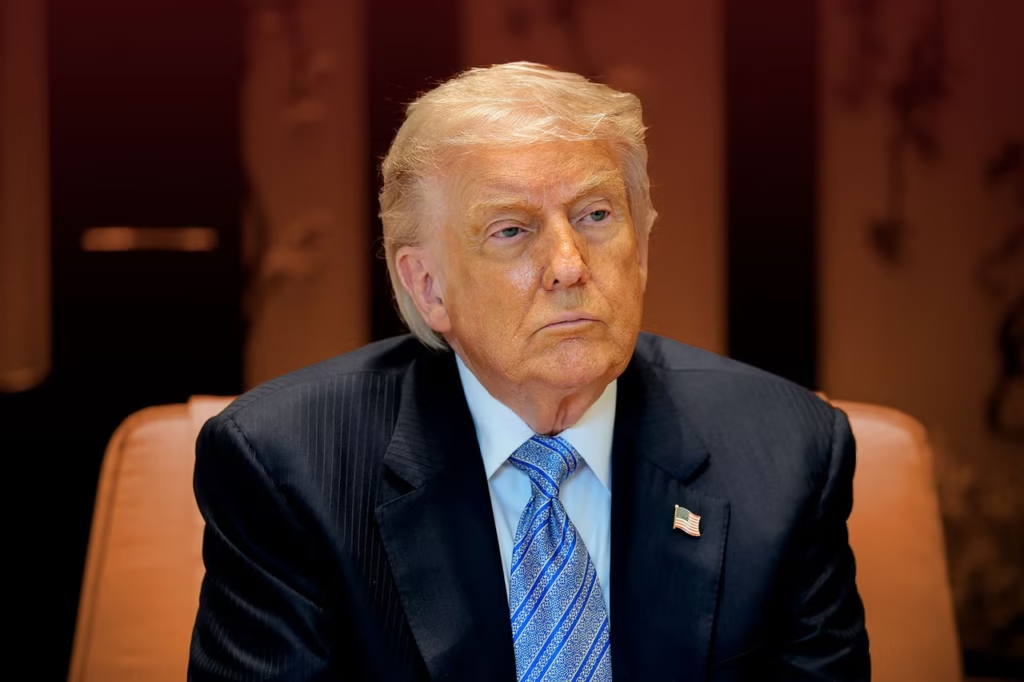
A new poll found a majority of US citizens are concerned about the Iran conflict’s impacts, according to Al Jazeera. This landing simultaneous with bipartisan Senate pushback on South Korea drill reductions, CNN’s visual documentation of Ukraine’s empty Patriot depots, and Indiana’s record flooding suggests a broader pattern: the cumulative cost of the war period — economic, military, diplomatic — is reaching public consciousness at a specific moment when multiple simultaneous crises are visible simultaneously.

WHAT CONCERN MEANS IN CONTEXT
Concern about the Iran war and its aftermath is not equivalent to opposition to the ceasefire or to the military operations that produced it. The poll’s specific content — what exactly Americans are concerned about and how that concern breaks down by party, age, and geography — matters for interpreting its political significance. ONYX characterizes the poll at the level the Al Jazeera report supports, without extrapolating beyond its specific findings.
The broader context for the concern: gas prices, while now falling from the deal, were elevated for five months; the USS Lincoln’s 240-day deployment is a human story that has broken into public consciousness; the Patriot shortage is a capability story that is now visually documented; and the South Korea drill reduction is being criticized by members of the president’s own party. Each of these is an input to public concern about the war’s management.
THE APPROVAL RATING DIMENSION
The brief notes that Trump’s approval has tied its career low and 78% of Americans say the administration isn’t focused enough on lowering prices. ONYX presents these as related but distinct data points: the approval rating reflects cumulative assessments across all policy domains; the price-focus finding reflects a specific economic communication problem. The deal is producing price decreases; whether Americans are receiving and crediting that information is a separate question from whether the prices are actually falling.
The prices are falling. The approval is at its career low. Both can be true simultaneously when the decline is not yet reaching the people who are forming the approval opinion. That’s the specific political timing problem.
WHAT HAPPENS NEXT
▸ Continued gas price decline (projected floor August 20-22) will produce the most direct consumer-visible evidence of the deal’s benefit
▸ August CPI data (mid-September) will show the deal’s first measurable price impact in official statistics
▸ Labor Day (September 1) is the peak political visibility window for gas price narratives
▸ Second nuclear dialogue session — its content and outcome will be the next major public-facing deal event
| CONFIDENCE: MODERATE | Poll finding (majority concerned) is from Al Jazeera reporting. Approval rating and 78% price focus figures are from brief sourcing — specific poll methodology should be consulted. ONYX presents at the level the reporting supports. |
SOURCES
▸ Al Jazeera — Iran war public concern poll, August 2026