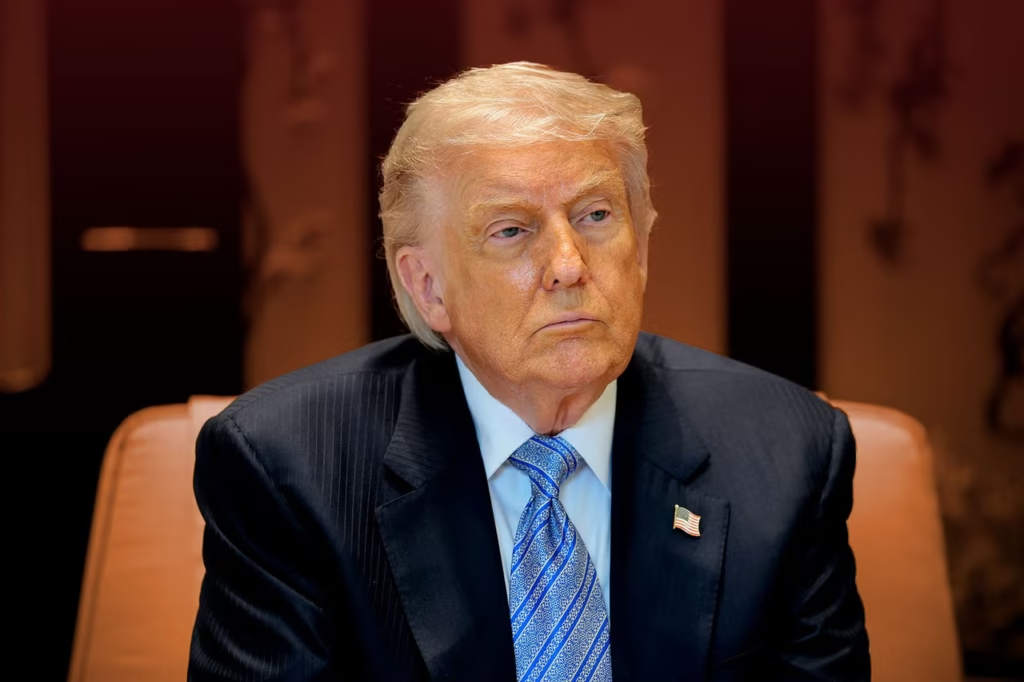
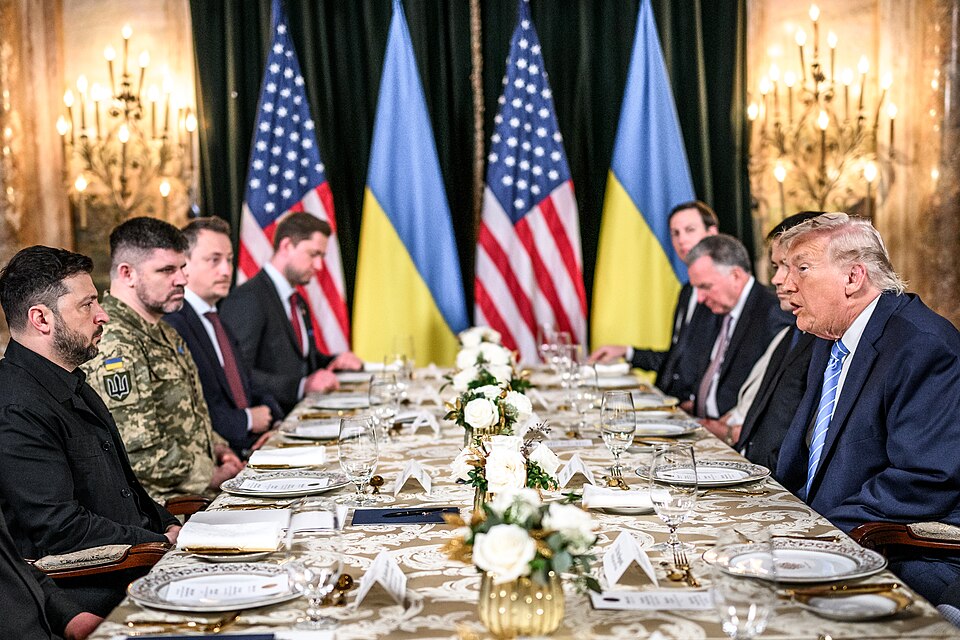
President Trump and Ukrainian President Zelenskyy are meeting in Turkey, with Turkish President Erdogan as host. The meeting’s purpose is to advance Ukraine peace negotiations, with Putin’s participation or response still being worked through diplomatic channels. Trump’s direct presence — rather than the envoy-level engagement of prior weeks — signals that the US is treating this as a high-priority diplomatic moment that Trump is personally invested in.
WHAT TRUMP IS BRINGING
The US brings specific leverage to a Ukraine peace framework that no other actor provides:
▸ Military aid conditionality: Trump’s willingness to condition continued US military aid on Ukrainian negotiating participation is the specific pressure tool that produced Zelenskyy’s attendance
▸ Sanctions leverage: US primary and secondary sanctions against Russia are the most consequential economic pressure tool available to any party
▸ NATO dimension: US influence over NATO’s posture toward any Ukraine peace framework is essential; a security guarantee for Ukraine that NATO members endorse requires US leadership
▸ Post-war reconstruction: US participation in Ukraine’s reconstruction financing would be significant; Trump’s prior statements about minerals deals suggest a specific economic interest
THE NO-TROOPS CONSTRAINT
Trump’s August 18 statement that no US troops will serve as a security guarantee (ONYX August 18 Section B Story 16) is the specific constraint that limits what the US can bring to the security architecture. Any ceasefire or peace agreement requires a security framework that deters future Russian aggression. Without a US troop commitment, the security framework must be built from:
▸ European security guarantees (UK and France have treaty commitments; Germany has been building capacity but is politically complicated)
▸ NATO Article 5 extension (requires Ukrainian NATO membership, which Russia formally opposes)
▸ Bilateral security agreements with individual European states
▸ Ukrainian deterrence through continued weapon supply and military capacity
The gap between what Ukraine needs (a credible deterrent against future Russian attack) and what Trump has committed to provide (no US troops) is the specific security architecture problem that any Turkey meeting outcome must navigate.
THE ZELENSKYY POSITION
Zelenskyy’s negotiating constraints going into Turkey: Ukraine’s formal legal prohibition on territorial concessions; his domestic political position that requires any agreement to be presented as preserving Ukrainian sovereignty; and the specific military reality that Ukraine cannot sustain current operational tempo indefinitely without continued US support. These constraints push Zelenskyy toward a ceasefire framework that freezes current front lines while negotiations continue — the ‘frozen conflict’ model — rather than a full peace that requires territorial compromise.
Trump is personally in Turkey, personally invested in a Ukraine deal. He has explicitly ruled out the security guarantee Ukraine most wants. Zelenskyy is there because not being there risks losing US support. The gap between what both sides need and what both can offer is what the Turkey meeting has to bridge.
THE HISTORICAL COMPARISON
The most relevant historical comparison for this diplomatic moment is not Yalta (1945) or Minsk (2014-2015), which produced agreements that collapsed. The more useful comparison is the 1953 Korean armistice: a ceasefire that froze a conflict along a demilitarized line without a formal peace treaty, sustained by a US security presence and an ongoing state of non-war. If the Turkey meeting produces anything, a Korea-model ceasefire is the most analytically plausible outcome — and it has the same specific limitation: it requires a US military presence in Ukraine that Trump has ruled out.
WHAT HAPPENS NEXT
▸ Turkey meeting outcome — whether a joint statement, a framework agreement, or a breakdown emerges
▸ Putin’s response — whether Russia formally engages with whatever framework the Turkey meeting produces
▸ Security architecture — the specific security guarantee framework that can be assembled without US troops
▸ Congressional response — whether the Senate, which has oversight of treaties, is engaged in the framework development
▸ North Korean troop posture — whether Russia reduces NK deployment as a diplomatic signal
| CONFIDENCE: HIGH | Trump and Zelenskyy meeting in Turkey and Erdogan hosting are from confirmed reporting. August 22 Section B context (meeting being arranged, what it can/cannot produce) is from ONYX documentation. No-troops constraint is from ONYX August 18 Section B Story 16. Historical comparison analysis is ONYX editorial. |
| ⚖️ BIAS CHECK — WHO IS SAYING WHAT | |
| Trump | Personally invested in claiming credit for Ukraine peace; willing to pressure Zelenskyy but limited in what he can offer without US troop commitment |
| Zelenskyy | Attending under pressure; his red lines (territorial integrity, no unilateral concessions) constrain what he can accept |
| Erdogan | Benefits from hosting a historic diplomatic moment regardless of outcome; Turkey’s leverage in the region is enhanced by its indispensability |
| Putin | Has not confirmed attendance at any meeting; Russia’s willingness to engage is the specific unknown that determines whether the Turkey meeting is bilateral (US-Ukraine) or trilateral |
| European Allies | Want to be involved in any security framework; concerned about being excluded from a US-Russia understanding that determines European security architecture |
SOURCES
▸ Confirmed reporting — Trump and Zelenskyy Turkey meeting, August 23, 2026
▸ ONYX August 18-22 — Ukraine peace negotiations documentation
Q: Is Putin attending the Turkey meeting?
A: Not confirmed in available reporting. The meeting as currently reported is between Trump and Zelenskyy, with Erdogan hosting. Whether Putin is invited to or will attend any session is the specific unknown that determines whether this is a bilateral US-Ukraine meeting or the beginning of a trilateral framework.
Q: What is a frozen conflict and why is it relevant?
A: A frozen conflict is a military standoff where active combat has stopped but no formal peace agreement resolves the underlying territorial or political dispute. Cyprus, Georgia’s Abkhazia and South Ossetia, and Moldova’s Transnistria are examples. A Ukraine frozen conflict would likely involve a ceasefire line near current front lines, a DMZ, and an unresolved status for Russian-occupied Ukrainian territories. This is the most achievable outcome without territorial concessions from Ukraine.