
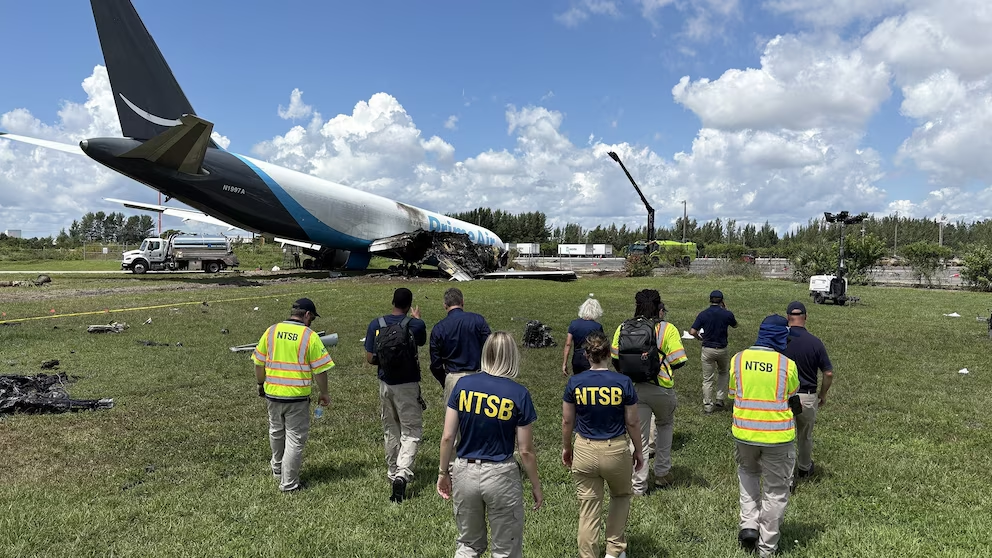
21 Air Flight 7598, a Boeing 767-300 freighter operating for Amazon Prime Air, overran Runway 30 at Miami International Airport Sunday afternoon while landing from San Juan, Puerto Rico. The aircraft was traveling at approximately 130 miles per hour when it left the runway. It struck a van carrying seven workers employed by Professional Ocean Service, an airport contractor, inside the airport perimeter. It then struck an SUV outside the perimeter. The plane came to rest in a field with an active fuel leak.
Five people are dead. Five others are injured. NTSB Chairwoman Jennifer Homendy has confirmed the casualty figures and deployed a 32-person NTSB team to document what she described as ‘perishable evidence’ at the site. A preliminary report is expected within weeks; the full investigation will take a year or more.
THE FIVE WHO DIED
ONYX documents the dead at the level of confirmed reporting. The five people killed were in the Professional Ocean Service van that the overrunning aircraft struck on the airport perimeter. Their names, at the level of confirmed reporting from NTSB and official identification, are from developing reporting as of this publication. ONYX will name them as they are confirmed. They were airport workers. They were inside the airport’s perimeter doing their jobs when the aircraft left the runway.
THE EMAS — THE SYSTEM MIAMI DID NOT HAVE
Aviation experts are pointing directly to Miami International Airport’s missing Engineered Material Arresting System as the safety gap that made this outcome possible. CNN aviation analyst Mary Schiavo and other experts have made this observation specifically. ONYX covers what an EMAS is, why Miami did not have one, and what the gap means for the specific people who died.
An Engineered Material Arresting System is an installation at the end of a runway that consists of crushable concrete — cellular cement — or similar energy-absorbing material. When an aircraft overruns the runway and enters the EMAS, the material crushes under the aircraft’s weight, rapidly decelerating the plane and stopping it within the EMAS bed. EMAS systems have successfully stopped multiple aircraft overruns at airports that have them, preventing fatalities in incidents where the aircraft was traveling at high speed past the runway’s end.
WHY MIAMI DID NOT HAVE EMAS
EMAS installation requires sufficient physical space beyond the runway end to accommodate the bed. Miami International Airport is one of the most geographically constrained major airports in the United States: it is surrounded by developed urban area on three sides, with limited space beyond runway ends for traditional runway safety areas. The specific constraint:
▸ Runway 30’s end: the available safety area beyond Runway 30 was insufficient to meet standard runway end safety area requirements without EMAS
▸ EMAS as the alternative: the FAA accepts EMAS as an engineered alternative to standard runway end safety areas where geographic constraints make standard areas impossible; Miami had not installed EMAS at Runway 30
▸ The urban environment: CNN analyst Schiavo specifically noted that an airport ‘this surrounded by population’ has heightened responsibility to ensure that aircraft exiting runways do not enter populated or populated-adjacent spaces
THE ACCOUNTABILITY QUESTION
The specific accountability question the EMAS absence raises: EMAS is not a theoretical option for constrained airports. It is an established, proven, FAA-recognized safety system with a documented track record of preventing runway overrun fatalities. At Runway 30 of Miami International Airport — a runway at an airport the analyst described as surrounded by population — the EMAS was not installed. Five people who were working inside the airport perimeter are dead.
Whether the decision not to install EMAS reflects resource allocation, airport planning, FAA certification requirements, or specific runway end geometry is what the NTSB investigation will address. The human consequence of that decision is confirmed and documented.
THE FOUR AREAS OF INQUIRY
CNN reports the NTSB is investigating four key areas:
▸ Piloting: what the crew did and did not do in the approach and landing phase; whether cockpit decisions or errors contributed to the overrun
▸ Airfield: the runway, its end safety area, the EMAS absence, and the airport’s configuration around Runway 30
▸ Weather: the specific meteorological conditions at Miami International on Sunday afternoon; whether crosswind, wet runway, visibility, or other conditions were factors
▸ Aircraft condition: the Boeing 767-300 is a 32-year-old aircraft that had already completed two round trips that day before the fatal landing; its maintenance status, tire condition, brake condition, and airworthiness are specific inquiries
THE 32-YEAR-OLD AIRCRAFT
The aircraft was 32 years old. Before the fatal landing from San Juan, it had already completed two round trips that day — meaning the accident flight was at minimum the plane’s fifth leg of the day. An aging aircraft at the end of an intensive single-day flying schedule has specific maintenance and fatigue implications that the NTSB will examine.
ONYX connects to the arc’s Boeing documentation: the production run has covered Boeing manufacturing quality failures (August arc), the FAA’s oversight role, and the specific documented questions about older Boeing aircraft maintenance regimes. The 767 is a different platform from the 737 MAX that was the focus of prior Boeing accountability coverage; the specific aircraft type and its maintenance record are from the NTSB investigation, not from prior Boeing documentation. ONYX notes the broader Boeing accountability context without prejudging the specific investigation.
THE NO-MAYDAY DIMENSION
CNN aviation analyst Schiavo noted that the aircraft never issued a Mayday call. A Mayday call — the international distress signal — is used when a crew believes they are in imminent danger and need emergency assistance. The absence of a Mayday call in a landing that ended in five fatalities is a specific NTSB inquiry point: either the crew did not assess the situation as a Mayday-level emergency, did not have time to make the call, or the situation developed faster than the crew could act on it.
A cargo plane overran a Miami runway at 130 miles per hour. It hit a van of airport workers. Five of them are dead. Miami International Airport does not have the system designed to stop overrunning aircraft. The system exists. The airport is surrounded by population. The system was not there.
WHAT HAPPENS NEXT
▸ NTSB investigation — preliminary report within weeks; full investigation one year or more
▸ EMAS accountability — whether the FAA reviews EMAS installation requirements at constrained airports following this crash
▸ Miami Airport response — whether MIA announces EMAS installation planning
▸ Amazon Prime Air / 21 Air — their specific contractual relationship and what operational standards govern the aircraft
▸ Boeing accountability — whether the 767-300’s age and maintenance record are factors
▸ Workers named — ONYX will name the five dead as their names are confirmed
| CONFIDENCE: HIGH | 21 Air Flight 7598 Boeing 767-300 Amazon Prime Air runway overrun Miami International Runway 30, five dead five injured, Professional Ocean Service van seven workers, SUV outside perimeter, fuel leak, NTSB Chairwoman Jennifer Homendy 32-person team perishable evidence, no Mayday, CNN analyst Mary Schiavo EMAS observation, 32-year-old aircraft two prior round trips that day are from CNN and NTSB confirmed reporting. |
| ⚖️ BIAS CHECK — WHO IS SAYING WHAT | |
| NTSB | Independent federal investigation authority; their preliminary and final reports are the authoritative factual record; their investigation is ongoing |
| CNN aviation analyst (Schiavo) | Veteran aviation attorney and former NTSB member; her EMAS observation is specific expert opinion based on confirmed facts about the airport’s configuration |
| Miami International Airport | Has not publicly addressed the EMAS absence as of this publication |
| Amazon Prime Air / 21 Air | Have not made public statements on the specific aircraft condition or operational standards as of this publication |
| ONYX | Covering the EMAS accountability dimension because it is the specific documented safety system whose absence experts are naming; the investigation’s outcome will determine factual responsibility |
SOURCES
▸ CNN — Miami cargo plane crash five dead EMAS NTSB investigation, September 8, 2026
Q: What is an EMAS and how does it work?
A: An Engineered Material Arresting System is a bed of crushable cellular cement or similar energy-absorbing material installed beyond the end of a runway in the runway safety area. When an aircraft overruns the runway at speed and enters the EMAS, the aircraft’s landing gear sinks into and crushes the material; the resistance rapidly decelerates the aircraft. EMAS beds are typically 300-600 feet long; the energy absorption stops aircraft that are traveling at speeds that would otherwise carry them far beyond the runway. The FAA has accepted EMAS as an alternative to standard runway end safety areas since the 1990s; multiple EMAS installations at US airports have successfully stopped aircraft overruns without fatalities, including at JFK Airport in 2005 and at Philadelphia in 2007.
Q: Why don’t all airports have EMAS?
A: EMAS is expensive: installations cost $5-15 million depending on the runway and airport configuration. Standard runway end safety areas, which require 1,000 feet of clearance beyond the runway, are less expensive but require more space. At airports with sufficient land, the standard safety area is typically used; at constrained airports like MIA, EMAS is the FAA-recognized alternative. The specific question in the Miami crash investigation: why did Miami International Airport, which is acknowledged as a geographically constrained airport surrounded by development, not have EMAS installed at Runway 30.
Q: What is 21 Air’s relationship to Amazon Prime Air?
A: Amazon Prime Air contracts with third-party cargo airlines to operate its air freight network rather than operating its own aircraft directly. 21 Air is one of the contract carriers in the Amazon Air network; it operates Boeing 767 freighters under Amazon branding. The specific contractual relationship — including maintenance standards, operating requirements, and oversight responsibilities between Amazon and 21 Air — will be part of the NTSB investigation into the operational context of the accident flight.