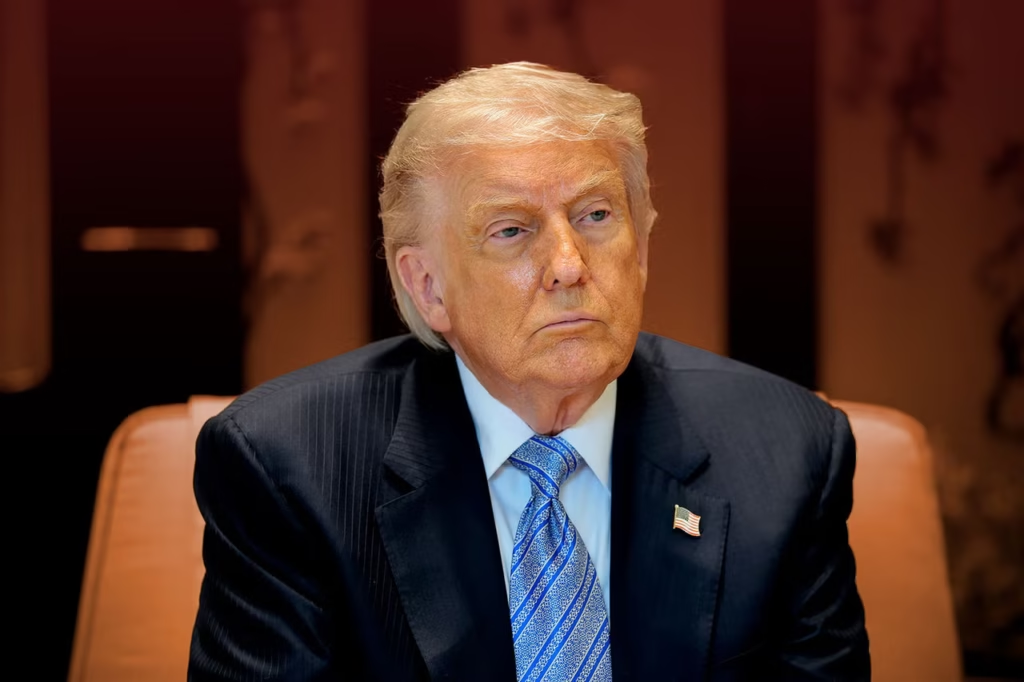
By announcing the EPA’s climate rollback at a G20 energy ministers summit rather than a domestic venue, the US government made its position unmistakably clear to the world’s twenty largest economies simultaneously: the United States will not regulate greenhouse gases as a health danger. That is not an implication. It is the stated legal position of the US Environmental Protection Agency.
HOW DIFFERENT G20 MEMBERS ARE LIKELY TO RESPOND
ONYX covers the likely responses by category, not by attributing specific positions to specific governments whose formal responses have not yet been confirmed:
▸ European allies (EU members at the G20): the EU has committed to the European Green Deal and its own emissions reduction targets; a US declaration that greenhouse gases are not a regulatory concern is a specific divergence from European climate policy; it may accelerate EU climate border adjustment mechanisms (carbon tariffs on imports from countries with less stringent emissions regulation)
▸ UK: separately managing the Iran war alongside the US; now receiving a direct US statement that climate regulation is not the US EPA’s mandate; the UK has its own Climate Change Act with legally binding emissions targets
▸ China: the US-China relationship on climate has been one of the few areas of bilateral engagement; a US EPA declaration that greenhouse gases are not dangerous removes the regulatory foundation for US climate engagement with China
▸ India, Brazil, South Africa (developing G20 economies): have argued that developed nations should bear greater responsibility for emissions reduction; a US retreat from regulation validates the argument that wealthy nations are not holding to commitments
THE TRADE DIMENSION
The EU’s carbon border adjustment mechanism — a tariff on imports from countries with less stringent carbon pricing — is designed specifically for this scenario. If the US EPA removes its regulatory obligation for greenhouse gases, US goods exported to the EU could face higher carbon tariffs. This is a specific trade consequence that connects the EPA’s domestic legal action to international economic relations.
The US told the G20 it won’t regulate climate pollution. The EU has a carbon tariff designed for exactly this scenario. China has no formal basis for bilateral climate engagement with a US EPA that says greenhouse gases aren’t dangerous. India’s argument that rich countries don’t meet their commitments just got documented at a summit. The diplomatic consequences are specific.
WHAT HAPPENS NEXT
▸ EU carbon border adjustment — whether the EPA action triggers accelerated application of EU carbon tariffs to US goods
▸ Paris Agreement — whether any formal challenge to US commitments under the agreement is raised
▸ G20 communique — whether the G20 summit produces a formal statement on the EPA announcement
| CONFIDENCE: HIGH | EPA G20 Houston announcement climate rollback endangerment proposal US position international audience, EU carbon border adjustment mechanism likely consequence from confirmed reporting and ONYX Section A documentation. |
SOURCES
▸ Confirmed reporting — G20 US climate divergence allies September 16, 2026