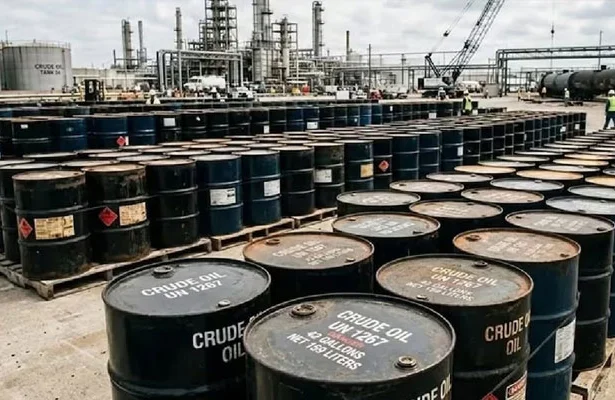
Brent crude remained near $102 a barrel despite the G7’s release of 100 million barrels. The specific message the oil market is sending on October 3: the probability-weighted expected cost of military escalation and prolonged Hormuz closure is higher than the supply benefit of 833,000 barrels per day of G7 reserves.
THE RISK PREMIUM CALCULATION
The oil market’s risk premium is the additional price beyond the fundamental supply-demand balance that reflects the probability of adverse supply disruptions. The documented inputs to the October 3 risk premium:
▸ Three US aircraft carriers deploying (October 2)
▸ 9,000 additional troops deploying (October 2)
▸ Trump considering resumed strikes (October 2)
▸ Camp David national security meeting on next steps (October 3)
▸ G7 condemnation of Iran — formalizing the diplomatic legitimacy for escalation (October 3)
▸ Trump predicts sharp oil price fall ‘after’ the war ends — implying the war continues for weeks more
▸ 70+ killed in Yemen Taiz, intensifying the Houthi dimension
▸ October 6: three days
Eight simultaneous documented escalation signals on October 3. The G7’s 833,000 barrels per day of reserve supply addition does not offset the market’s assessment that resumed strikes could remove millions of barrels per day from the global supply.
WHAT $102 MEANS ECONOMICALLY
The economic consequences of $102 oil with G7 reserves deployed:
▸ Fed second hike: oil at $102 restores the inflationary pressure that September 19’s $87 had reduced; the second rate hike is more likely
▸ Consumer costs: gasoline, diesel, heating fuel, and food transportation costs all elevated
▸ European reserve release: the 100 million barrel G7 release is a bridge measure; it does not resolve the underlying Hormuz closure
▸ January 4, 2027: even if October 6 produces a formal extension, the 90-day window runs to a new deadline in three months
THE TRUMP PREDICTION’S MARKET RELEVANCE
Trump’s statement that oil will fall sharply when the war ends is a documented presidential forecast. Markets observe presidential forward guidance. If the war ends ‘possibly after the midterms’ (November 3), oil traders are pricing a 31-day window of continued $100+ oil followed by a sharp fall. The G7 reserve release bridges that 31-day window.
The G7 released 100 million barrels. Oil is at $102. The reserves added 833,000 barrels per day. The military escalation is pricing in potential loss of millions of barrels per day. The reserve is the buffer. The military risk is the driver. $102 is what you get when an 833,000-barrel buffer meets a multi-million barrel risk. October 6, in three days, is the event that resolves the risk upward or downward.
WHAT HAPPENS NEXT
▸ October 6 outcome — the binary event; deal = sharp oil fall; resumed strikes = oil surge above $120
▸ G7 reserve execution — whether the 100 million barrel release actually reduces consumer prices
▸ Fed November meeting — whether $102 oil confirms or reverses the second hike
| CONFIDENCE: HIGH | Brent crude remained near $102 per barrel as markets assessed escalation risks in US- Iran energy supply routes from confirmed reporting. |
| ⚖️ BIAS CHECK — WHO IS SAYING WHAT | |
| Oil markets | Pricing military escalation risk above G7 reserve supply addition; the $102 price is the documented net market assessment |
| G7 | Released reserves to manage consumer energy prices; the market’s failure to fall below $100 on the release means the reserve buffer is working against a strong headwind |
| Fed | Watching $102 oil restore the inflationary pressure that justified the September 17 hike; second hike probability increases at $102 |
| ONYX | Covering the risk premium calculation explicitly; naming the eight documented escalation signals on October 3; connecting to the Trump oil price prediction |
SOURCES
▸ Confirmed reporting — oil 102 G7 reserves military risk October 3 2026