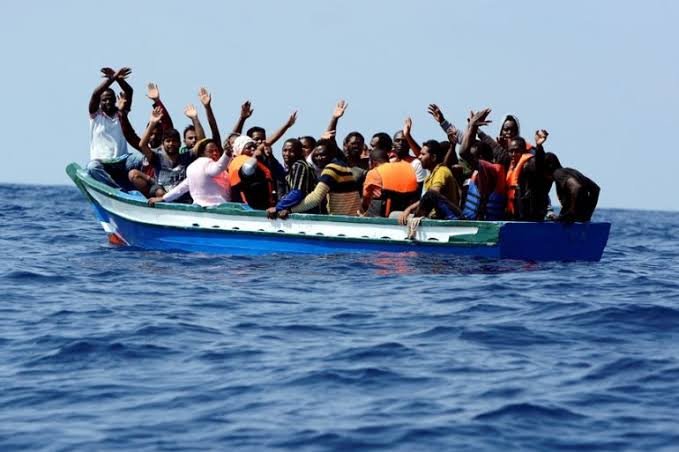
At least 139 people — including children — drowned, and approximately 84 remain missing after an overcrowded boat carrying roughly 305 people, mostly Ethiopian migrants, capsized in waters off Djibouti en route to Yemen. It is one of the deadliest single incidents on the Horn of Africa-to-Yemen migration corridor.
🌊 DJIBOUTI · OCTOBER 12, 2026 · MIGRATION DISASTER
At least 139 people drowned. Approximately 84 more are missing. The boat was carrying roughly 305 people — nearly all of them Ethiopian migrants attempting to reach Yemen. The vessel capsized in the Gulf of Aden, in waters off Djibouti, on a route that has killed thousands of people over the past decade and that continues to operate because the people who attempt it have concluded that the risk of the crossing is preferable to the conditions they are leaving behind.
The International Organization for Migration confirmed the death toll and the search status, as did AP, BBC, Reuters, and CNN. Children were among the dead. The 84 people still listed as missing at filing time are, given the crossing conditions and the time elapsed, unlikely to be found alive. The final death toll from this incident will almost certainly be higher than 139.
WHY PEOPLE CROSS THIS WAY
The Horn of Africa to Yemen migration route is one of the most counterintuitive in the world: people are crossing from the African continent into Yemen, which is itself one of the most devastated countries on earth after a decade of civil war and Saudi-led bombardment. They do it because Yemen, despite the war, offers a transit route toward the Gulf states — Saudi Arabia, the UAE, Kuwait — where low-wage labor opportunities exist that are inaccessible from the migrants’ home countries through legal channels. Ethiopian migrants on this route are predominantly from Oromia and the Amhara region, driven by a combination of the Ethiopian civil conflict, economic collapse, and the specific arithmetic that says the Gulf states’ informal labor markets are worth crossing through a war zone to reach.
The smuggling networks that operate this crossing are not charities. They are commercial enterprises that pack as many people as possible into vessels designed for far fewer, collect their fees in advance, and bear no legal or financial consequence when those vessels capsize. The people who drown are the product of a market failure that international migration governance has not found a way to address: the demand for irregular migration exists, the legal channels do not meet the demand, and the gap between them is filled by smugglers whose business model depends on the gap remaining open.
THE SCALE OF THE ROUTE
The IOM estimates that hundreds of thousands of people attempt the Horn of Africa to Yemen crossing every year. Deaths on the route are tracked but never fully captured: many capsizings go unreported because the survivors are undocumented and have every reason to avoid contact with authorities, and the bodies of those who drown are often never recovered. The 139 confirmed dead in this incident are among the most visible fatalities on a route that produces invisible ones at a scale that official statistics do not reflect.
This specific incident is being characterized as one of the deadliest single events on the route. That characterization is accurate within the data that exists, which is not complete. Deadlier incidents may have occurred without generating any reportable information. The ones that get counted are the ones where survivors reach shore and talk to IOM or local authorities. The ones that do not get counted sink without witnesses.
“One hundred and thirty-nine people drowned going to Yemen. They were going to Yemen. That sentence contains everything you need to know about how bad the place they were leaving was.”
WHAT HAPPENS NEXT
► Missing persons search — IOM and Djiboutian coast guard continuation of recovery operations
► Final death toll — expected to rise as search operations conclude
► Survivor testimony — IOM interviews that document the crossing conditions and smuggling network
► Ethiopian government response — whether Addis Ababa formally responds to the loss of its citizens
► Route enforcement — whether Djiboutian or IOM pressure on smuggling networks increases following the incident
| CONFIDENCE: HIGH | AP, BBC, Reuters, CNN, IOM confirmed 139 dead including children, ~84 missing, ~305 people on vessel, mostly Ethiopian, Horn of Africa to Yemen route, Djibouti waters. One of the deadliest single incidents on this corridor. |
| BIAS CHECK | ASSESSMENT |
| Source weight | AP, BBC, Reuters, CNN, IOM — full multi-source international confirmation plus UN agency sourcing |
| Death toll framing | 139 confirmed; 84 missing noted as likely additional dead given time elapsed; stated as assessment, not fact |
| Route characterization | Economic rationale for Yemen crossing explained accurately; not used to diminish the tragedy |
| Smuggling framing | Characterized as commercial failure, not criminalized in a way that transfers blame to migrants |
SOURCES
► AP — Djibouti migrant boat capsize, 139 dead, 84 missing, October 12, 2026
► BBC News — Ethiopian migrants, Horn of Africa Yemen route, October 12, 2026
► Reuters — IOM confirms death toll, Djibouti crossing disaster, October 12, 2026
► CNN — Migrant vessel capsize, children among dead, October 12, 2026
► IOM — International Organization for Migration confirmed figures and search status, October 12, 2026