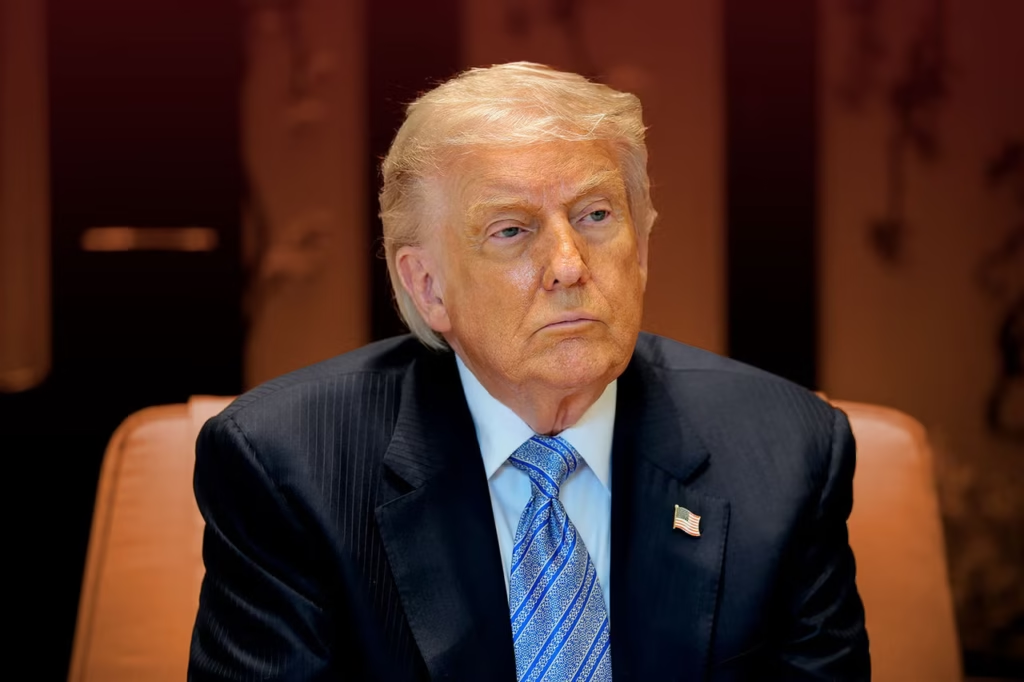
Donald Trump suggested that Ukraine should replace Volodymyr Zelensky amid the diesel deal negotiations and ceasefire discussions. Zelensky responded that he would accept whatever Ukrainian voters decide — provided that the security conditions for holding elections could be established. That condition is doing a great deal of work.
🇺🇦 KYIV / WASHINGTON · OCTOBER 12, 2026 · UKRAINE LEADERSHIP
Donald Trump suggested that Ukraine should find a new leader. The suggestion arrived in the context of the diesel deal, the energy ceasefire claim, and the broader pressure that the Trump administration has been applying to Kyiv to move toward some form of negotiated settlement with Russia. Zelensky, Trump implied, was an obstacle to that settlement. A different Ukrainian leader — one more willing to make concessions, one less associated in the public mind with the maximalist position of full territorial restoration — might clear the path.
Zelensky’s response was precise. He would accept whatever Ukrainian voters decide. He is not above democratic accountability, he said. But elections in Ukraine require security conditions that do not currently exist. Holding a free and fair election in a country under active military bombardment, with large portions of its territory under foreign occupation, with millions of its citizens internally displaced or living as refugees abroad, is not a procedural challenge — it is a fundamental one. Zelensky was not refusing democracy. He was describing what democracy requires to function.
THE CONDITIONAL THAT MATTERS
The phrase “if security allows elections” is the hinge on which this entire exchange turns. Trump, and those in the American political space who share his view of the Zelensky situation, tend to read Ukrainian reluctance to hold elections as evidence of Zelensky’s personal interest in remaining in power. Zelensky, and those who share his analysis of the security situation, read the security caveat as a straightforward factual description of the conditions under which democratic elections cannot be conducted without producing an outcome that reflects military pressure rather than genuine popular will.
Both readings contain a kernel of truth. Zelensky has a personal interest in continuing to lead Ukraine through a war that has defined his political identity and produced a level of public esteem that would be difficult to match in peacetime politics. And the security conditions in Ukraine are genuinely incompatible with a fully free election by any international standard. The question of where the honest line falls between those two things is one that Axios, ABC, Politico, and the Washington Post covered with varying emphases, reflecting the genuine difficulty of the analytical question.
TRUMP’S LEVERAGE AND ITS LIMITS
Trump’s ability to pressure Ukraine on the leadership question is real but not unlimited. The United States is Ukraine’s largest single military supporter, and American political will to continue that support is a genuine variable. But Zelensky is also not simply a dependent who can be replaced by American preference: he was elected, he leads a country at war, he has a domestic political base that the war has consolidated, and any American move that appeared to be explicitly engineering a Ukrainian leadership change would generate significant pushback from European allies and from the American foreign policy establishment. Trump can suggest. He cannot appoint.
“Trump said replace Zelensky. Zelensky said voters decide. But then he named the condition: security must allow it. Conducting a free election in an active war zone is not a procedural detail. It is the question.”
WHAT HAPPENS NEXT
► Zelensky’s domestic position — Ukrainian public opinion response to the Trump pressure
► European reaction — whether EU and NATO partners publicly defend Zelensky’s continued leadership
► US aid conditionality — whether Trump links military support to Ukrainian willingness to hold elections
► Election framework — whether Ukraine and international partners begin formal discussion of election security conditions
| CONFIDENCE: HIGH | Axios, ABC, Politico, Washington Post confirmed Trump suggestion to replace Zelensky; Zelensky’s response accepting voters’ decision conditional on security conditions for elections. |
| BIAS CHECK | ASSESSMENT |
| Source weight | Axios, ABC, Politico, WaPo — four-outlet confirmation across political spectrum |
| Trump framing | Suggestion characterized as political pressure; not editorialized as illegitimate without qualification |
| Zelensky framing | Security condition framed accurately as both a factual description and a political position |
| Both-sides accuracy | Personal interest dimension of Zelensky position acknowledged alongside genuine security constraint |
SOURCES
► Axios — Trump suggests Ukraine replace Zelensky, October 12, 2026
► ABC News — Zelensky response, election security conditions, October 12, 2026
► Politico — Ukraine leadership pressure, diesel deal context, October 12, 2026
► Washington Post — Trump-Zelensky exchange, ceasefire talks, October 12, 2026