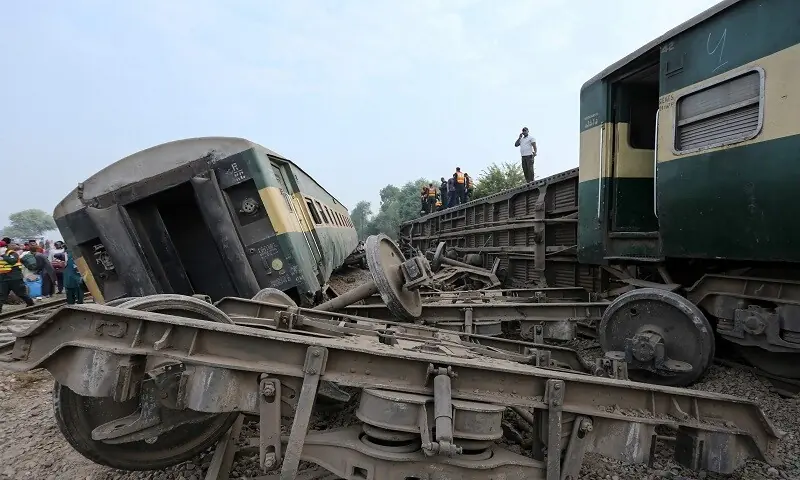
A train derailed on the outskirts of Multan, in Pakistan’s Punjab province, killing at least four people and injuring seventeen. The incident is the latest in a long series of Pakistani railway accidents that reflect a rail infrastructure system that has been underfunded and insufficiently modernized for decades.
🚂 MULTAN, PAKISTAN · OCTOBER 13, 2026 · TRAIN DERAILMENT
A train derailed near Multan, in Punjab province, killing at least four people and injuring seventeen. Local reports aggregated through the Straits Times and via Wikipedia’s current events tracking confirmed the incident. The cause of the derailment was not established in available reporting. The toll — four dead, seventeen injured — reflects the scale of a medium-severity rail accident on Pakistan’s network, which moves millions of passengers annually on infrastructure that has not received adequate investment in maintenance or modernization.
Pakistan Railways operates one of the largest rail networks in South Asia — approximately 7,800 kilometers of track connecting major population centers including Karachi, Lahore, Islamabad, Peshawar, and Multan. The network is heavily used and chronically underfunded. Derailments, collisions, and track failures are a recurring feature of the system. The causes cluster around a set of known infrastructure deficiencies: aging track that requires replacement, signaling systems that predate modern safety standards, locomotive and rolling stock that is beyond its designed service life, and maintenance workforce capacity that cannot keep pace with the scale of the network.
THE PATTERN
This is not a singular event. Pakistan has experienced multiple significant rail accidents in the current year and in the years immediately preceding. The 2021 train collision near Ghotki killed 63 people when one train derailed in front of another. The 2023 Hazara Express attack killed 28. The 2025 derailment near Sahiwal killed 11. Each accident produces political response — inquiries, promises of investment, ministerial statements — that has not, in aggregate, produced the systematic improvement in safety outcomes that would reduce the frequency and severity of these events.
The underlying problem is an infrastructure investment deficit that has accumulated over decades. Pakistan has prioritized road transport investment, including the China-Pakistan Economic Corridor motorway network, over rail infrastructure modernization. Changing that prioritization requires political will, fiscal space, and the long lead times of large infrastructure projects. None of those conditions has been consistently present.
“Four dead, seventeen injured near Multan. Another Pakistani rail accident in a decade of Pakistani rail accidents. The infrastructure problem is known. The solution is expensive. Nothing has changed fast enough.”
WHAT HAPPENS NEXT
► Cause investigation — Pakistan Railways and rescue services assessment of the derailment cause
► Injured status — hospital updates on the seventeen injured
► Political response — Railway Ministry statement and whether a formal inquiry is ordered
► Track condition review — whether the Multan stretch is inspected for systemic defects
| CONFIDENCE: MODERATE | Straits Times aggregation via Wikipedia current events confirmed Pakistan train derailment near Multan, at least 4 dead, 17 injured. Cause not established at filing time. |
| BIAS CHECK | ASSESSMENT |
| Source weight | Straits Times via Wikipedia current events — secondary aggregation; filed as MODERATE confidence |
| Casualty figures | At least 4 dead, 17 injured reported as minimum confirmed figures |
| Infrastructure framing | Rail safety record characterized from documented historical pattern |
| Cause | Not attributed; investigation ongoing |
SOURCES
► Straits Times via Wikipedia current events — Pakistan train derailment, Multan, October 13, 2026
► Local aggregated reports — Derailment casualties, Punjab province, October 13, 2026