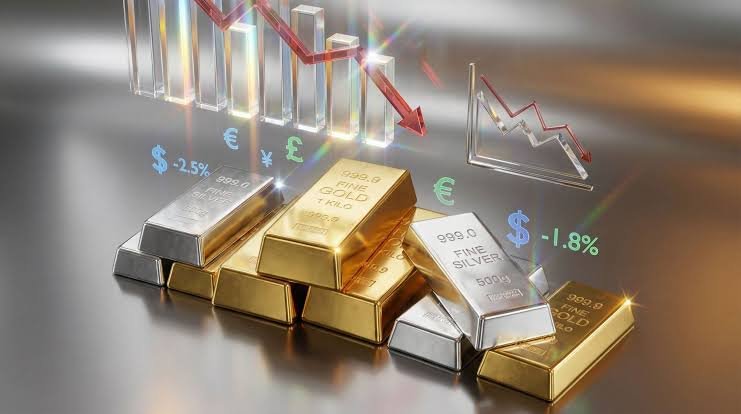
Gold and silver prices dropped sharply after the September CPI came in at 3.7 percent — hotter than expected and accelerating from 3.4 percent in August. The combined market capitalization loss across gold and silver was approximately $700 billion. The sell-off reflects a straightforward market logic: hotter inflation reduces the probability of Federal Reserve interest rate cuts, higher rates make yield-bearing assets more competitive relative to non-yielding precious metals, and the gold and silver trade unwinds accordingly.
🥇 PRECIOUS METALS MARKETS · OCTOBER 14, 2026 · POST-CPI PRICE DROP
Gold and silver prices dropped sharply Tuesday after the September Consumer Price Index came in at 3.7 percent year-over-year — above analyst expectations and higher than the 3.4 percent August reading. Watcher. Guru and market coverage confirmed the price drops and the aggregate figure: approximately $700 billion combined was wiped from gold and silver market capitalization in the reaction to the CPI data. The sell-off followed the market open and accelerated as the implications of the report for Federal Reserve policy were processed.
The mechanism is standard monetary economics. Gold and silver do not pay dividends or interest. Their value as portfolio assets depends heavily on the opportunity cost of holding them versus yield-bearing alternatives — bonds, money market funds, high-yield savings. When interest rates are falling, the opportunity cost of holding gold declines and the metal becomes more attractive. When inflation comes in hotter than expected, the Federal Reserve is less likely to cut interest rates and more likely to hold them higher for longer. Higher rates for longer make yield-bearing assets more competitive, the opportunity cost of holding gold rises, and gold positions are liquidated. Tuesday’s $700 billion figure is the market putting a dollar value on that logic.
WHAT THE GOLD PRICE WAS DOING
Gold has been trading at elevated levels throughout 2026, driven by a combination of geopolitical risk premium — the Gulf conflict, the Ukraine war, the broader uncertainty of a world with multiple active military conflicts — and expectations that the Federal Reserve would move toward rate cuts as inflation declined. The September CPI data disrupted the second of those drivers directly. The geopolitical risk premium remains; the rate cut expectation has been pushed back. The net effect is a price decline of the magnitude the market recorded Tuesday. The scale of the sell-off — $700 billion combined with silver — reflects how significant a position the precious metals trade had accumulated on the expectation of a more dovish Fed.
Silver moves more dramatically than gold in both directions because its market is smaller and it has industrial uses that create additional price drivers. AI data center buildout is a silver demand story: silver is used in electronics manufacturing, solar panels, and certain AI-related components. But the monetary driver — the rate cut expectation — dominates in a CPI reaction event. Both metals sold off; silver likely sold off more sharply than gold in percentage terms, though the aggregate $700 billion figure across both is the number in available reporting.
THE FED POLICY IMPLICATION
The Federal Reserve has its next scheduled meeting in early November — days after the midterms. A 3.7 percent CPI print with gasoline as the primary driver and core inflation elevated reduces the probability that the Fed will cut rates at that meeting. The futures market will re-price its rate cut expectations in response to Tuesday data. The administration will feel this in two ways: politically, because rate cuts before the midterms would have been a helpful economic narrative, and financially, because higher rates for longer mean continued pressure on mortgage costs, consumer credit, and the leveraged economy generally. The CPI number that drove the gold sell-off is the same number that complicates the pre-midterm economic picture for the party in power.
“Hot inflation means no rate cut. No rate cut means gold and silver are less attractive. $700 billion came out of precious metals Tuesday. The September CPI number moved markets in every direction simultaneously.”
WHAT HAPPENS NEXT
► Fed rate guidance — whether Federal Reserve officials issue statements updating their rate path expectations
► Precious metals recovery — whether gold and silver stabilize or continue declining in the days following the CPI
► Bond market reaction — 10-year Treasury yield movement as the definitive rate cut expectation indicator
► November Fed meeting — whether the hotter CPI removes rate cut from the table entirely
► Portfolio realignment — how institutional investors adjust precious metals allocation in the new rate environment
| CONFIDENCE: HIGH | Watcher. Guru and market coverage confirmed gold and silver prices dropped sharply after September CPI at 3.7 percent, with approximately $700 billion combined wiped from precious metals markets. |
| BIAS CHECK | ASSESSMENT |
| Source weight | Watcher.Guru and market coverage — market data source; monetary mechanism described from standard economics |
| $700 billion figure | Reported as approximate combined figure; specific gold and silver breakdown not available at filing time |
| Fed characterization | Rate policy described as probability-based; no prediction of specific Fed action made |
| Political framing | Administration interest in rate cuts characterized as political and economic reality; not used editorially |
SOURCES
► Watcher.Guru (X) and market coverage — gold silver drop $700 billion CPI inflation September, October 14, 2026