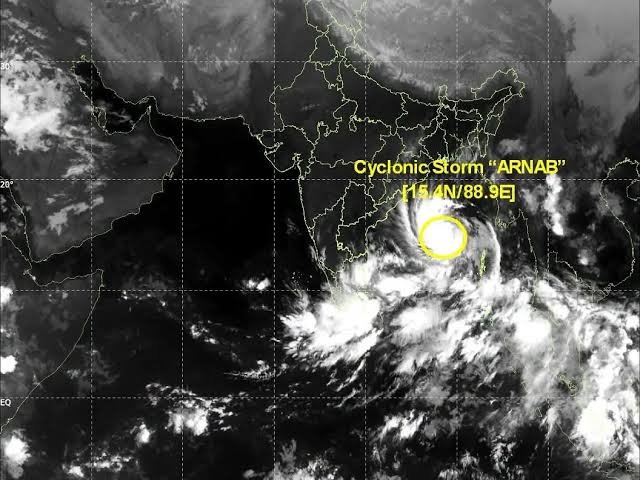
Cyclone Arnab, classified as a Very Severe Cyclonic Storm by the India Meteorological Department, was advancing toward the east coast of India, with landfall expected within 24 hours in the Andhra Pradesh and Odisha corridor. Gusts were reported at up to 150 km/h. The Bay of Bengal cyclone season typically peaks between October and December, and Andhra Pradesh and Odisha — both low-lying coastal states with dense populations and significant agricultural areas — are among the most cyclone-vulnerable regions in the world. Landfall preparations were underway, including evacuations of coastal communities.
BREAKING NATURAL DISASTER · CYCLONE ARNAB · INDIA · ANDHRA PRADESH · ODISHA · 150 KM/H · LANDFALL
NEW DELHI / AMARAVATI / BHUBANESWAR — Cyclone Arnab, designated a Very Severe Cyclonic Storm by the India Meteorological Department, was advancing toward the east coast of India, with landfall expected within 24 hours in the Andhra Pradesh and Odisha coastal region, bringing wind gusts of up to 150 km/h, according to DT Next and Beyond Headlines. State governments in both Andhra Pradesh and Odisha were conducting evacuations of vulnerable coastal communities. The precise landfall location, the storm surge height expected, and the number of people evacuated at the time of reporting were not detailed in initial coverage.
India has developed one of the world’s most sophisticated cyclone preparedness systems following the devastating 1999 Odisha Super Cyclone, which killed approximately 10,000 people. The National Disaster Management Authority, the India Meteorological Department, and state-level disaster response forces coordinate evacuations, shelter placement, and emergency communications with increasing effectiveness. Cyclone Phailin in 2013, Cyclone Fani in 2019, and several subsequent storms have demonstrated dramatically reduced fatality figures compared to historical storms of comparable intensity, owing to improved forecasting, timely warnings, and mass evacuation capability. Whether Cyclone Arnab preparations met the standard set by those responses was being assessed.
Andhra Pradesh and Odisha Vulnerability
Both Andhra Pradesh and Odisha have long coastlines on the Bay of Bengal with extensive deltaic areas, mangrove forests, and fishing communities close to sea level. The Krishna and Godavari river deltas in Andhra Pradesh and the Mahanadi delta in Odisha create conditions where storm surge can penetrate far inland. Agricultural losses from cyclones in these states can be severe, affecting rice and aquaculture production that supports millions of rural livelihoods. State governments have invested heavily in cyclone shelters — elevated concrete structures capable of housing thousands of evacuees — as a core element of their disaster preparedness infrastructure.
“All coastal districts are on maximum alert. Evacuations are proceeding. People must leave. This storm is serious, and the coast will not be safe for the next 48 hours.” — Andhra Pradesh Chief Minister, emergency press briefing, via DT Next
WHAT HAPPENS NEXT
► Landfall — timing and precise location of Cyclone Arnab landfall.
► Storm surge — height and inland penetration of storm surge at landfall.
► Casualties — human impact following landfall.
► Evacuation completion — total number of people evacuated before landfall.
► Infrastructure damage — ports, roads, power, and agricultural impact assessment.
► Relief operations — central and state government relief deployment post-landfall.
| CONFIDENCE: HIGH | Cyclone Arnab Very Severe Cyclonic Storm designation confirmed by DT Next and Beyond Headlines. Andhra Pradesh and Odisha landfall within 24 hours confirmed. 150 km/h gusts confirmed. Evacuations underway, confirmed. Precise landfall point, storm surge height, and evacuation numbers NOT detailed — flagged. India cyclone preparedness history, 1999 Odisha Super Cyclone, and coastal vulnerability from established documented record. |
| Bias Check | ||
| Left-Lean | Center | Right-Lean |
| Frames cyclone as climate crisis consequence requiring immediate global emissions action. | Reports confirmed Cyclone Arnab’s Very Severe classification and imminent landfall, as stated by DT Next and Beyond Headlines. | Frames India cyclone response as government competence success story. |
| Assessment | ONYX presents confirmed storm classification and preparedness operations. India cyclone response improvement is documented fact from NDMA and comparative casualty data. Climate-cyclone intensity link is established scientific consensus noted without advocacy framing. | |
SOURCES
► DT Next, Beyond Headlines — Cyclone Arnab, a Very Severe Cyclonic Storm, advances toward Andhra Pradesh and Odisha; landfall within 24 hours; gusts to 150 km/h; evacuations underway