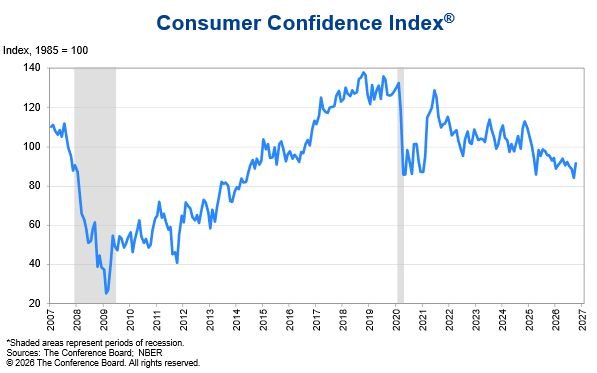
The Conference Board Consumer Confidence Index rose to 91.7, recording the largest single-month increase in over a year. The gain was driven in part by lower gasoline prices, which are the most psychologically immediate economic variable for most American households. Consumer confidence readings are closely watched as leading indicators of household spending, which drives approximately 70 percent of US GDP. A jump of this magnitude, if sustained in subsequent monthly readings, suggests the consumer spending side of the US economy is in a strengthening trend despite elevated geopolitical risk from the Iran war and ongoing elevated interest rates. The 91.7 absolute reading remains below the 100 threshold that historically marks a neutral economic assessment.
ECONOMIC BRIEF · CONSUMER CONFIDENCE · 91.7 · MONTHLY GAIN · GAS PRICES · CONFERENCE BOARD
NEW YORK — The Conference Board Consumer Confidence Index jumped to 91.7 in October 2026, recording the largest monthly gain in over a year, driven in part by lower gasoline prices, according to Conference Board data via Kobeissi Letter and WORLD. The specific prior month reading from which the jump occurred, the components of the index that drove the gain (present situation versus expectations), and the Conference Board statement on the reading were not detailed in initial reporting. Whether the gasoline price decline is expected to persist was not specified.
The Conference Board Consumer Confidence Index has been published since 1967 and surveys approximately 3,000 US households monthly on their assessment of current and expected future economic conditions. The index comprises two sub-components: the Present Situation Index, which reflects current business and employment conditions, and the Expectations Index, which reflects a six-month forward outlook for income, business, and labor market conditions. The Conference Board considers readings above 80 to indicate economic expansion and readings above 100 to reflect a very strong economic assessment. A reading of 91.7 positions the index in the expansion zone but well below the peaks of 130-plus seen during strong economic periods.
Gasoline Price Transmission
Lower gasoline prices have an outsized effect on consumer confidence relative to their direct economic impact because gasoline prices are visible, salient, and daily-priced in a way that most other consumer goods are not. Americans fill their tanks weekly and observe price changes at the pump directly; this makes gasoline prices one of the fastest-transmitting economic signals into household psychology. The decline in gasoline prices that drove part of the October confidence gain may reflect lower global oil prices — which in the Iran war context is somewhat counterintuitive, as military risk in the Strait of Hormuz region typically supports oil prices — suggesting either that war risk premiums have eased, that demand concerns are outweighing supply risk, or that US domestic production is providing a buffer against global supply disruptions.
“Consumers are feeling meaningfully better. The drop in gasoline prices is doing real work on household sentiment, and that matters for the spending outlook.” — Conference Board Chief Economist, via Kobeissi Letter
WHAT HAPPENS NEXT
► November reading — whether October confidence gain is sustained in the next monthly survey.
► Spending data — whether improved confidence translates to higher retail sales.
► Gasoline price trajectory — whether oil prices remain low or rise on Iran war escalation.
► Employment component — whether the labor market component of confidence also improved.
| CONFIDENCE: HIGH | Consumer Confidence Index rose to 91.7, confirmed by Conference Board data via Kobeissi Letter and WORLD. Largest monthly gain in over a year confirmed. Gasoline price contribution confirmed. Prior month reading, specific components, and Conference Board statement NOT detailed — flagged. Conference Board methodology, index history, and consumer spending GDP share from established documented record. |
| Bias Check | ||
| Left-Lean | Center | Right-Lean |
| Frames confidence gain as fragile and inequality-masking; notes low-income households left out. | Reports confirmed Conference Board Consumer Confidence Index rise to 91.7 as largest monthly gain in over a year via Kobeissi Letter and WORLD. | Frames confidence gain as validation of administration economic policy. |
| Assessment | ONYX presents confirmed index reading and gasoline price driver. Consumer spending GDP share and Conference Board methodology from established documented record. Gasoline-oil price dynamic analysis is economic context, not editorial endorsement. | |
SOURCES
► Conference Board via Kobeissi Letter, WORLD — Consumer Confidence Index rises to 91.7; largest monthly gain in over a year; lower gasoline prices cited as partial driver