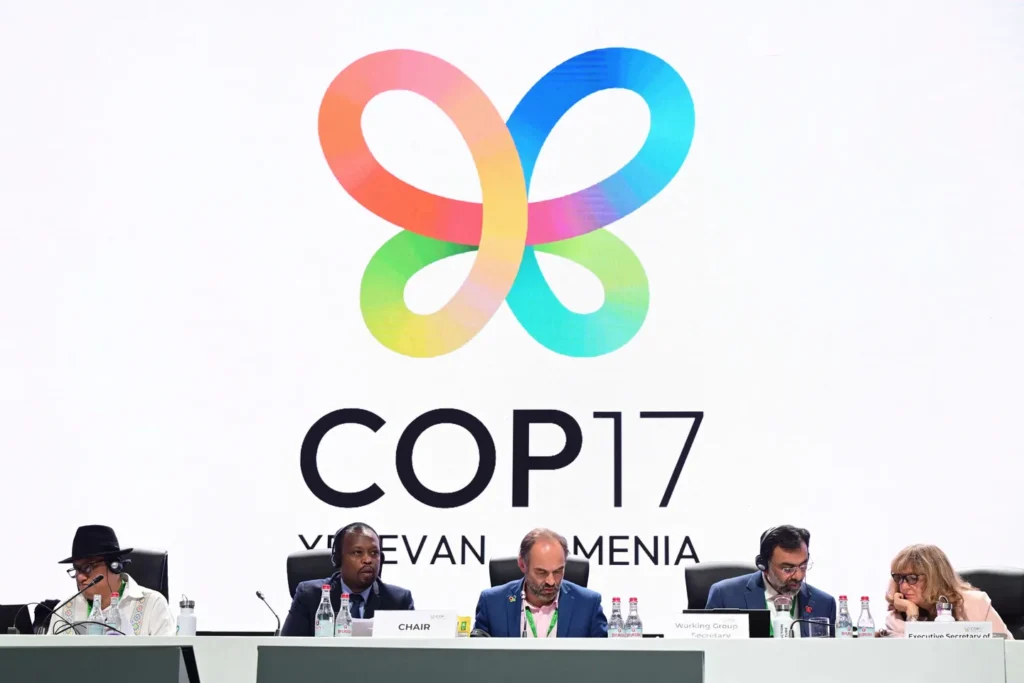
The COP17 biodiversity summit in Yerevan, Armenia — the 17th Conference of the Parties to the Convention on Biological Diversity — ended in deadlock as nearly 200 countries failed to resolve the fundamental question of who pays for global biodiversity protection. The Kunming-Montreal Global Biodiversity Framework, adopted at COP15 in 2022, committed signatories to protecting 30 percent of the planet by 2030 and established a $200 billion annual funding target. COP17 was meant to advance implementation — particularly the mobilization of funds from wealthy nations to developing countries that contain most of the world’s biodiversity but lack the resources to protect it. The deadlock continues a pattern from climate COPs: binding commitments easily made, funding mechanisms endlessly contested.
INTERNATIONAL / ENVIRONMENT · COP17 · YEREVAN · BIODIVERSITY · DEADLOCKED · FUNDING · 200 COUNTRIES · NATURE · KUNMING-MONTREAL
YEREVAN — The COP17 biodiversity summit ended in deadlock as nearly 200 countries failed to resolve who pays for global biodiversity protection, according to Politico Europe. The specific financial mechanism that proved most contentious, the countries or blocs that blocked agreement, whether any partial agreements were reached on subsidiary issues, the reaction from major conservation NGOs attending the summit, whether a future deadline or intersessional meeting was agreed, and the Armenian host government’s response to the failed outcome were not detailed in initial reporting.
The Kunming-Montreal Global Biodiversity Framework committed member states at COP15 in 2022 to a 30×30 target — protecting 30 percent of land and oceans by 2030 — and to mobilizing $200 billion annually in biodiversity finance, including at least $30 billion from developed to developing nations. The biodiversity finance gap is structurally similar to the climate finance gap: developed nations that historically drove species loss through industrialization are expected to fund conservation in developing nations that hold the majority of remaining biodiversity. The G7 and EU have resisted creating a binding biodiversity fund with guaranteed contributions, preferring a mix of public finance, private sector mobilization, and reformed subsidies. Developing nations, led by the Like-Minded Megadiverse Countries group — Brazil, China, India, Indonesia, Colombia, Mexico, and others — have demanded binding public finance commitments.
30×30 and the $200 Billion Finance Gap
The 30×30 commitment represents the most ambitious global conservation target in history. Implementing it requires creating and managing protected areas at a scale that exceeds anything previously attempted — and doing so primarily in tropical and subtropical nations that harbor the greatest share of terrestrial and marine biodiversity. The cost estimates for achieving 30×30 globally run from $140 billion to $440 billion annually. Against current biodiversity spending levels of roughly $130 billion per year — most of it domestic, with minimal international transfer — the gap is enormous. The COP17 Yerevan deadlock means the Kunming-Montreal commitment to 30 percent protection by 2030 is on track to fail in the same way that the 2010 Aichi Biodiversity Targets failed: adopted with broad consensus, abandoned without accountability.
“We came to Yerevan to secure the financing that would make the Kunming-Montreal commitments real. We are leaving without it. The biodiversity we pledged to protect will not wait for the next COP.” — Alliance of Small Island States delegate, Yerevan, via Politico Europe
WHAT HAPPENS NEXT
► Intersessional — whether a special session is scheduled before COP18 to resolve the funding deadlock.
► G7 position — whether wealthy nations’ finance pledges advance at the G7 summit cycle.
► 30×30 tracking — whether the 2030 target deadline shifts in response to the funding failure.
► Private finance — whether a private sector biodiversity finance mechanism advances as an alternative.
► Host reaction — Armenian government statement on the COP17 outcome.
► NGO assessment — WWF, IUCN, and Conservation International analysis of the deadlock.
| CONFIDENCE: MODERATE | COP17 biodiversity summit in Yerevan ended deadlocked over funding, with nearly 200 countries failing to resolve who pays, confirmed by Politico Europe. Single outlet — flagged. Specific blocking parties, subsidiary agreements, and future deadlines NOT confirmed in initial reporting. Kunming-Montreal Framework, 30×30 target, and biodiversity finance gap from established documented record. |
| Bias Check | ||
| Left-Lean | Center | Right-Lean |
| Frames COP17 deadlock as wealthy nation betrayal of developing countries and the planet. | Reports confirmed COP17 Yerevan ended deadlocked, with nearly 200 countries failing to resolve biodiversity funding, as stated by Politico Europe. | Frames COP17 deadlock as necessary caution against binding financial commitments without implementation accountability. |
| Assessment | ONYX presents a confirmed single-source report with a MODERATE flag. Kunming-Montreal Framework, 30×30 target, and biodiversity finance gap from established documented record. Neither wealthy-nation-betrayal nor accountability-caution framing adopted editorially. | |
SOURCES
► Politico Europe — COP17 nature summit in Yerevan ends deadlocked over funding; nearly 200 countries left without resolving who pays for biodiversity protection