State media reported the launch of a newly designed air-defense system; the test follows the ballistic missile launches reported on November 4 and extends the Korean peninsula provocation pattern.
NORTH KOREA · MISSILE TEST · STATE MEDIA PRIMARY · ARC: NOV 4 LAUNCHES
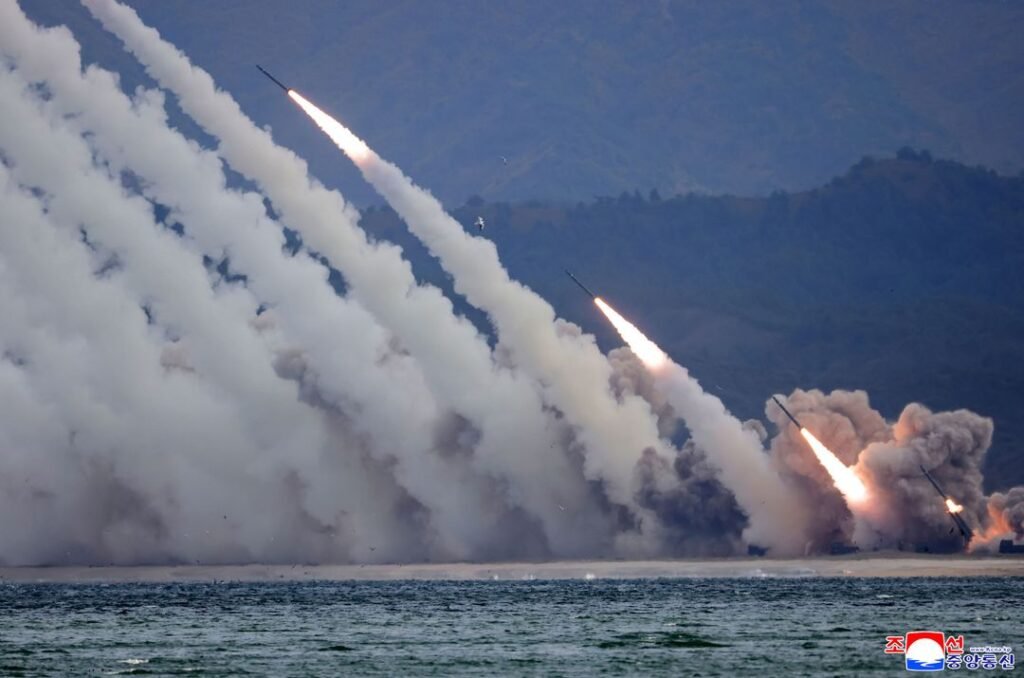
North Korea test-fired an advanced air-defense missile system, with state media outlet KCNA reporting that the launch demonstrated the capabilities of a newly designed system under the supervision of Kim Jong Un, Nhan Dan, citing KCNA, reported on Thursday. The test follows the ballistic missile launches toward the sea reported on November 4 and represents a continuation of the Korean peninsula military testing pattern across the current week.
KCNA characterized the air-defense system as designed to intercept “hostile aircraft and strategic bombers,” language typically used in North Korean state media to refer to US B-52 and B-1B aircraft that conduct periodic flights near the Korean peninsula as part of extended deterrence demonstrations. The test of an air-defense system, as distinct from the offensive ballistic missiles tested in prior launches, adds a defensive dimension to the North Korean military signaling that KCNA framing explicitly connected to US regional military posture.
What This Test Signals
Air-defense missile development is a component of a broader North Korean military modernization program that has included intercontinental ballistic missile development, submarine-launched ballistic missile testing, hypersonic glide vehicle tests, and tactical nuclear weapons development. The addition of advanced air-defense capability — if the KCNA characterization reflects genuine system capability — would complicate US military planning for any strike operations targeting North Korean nuclear facilities, since air-defense suppression is a prerequisite for sustained air operations.
ONYX News rates this article at 74/DGRAY and MODERATE confidence, reflecting the state media primary source. KCNA reports, routed through Nhan Dan, are the first-instance source for North Korean military announcements; they are reliable as confirmation that an event occurred and was intended to be publicized, but the technical specifications and capability claims made in KCNA coverage require independent verification through South Korean, Japanese, and US intelligence assessments that are typically released with significant delay.
“The test demonstrated the precision and reliability of the new air-defense system designed to protect the country from hostile aircraft.” — KCNA state media report via Nhan Dan
Korean Peninsula Context This Week
The two North Korean military events this week — ballistic missile launches on November 4 and the air-defense test on November 5 — suggest a deliberate escalatory signaling pattern timed to the US midterm transition period. North Korea has historically used moments of US political transition or distraction to advance its testing program, calculating that the reduced political bandwidth available to respond to provocations during those periods reduces the costs of testing. The Iran war and its domestic political fallout provide exactly the kind of distraction that North Korean strategic planners may be exploiting.
WHAT HAPPENS NEXT
► South Korea and Japan to issue assessments of the air-defense system capability from radar tracking data
► US Indo-Pacific Command to assess implications for strike planning against Korean peninsula targets
► UN Security Council to consider North Korea testing pattern at scheduled session
► North Korea testing pace expected to continue through US political transition period
| CONFIDENCE: MODERATE | Primary source is KCNA via Nhan Dan — state media reporting. Reliable for confirming the event occurred and North Korean intent to publicize; technical capability claims unverified by independent intelligence. DGRAY reflects state media primary source chain. |
| Bias Check | ||
| Left-Lean | Center | Right-Lean |
| North Korea testing framed as urgent threat requiring immediate US military response. | Reports KCNA announcement factually; notes state media confidence limitation and signaling context. | North Korea testing framed as predictable reaction to US regional presence and extended deterrence. |
| Assessment | ||
SOURCES
► Nhan Dan citing KCNA — North Korea air-defense missile test, Kim Jong Un supervision, November 5, 2026