Record flooding forced evacuations and damaged homes in the border communities of McCaysville and Copperhill; the event follows a year of intensifying extreme precipitation events across the American Southeast.
NATURAL DISASTER · GEORGIA · TENNESSEE · FLOODING
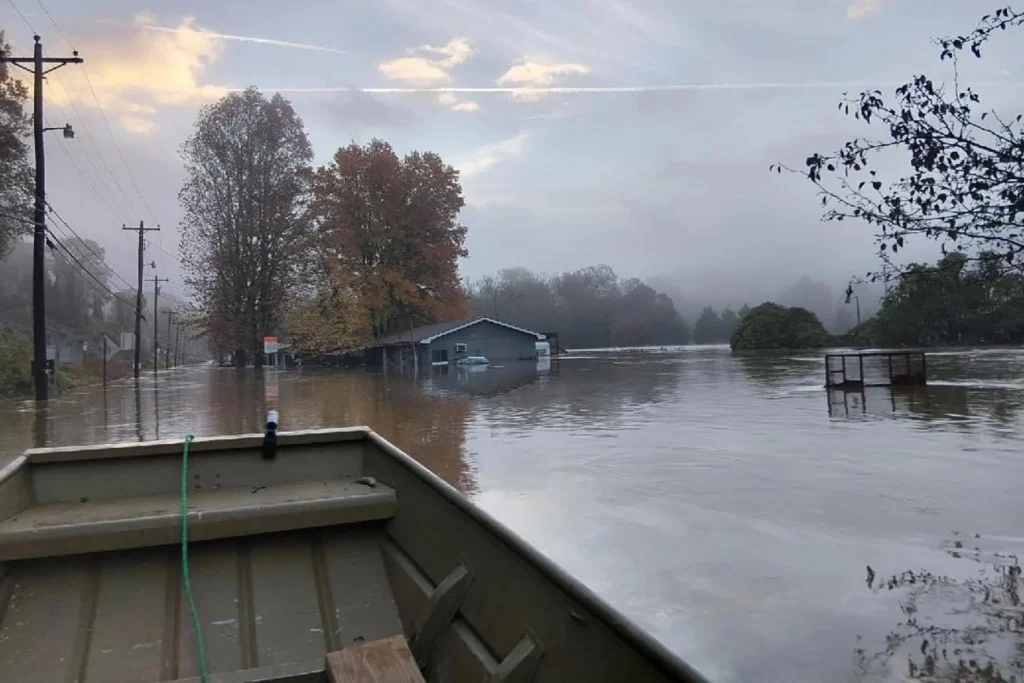
Record flooding struck the Georgia-Tennessee border communities of McCaysville, Georgia, and Copperhill, Tennessee, on Friday, forcing evacuations and causing significant damage to homes and infrastructure, WORLD Radio and CBS reported. The twin communities, which sit on opposite sides of the Toccoa River at the state line, experienced water levels that exceeded previous records for the area, with the river rising rapidly following heavy rainfall across the watershed. Emergency management officials in both Polk County, Tennessee, and Fannin County, Georgia, activated emergency response protocols as the flooding developed.
WORLD Radio reported that mandatory evacuation orders were issued for low-lying areas of both communities, with residents directed to shelters established by local emergency management agencies. CBS provided additional detail on the scale of property damage, noting that multiple homes in the floodplain areas were inundated to the first-floor level and that at least two structures were reported as structurally compromised. The flooding extended to commercial areas of Copperhill, which is the larger of the two communities, affecting businesses in the downtown core.
The Geographic and Climatic Context
McCaysville and Copperhill occupy a geographic position in the southern Appalachian mountains where river flooding has been a historic concern, but the record-level event on Friday reflects the intensifying precipitation patterns that have characterized the American Southeast in recent years. The same general region experienced significant flooding in prior years, and the cumulative effect of these events on community infrastructure — bridges, roads, culverts, and residential foundations — creates compounding vulnerability with each successive high-water event.
CBS noted that the National Weather Service had issued flash flood warnings for the broader region in the days preceding the event, though the specific rainfall totals that triggered the record levels exceeded the high-end projections in the forecast models. WORLD Radio reported that Georgia Governor and Tennessee Governor offices had been briefed on the situation and that requests for state emergency declarations were being prepared, which would unlock state disaster response resources and facilitate eventual requests for federal assistance through FEMA.
“We have never seen the river this high. Not in living memory. These people lost everything they owned in a matter of hours.” — Fannin County emergency management official, quoted by WORLD Radio
Response and Recovery
The immediate response to the flooding involved local fire departments, emergency management agencies, and volunteer search-and-rescue teams. CBS reported that the National Guard had been placed on standby in both states to provide additional capacity for water rescues and logistics support. WORLD Radio noted that the Red Cross had deployed to both communities to establish disaster relief services, including temporary shelter, meals, and case management for displaced residents. The recovery timeline for the most heavily affected areas was expected to be measured in weeks to months given the scale of structural damage.
WHAT HAPPENS NEXT
► Georgia and Tennessee governors to issue state emergency declarations enabling disaster funding
► FEMA disaster assessment teams to survey damage for federal disaster declaration consideration
► Red Cross and voluntary organizations to provide ongoing relief services to displaced residents
► Army Corps of Engineers to assess infrastructure integrity including bridges and retaining walls
| CONFIDENCE: HIGH | WORLD Radio and CBS both independently reported on the Georgia-Tennessee border flooding. Two-source convergence on a confirmed natural disaster event. CBS has strong local and national emergency coverage; WORLD Radio provides corroboration. |
| Bias Check | ||
| Left-Lean | Center | Right-Lean |
| Flooding framed through climate change lens; calls for immediate federal infrastructure investment. | Reports flooding factually; contextualizes evacuation, damage scope, and emergency response. | Flooding reported as a natural event; caution about attributing to climate change without a direct link. |
SOURCES
► WORLD Radio — Severe flooding McCaysville and Copperhill, Georgia-Tennessee border, November 6, 2026
► CBS News — Record flooding on the Georgia-Tennessee border, evacuations and home damage