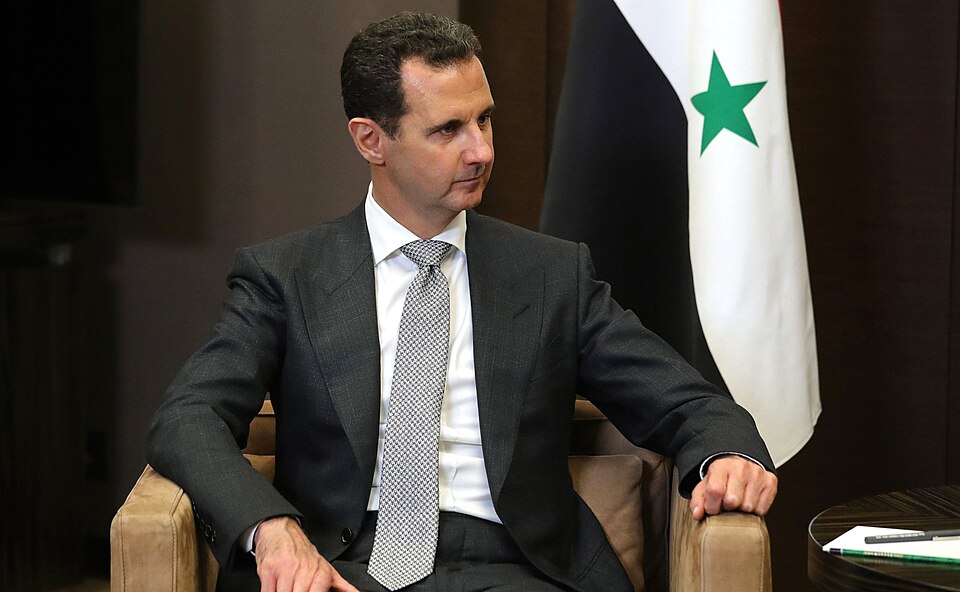
A Syrian court issued a death sentence against former President Bashar al-Assad, according to CNN — a landmark judicial act by Ahmad al-Sharaa’s new government that carries real symbolic and practical weight in Syria’s transitional period. Assad, who fled to Russia following the fall of his government in late 2024, is not physically in Syrian custody and cannot be immediately executed. The sentence is therefore simultaneously meaningful — as a formal legal record of accountability — and limited, because enforcement depends on Assad either returning to Syria voluntarily (he will not) or being extradited from Russia (Russia will not).
2-MINUTE CONTEXT — HOW SYRIA GOT HERE
Bashar al-Assad governed Syria from 2000 following the death of his father Hafez al-Assad, who had ruled since 1971. The Syrian civil war began in 2011 as part of the Arab Spring. Assad’s government suppressed the uprising with documented mass atrocities: barrel bomb attacks on civilian areas, chemical weapons attacks (including the 2013 Ghouta attack and the 2017 Khan Shaykhun attack), siege warfare that produced deliberate starvation, and the documented torture and killing of more than 13,000 people in Assad’s detention system (the Caesar photographs).
Assad’s government fell in late 2024 as rebel forces led by Hayat Tahrir al-Sham (HTS), now governed by Ahmad al-Sharaa, rapidly advanced and took Damascus. Assad fled to Russia, where he remains. Al-Sharaa’s government has been engaged in a transitional process that includes conducting trials of Assad-era officials and now Assad himself.
WHAT THE DEATH SENTENCE MEANS — AND DOESN’T MEAN
Legally: a Syrian court has formally adjudicated that Assad is guilty of crimes carrying the death penalty under Syrian law. This is a significant act of legal authority by the new government — asserting jurisdiction over its own transitional justice process without relying on international courts.
Practically: Assad is in Russia. Russia will not extradite him. The sentence cannot be carried out unless Assad leaves Russia voluntarily or is physically captured. The probability of either is very low, given Russia’s protected status as a UN Security Council P5 member and its documented protection of Assad throughout the Syrian civil war.
| WHAT THE SENTENCE PRODUCES | WHAT THE SENTENCE CANNOT PRODUCE |
| Formal legal record of accountability for Assad’s crimes | Assad’s physical punishment or execution while in Russia |
| Legitimacy signal for al-Sharaa’s government’s rule of law claims | Russia’s cooperation with Syrian transitional justice |
| Symbolic closure for survivors of Assad regime atrocities | Extradition from Russia under any foreseeable political conditions |
| International diplomatic signal that Syria is conducting transitional justice | Satisfaction for the thousands of missing detainees’ families |
| Foundation for continued trials of lower-level Assad officials | ICC complementarity — Syria is not an ICC member, limiting international dimension |
THE TRANSITIONAL JUSTICE CHALLENGE BEYOND ASSAD
The specific analytical point that CNN and legal experts emphasize: the harder question is what happens to the thousands of officials, military officers, intelligence personnel, and security apparatus members who served under Assad and carried out the regime’s policies. Assad’s sentence is one data point in a much larger accountability problem.
Syria’s transitional justice process must address: the commanders who ordered barrel bomb attacks; the intelligence officials who ran the detention system; the military officers who executed sieges; and the ordinary conscripts who were ordered to do things that produced documented atrocities. Distinguishing between different levels of culpability, conducting trials that meet basic fairness standards, and managing the security implications of prosecuting members of institutions that still exist in some form — these are the actual transitional justice challenges that Assad’s death sentence does not resolve.
AL-SHARAA’S POLITICAL STAKE
Ahmad al-Sharaa’s government has significant political interest in the Assad verdict. Its international rehabilitation campaign — including diplomatic outreach to France, positioning as a Mediterranean shipping alternative (documented in ONYX August 12 Section B coverage), and seeking Western investment — depends on demonstrating that Syria’s new government is genuinely post-authoritarian rather than a new authoritarian with different branding. A formal accountability verdict against the previous dictator, conducted through a legal process, is exactly the kind of evidence al-Sharaa wants to present to Western governments.
The specific Western concern about al-Sharaa’s government: Hayat Tahrir al-Sham, the organization he led, was designated as a terrorist organization by the US and EU. Al-Sharaa has been working to have those designations removed or suspended to enable normal economic and diplomatic relations. The Assad verdict is one element of that rehabilitation effort.
Assad is sentenced to death. He is in Russia. Both things are true. The sentence is real; the enforcement is not. Syria’s transitional justice has to function in that gap.
WHAT HAPPENS NEXT
▸ Russia’s response to the verdict — Russia will likely not formally comment; it will not extradite Assad
▸ Trials of lower-level Assad officials — continue; these are the prosecutions that will actually produce sentences against people who can be physically brought to justice
▸ US and EU terrorist designation review of HTS/al-Sharaa government — the verdict may be used as evidence in the designation review process
▸ Syrian civil society — reactions from survivors’ groups, the Caesar Files advocates, and families of the missing will indicate whether the verdict is experienced as meaningful or performative
▸ ICC dimension — Syria is not a member of the ICC; international accountability mechanisms are therefore limited; the domestic trial is the primary accountability forum
| CONFIDENCE: HIGH | Assad death sentence is from CNN confirmed reporting. Assad in Russia is established fact. HTS terrorist designation context is from established public record. Al-Sharaa government diplomatic outreach is from ONYX August 12 documentation. Caesar photographs and atrocity documentation are from established public record. |
| ⚖️ BIAS CHECK — WHO IS SAYING WHAT | |
| Al-Sharaa’s Government | Will use the verdict for both internal legitimacy and international rehabilitation; presents it as rule of law rather than victor’s justice |
| Assad / Russian Government | Will not acknowledge the verdict; Russia will not respond publicly or diplomatically |
| Syrian Survivors and Civil Society | For many, the verdict carries genuine emotional weight regardless of whether it can be enforced; for others, justice that cannot be executed is incomplete |
| Western Governments | Will note the verdict as a positive transitional justice signal while watching al-Sharaa’s government’s broader human rights record |
| ICC and International Justice Community | Limited jurisdiction; the domestic trial is outside their direct authority; will note the verdict without being able to endorse or enforce it |
SOURCES
▸ CNN — Assad death sentence, Syrian court, August 2026
▸ Established record — Assad regime atrocities, Caesar photographs, chemical weapons attacks
▸ ONYX August 12 — al-Sharaa government diplomatic outreach context
Q: Could Assad ever face justice?
A: Only if he leaves Russia or Russia’s political situation changes dramatically. Neither appears likely in the near term. Assad’s legal status in Russia is protected by Putin’s government. However, history shows that leaders who seemed permanently protected have sometimes eventually faced accountability under changed political conditions.
Q: What is the “Caesar photographs”?
A: Code-named Caesar was a Syrian military photographer who defected in 2013, bringing with him more than 55,000 photographs documenting over 11,000 bodies of detainees who died in Syrian government custody. The photographs provided documentary evidence of the scale of Assad’s detention and killing system and became foundational evidence in international accountability discussions.