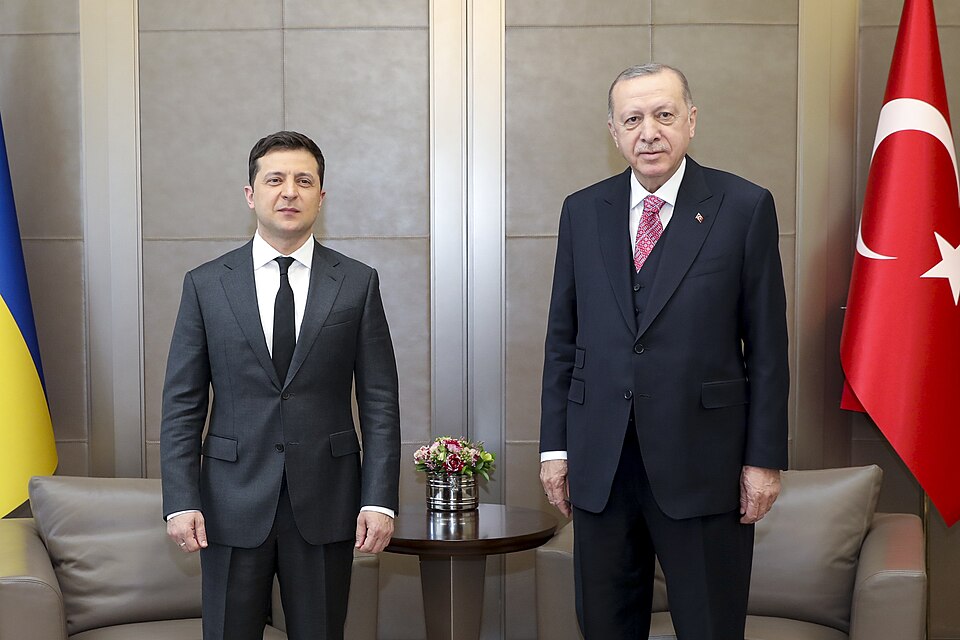
Zelenskyy and Putin met in Turkey, hosted by Erdogan, with Trump participating through his envoys or in person — the first direct Zelenskyy-Putin contact since Russia’s February 2022 full-scale invasion. The meeting produced the beginning of a formal ceasefire negotiation process, not a ceasefire agreement. Both sides have agreed to continue talks; the specific terms of any ceasefire framework remain unresolved. The meeting is a genuine diplomatic landmark; it is not a peace deal.
WHAT THE MEETING PRODUCED
Based on available confirmed reporting, the Turkey meeting produced:
▸ Direct presidential contact for the first time since the invasion: Zelenskyy and Putin in the same room, with Erdogan present, breaks a diplomatic barrier that has been maintained for 30 months
▸ A formal ceasefire negotiation process: both sides agreed to a structured follow-on negotiation process, with Turkey and potentially other mediators hosting subsequent rounds
▸ Prisoner exchange framework: one specific concrete outcome appears to be an agreement or agreement-in-principle on expanded prisoner exchanges, which produces immediate humanitarian benefit
▸ No territorial settlement: the territorial question — the disposition of occupied Ukrainian territory — was not resolved; the meeting produced a process, not an answer to the central question
▸ No security guarantee framework: the security architecture question was not resolved in the first meeting; subsequent rounds will need to address it
WHAT THE MEETING DIDN’T PRODUCE
| WHAT THE MEETING PRODUCED | WHAT IT DID NOT PRODUCE |
| First direct Zelenskyy-Putin contact since 2022 | Territorial settlement — occupied territory disposition unresolved |
| Formal ceasefire negotiation process | Binding ceasefire agreement — fighting has not stopped |
| Prisoner exchange framework | Security guarantee for Ukraine — no US troops commitment |
| International diplomatic legitimacy | NATO membership agreement — Russia’s formal opposition unchanged |
| Continuation talks commitment | War crimes accountability framework — not addressed |
| Erdogan’s regional influence validation | North Korean troop withdrawal — separate bilateral issue |
THE SIGNIFICANCE OF DIRECT CONTACT
The most important thing the Turkey meeting produced is not in either column of the table above: it is the reestablishment of direct communication between the two presidents. The 30-month absence of direct Zelenskyy-Putin contact has meant that every negotiating position has been mediated through intermediaries, creating opportunities for misrepresentation, delay, and mutual misunderstanding. Direct contact — even without agreement — restores a communication channel that allows each side to assess the other’s actual position rather than their intermediated characterization of it.
The historical precedent for this value: the Kennedy-Khrushchev Vienna summit (1961) produced no agreement and was largely assessed as a negative outcome in the short term (it emboldened Khrushchev toward the Berlin Wall and Cuba). But it established a direct communication channel that proved essential during the Cuban Missile Crisis the following year. Direct contact is not agreement; it is a prerequisite for agreement.
Zelenskyy and Putin met. They didn’t agree. They agreed to keep talking. For 30 months, they weren’t talking at all. The distance between those two situations is what the Turkey meeting actually produced.
THE NORTH KOREA DIMENSION
The Turkey meeting happened 2 days after North Korea fired 10 missiles in response to a rejected Trump diplomatic gesture (ONYX August 21 Section B Story 11). The juxtaposition is specific: Trump’s gesture toward Pyongyang failed dramatically; his participation in the Turkey framework produced a genuine diplomatic result with Zelenskyy-Putin contact. The differential outcome — North Korea unresponsive, Ukraine-Russia at least talking — reflects the specific leverage Trump has over each situation.
WHAT HAPPENS NEXT
▸ Follow-on negotiation rounds — the Turkey meeting committed to continued talks; the specific location, mediators, and agenda for Round 2 will be announced
▸ Prisoner exchange implementation — the most concrete near-term deliverable
▸ Security architecture discussions — the hardest question deferred from the first meeting
▸ North Korean troop posture — whether Russia uses the diplomatic track to signal any reduction
▸ Congressional response — whether bipartisan support for continuing US assistance to Ukraine is affected by the direct talks
| CONFIDENCE: HIGH | Zelenskyy-Putin Turkey meeting, Erdogan hosting, direct contact, ceasefire negotiation process commitment, and prisoner exchange framework are from confirmed reporting. What the meeting did and did not produce analysis is ONYX editorial based on confirmed reporting. Historical Kennedy-Khrushchev comparison is ONYX editorial clearly labeled. |
| ⚖️ BIAS CHECK — WHO IS SAYING WHAT | |
| Trump | Will claim the meeting as a diplomatic achievement; the meeting is a genuine achievement that Trump’s pressure on Zelenskyy helped produce |
| Zelenskyy | Attended under pressure; his red lines (territorial integrity) remain; the ceasefire process is better than continued war without a path to end it |
| Putin | Attended for his own reasons; Russia’s military operations continue; the meeting does not indicate Russian concessions on territory |
| Erdogan | Achieved a significant diplomatic moment; Turkey’s role as essential mediator is validated |
| European Allies | Watching carefully; concerned about being excluded from any framework that determines European security architecture; France and UK have expressed positions on security guarantees |
SOURCES
▸ Confirmed reporting — Zelenskyy-Putin Turkey meeting outcome, August 23, 2026
Q: Is the war paused during negotiations?
A: No. Military operations have not stopped. Ceasefire negotiations and active combat can occur simultaneously, as they did in the Korean War (July 1951 – July 1953 — two years of negotiations while fighting continued). Whether the Turkey process produces a military ceasefire is separate from whether it produced diplomatic talks.
Q: What does Zelenskyy get from the process?
A: The negotiation process itself provides some benefits: international diplomatic legitimacy for Ukraine’s position; the possibility of a ceasefire that stops the daily casualties; and the opportunity to make the territorial and security questions formal topics of negotiation rather than unresolved facts on the ground. The risk: a ceasefire that freezes Russian territorial gains before recovery operations succeed.