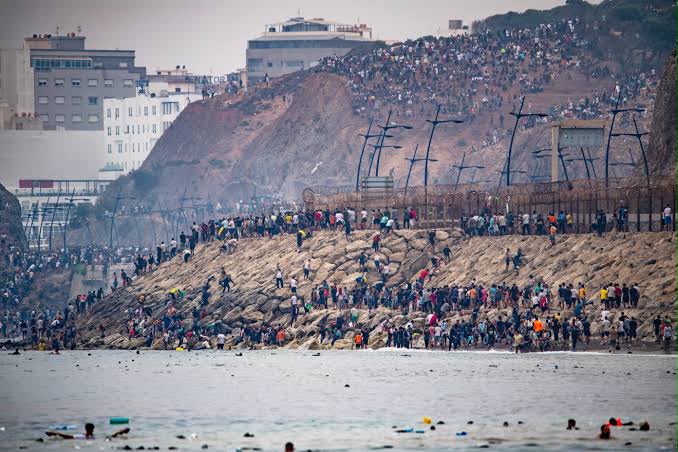
The death toll in Spain’s border crisis at Ceuta — a Spanish enclave on Morocco’s northern coast — has reached 67, according to NPR. The dead include people who drowned attempting to swim past the breakwater barrier and others killed in a stampede as crowds surged toward the fence. Ceuta is one of Europe’s most contested migration flashpoints: a piece of European Union territory physically located on the African continent, accessible from Morocco by a border that has seen repeated mass-crossing attempts. This crisis has received a fraction of the coverage devoted to conflicts in the Middle East.
2-MINUTE CONTEXT — WHAT IS CEUTA?
Ceuta is a Spanish autonomous city on the northern tip of Morocco. Along with Melilla (another Spanish enclave further east), it represents the only land border between the EU and Africa. For migrants seeking to reach Europe, these two cities are extraordinarily valuable waypoints — cross the fence or the water, and you are legally on EU soil.
Morocco’s relationship with Spain over Ceuta is complex and long-standing. Morocco formally claims both Ceuta and Melilla as part of its territory, though it has not pressed that claim militarily in modern times. More immediately relevant: Morocco periodically uses migration enforcement as a diplomatic lever — either tightening or relaxing border controls depending on the state of its relationship with Spain and the EU. The current crisis reflects a period of reduced Moroccan enforcement.
The specific geography of the Ceuta crossing is important. The city is bounded by a fortified fence on the land side and a breakwater — a rocky, constructed barrier extending into the sea — on the water side. Crossing attempts involve either scaling the fence (with razor wire and sensors) or swimming around or over the breakwater. Both methods are dangerous. The stampede deaths occurred as a mass of people surged toward the fence in a concentrated crossing attempt.
THE 67 DEAD — WHO THEY WERE
The victims represent multiple categories of death in a single crisis: some drowned attempting the water crossing, swimming in difficult conditions around or past the breakwater barrier. Others were killed in a stampede when a large crowd attempting to cross simultaneously compressed into a dangerous space — a crowd crush of the kind that kills people at concert venues, sporting events, and now at European border crossings.
Most attempting the crossing are from sub-Saharan Africa — Senegal, Mali, Guinea, Ivory Coast — driven by a combination of economic desperation, conflict displacement, and the collapse of stable livelihoods in the Sahel. They are not primarily war refugees in the legal definition (though some are); they are people for whom the risk of crossing a razor-wire fence or swimming a dangerous breakwater is preferable to remaining where they are.
67 people died trying to cross a fence. Most of the world was watching something else.
WHY THE COVERAGE GAP EXISTS — AND WHY IT MATTERS
The Middle East conflicts — Gaza, Iran — dominate global news attention because they involve major powers, have clear geopolitical stakes, and affect global energy prices. Ceuta’s dead are largely from countries that don’t affect oil prices, don’t involve NATO members in direct conflict, and don’t create the kind of alliance-management concerns that generate Washington policy attention.
This coverage asymmetry has consequences. When 67 people die at a European border and it receives minimal global coverage, the absence of accountability enables the conditions that caused those deaths to persist. It also creates a specific European political dynamic: politicians who want stricter border controls can point to the crossings without being held accountable for the deaths, because the deaths aren’t prominent enough to generate sustained public pressure.
ONYX covers this story because the death count is 67 human beings. That number, in any other context — a plane crash, a building collapse, a mass shooting — would be front-page everywhere for days. The fact that it isn’t, at a European border, is itself the story.
POLITICAL IMPACT
| EUROPEAN POLITICS | INTERNATIONAL DIMENSION |
| Spanish government faces domestic pressure from both pro-enforcement right and pro-humanitarian left | Morocco uses border control as EU diplomatic lever — stricter enforcement costs Spain politically |
| EU faces renewed calls for unified migration policy — 30 years of failing to agree on one | African sending countries face international pressure over conditions driving emigration |
| Far-right parties across Europe will use the crisis to argue for harder border enforcement | UN and UNHCR will issue formal statements — watch for any refugee status determinations |
| Spanish civil society and humanitarian organizations will demand accountability for deaths | US has little direct role but watches EU migration politics as it affects NATO cohesion |
WHAT HAPPENS NEXT
▸ Spain will face calls for an independent inquiry into the stampede deaths — how did the crowd compression occur and what did Spanish security forces do?
▸ Morocco will either tighten enforcement (if there’s EU diplomatic or financial pressure) or continue the current approach (if the leverage is serving its purpose)
▸ EU emergency funding for the Spain-Morocco border is likely to be discussed — it has been the standard EU response to Ceuta crises
▸ The 67 dead will be documented by organizations including UNHCR and MSF — watch for independent death toll verification
▸ Spanish summer is peak crossing season — without changed conditions, more attempts and more deaths are likely
GLOBAL IMPACT — DOES THIS AFFECT AMERICA?
Directly: No. The Ceuta crisis does not affect US energy prices, military commitments, or immediate diplomatic relationships. Indirectly: yes. European migration crises are a primary driver of the political far-right movements that are reshaping European politics and European foreign policy — including attitudes toward NATO, Ukraine, and US-European trade relationships. Every European migration crisis that goes unresolved is political fuel for movements that complicate American foreign policy goals.
| CONFIDENCE: HIGH | Death toll of 67 confirmed by NPR with sourcing from Spanish authorities and humanitarian organizations on the ground. Cause of deaths (drowning and stampede) is confirmed. Geographic and political context of Ceuta is established documented fact. Coverage gap observation is ONYX editorial analysis, clearly labeled. |
| ⚖️ BIAS CHECK — WHO IS SAYING WHAT | |
| Spanish Government | Expressing condolences; calling for EU-level response; avoiding direct responsibility framing |
| Moroccan Government | No formal statement on the deaths; maintaining that migration management is a bilateral Spain-EU matter |
| EU Institutions | Calling for managed migration frameworks; this crisis comes amid ongoing EU-wide migration policy paralysis |
| European Far-Right | Using the crossings as evidence for harder border controls; not prominently featuring the death count |
| Humanitarian Organizations | Condemning the deaths; calling for sea rescue operations and legal pathways as alternatives to dangerous crossings |
| African Sending Countries | Largely silent in official statements; diaspora communities mourning publicly |
| International Media | Significantly less coverage than equivalent death tolls from other contexts — NPR is one of few English-language outlets leading with the story |
📅 NEWS EVOLUTION
2021: Previous major Ceuta crossing crisis — Morocco briefly opened border during Spain-Morocco diplomatic dispute; 8,000 crossed in 24 hours
2023–2024: Continued crossing attempts; deaths recorded but no single mass-casualty incident at this scale
2025: Escalating sub-Saharan African migration pressure due to Sahel instability and climate stress
Aug 2, 2026: Death toll reaches 67 — drownings and stampede; NPR reports as crisis reaches new severity threshold
SOURCES
▸ NPR — Ceuta death toll report (67 confirmed), August 2, 2026
▸ Spanish Interior Ministry — border incident records
▸ UNHCR — migration statistics and Ceuta crossing documentation
▸ Médecins Sans Frontières — on-ground humanitarian documentation
▸ Historical: 2021 Ceuta mass crossing crisis — context for geographic and political background
QUESTIONS YOU MAY STILL HAVE
Q: Why is Ceuta part of Spain if it’s in Africa?
A: Ceuta has been under Spanish control since 1580, predating Morocco’s existence as a modern state. It has Spanish citizenship, Spanish infrastructure, and EU legal status. Morocco’s claim is based on territorial contiguity — that geographic logic would make any coastal enclave belong to whoever is on the continent. Spain and the EU reject that argument.
Q: What legal status do people who reach Ceuta have?
A: People who reach Spanish soil (or water) can request asylum. EU law requires Spain to process those requests. However, Spain has also conducted summary returns to Morocco — “pushbacks” — that human rights organizations have challenged as illegal under EU law.
Q: Why doesn’t the EU just build more processing centers?
A: EU migration policy requires unanimity or qualified majority agreement among 27 member states with radically different migration pressures and public opinions. After 30 years and multiple crises, no durable unified policy exists. Individual bilateral deals (like the 2016 EU-Turkey deal) have partially worked but created their own controversies.