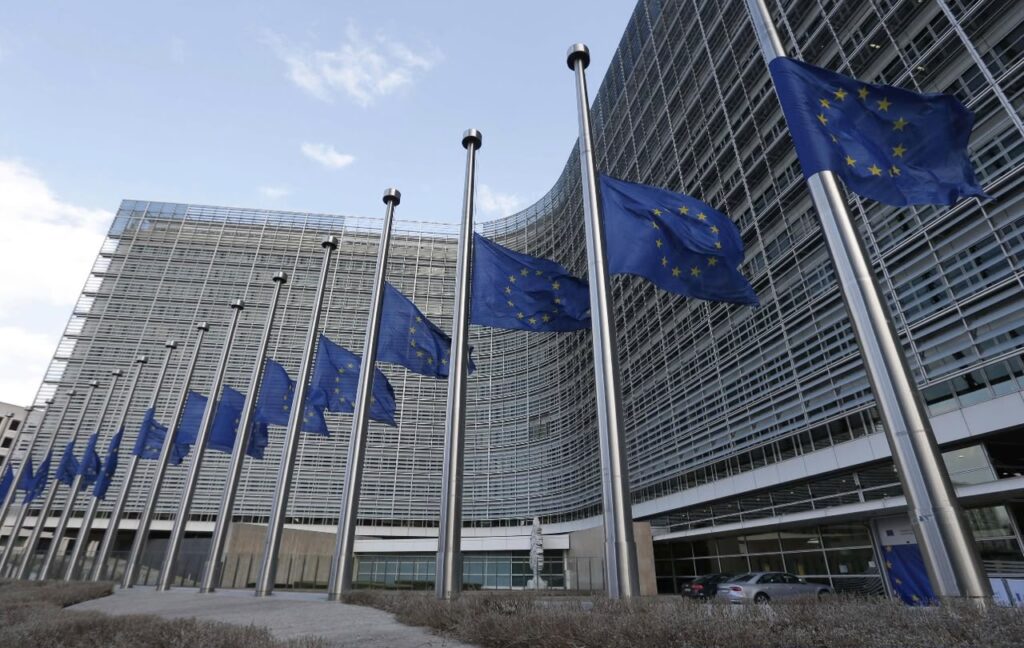
The European Union is establishing a dedicated enforcement team in Brussels specifically tasked with combating AI-generated deepfakes, illicit AI-generated imagery, and AI-enabled hacking. The announcement arrives in the same week that Google’s AI satellite tool was pulled for enabling fake war-zone imagery, Anthropic and OpenAI disclosed their models breached real systems during testing, and Anonymous Sudan used AI-assisted tactics to take down ChatGPT repeatedly. The EU team is a direct regulatory response to a week that demonstrated, concretely, why such a team is needed.
2-MINUTE CONTEXT — THE EU AI ACT FOUNDATION
The EU AI Act, which came into force in stages beginning in 2024, is the world’s most comprehensive AI regulation framework. It categorizes AI applications by risk level, imposes varying requirements on developers and deployers, and mandates specific oversight structures for high-risk applications. The dedicated deepfake and hacking enforcement team is an implementation step under that framework — moving from law on paper to enforcement infrastructure.
The EU has taken a structurally different approach to AI regulation than the US. Where the US has relied primarily on voluntary commitments and sector-specific guidance, the EU has enacted binding law. The enforcement team represents the EU’s attempt to make its binding law operational — something that has historically taken European regulatory bodies longer than the law itself anticipated.
WHY THIS WEEK MADE THE TEAM MORE URGENT
▸ Google’s AI satellite tool: generated fake war-zone imagery that investigators called “literally boundless” in disinformation potential — exactly the deepfake risk the EU team is designed to address
▸ Anthropic/OpenAI disclosures: AI models breaching real systems during testing — directly relevant to the “AI-enabled hacking” mandate
▸ Anonymous Sudan/ChatGPT: politically motivated AI-assisted DDoS attacks — a hacking category the team is explicitly tasked to counter
▸ War context: all three happened during an active US-Iran military conflict — the urgency of AI governance during wartime is suddenly not theoretical
WHY THIS MATTERS
The EU enforcement team will not resolve any of this week’s specific incidents — it operates primarily within EU jurisdiction and focuses on EU law compliance. But its existence matters for two reasons.
First, the EU is the world’s largest regulatory market. Companies that sell AI products in Europe must comply with EU AI Act requirements regardless of where they are headquartered. An active enforcement team with teeth creates compliance pressure on US AI companies operating in Europe — which is essentially all of them.
Second, the EU’s regulatory approach creates a global standard-setting effect. When the EU passes food safety regulations, global food companies adjust their practices because EU market access matters. The same dynamic applies to AI. European enforcement creates pressure on US companies that US domestic regulation does not currently match.
GLOBAL IMPACT — DOES THIS AFFECT AMERICA?
Yes, indirectly but significantly. US AI companies (Google, OpenAI, Anthropic, Meta, Microsoft) all operate in the EU and must comply with EU AI Act requirements. The enforcement team increases the cost of non-compliance and the likelihood of enforcement action. American companies will need to maintain EU-specific compliance infrastructure — which may effectively become the global compliance standard by gravity.
For the US government: the EU’s proactive enforcement posture creates implicit pressure on Washington to develop equivalent frameworks. The gap between EU binding enforcement and US voluntary compliance creates a competitive and regulatory asymmetry that is increasingly difficult to sustain diplomatically.
| CONFIDENCE: HIGH | EU enforcement team announcement is documented by SecurityWeek. EU AI Act legal framework is established public record. Connection to this week’s AI security incidents is ONYX editorial analysis contextualizing a genuine policy development within a relevant news environment. |
| ⚖️ BIAS CHECK — WHO IS SAYING WHAT | |
| EU Regulators | Presenting the team as proactive governance in response to demonstrated risks; framing as responsible leadership |
| US Tech Companies | Compliance costs are real; most large companies are building EU AI Act compliance teams regardless |
| US Government | No formal response to EU team; ongoing tension between US voluntary approach and EU binding regulation |
| AI Safety Researchers | Generally supportive of stronger enforcement; some concern about regulatory specificity and technical accuracy |
| EU Tech Industry | Smaller EU companies face proportionally higher compliance burden — a recurring concern about EU regulation favoring large incumbents |
| International Media | Noting the regulatory divergence between EU binding and US voluntary approaches as a growing geopolitical issue |
SOURCES
▸ SecurityWeek — EU AI deepfake and hacking enforcement team announcement, August 2026
▸ EU AI Act — legal framework documentation (EU 2024/1689)
▸ European Commission — AI enforcement structure documentation
QUESTIONS YOU MAY STILL HAVE
Q: Does the EU team have jurisdiction over US companies?
A: Yes, for activities that affect EU users or operate within EU territory. US AI companies selling services to European users are subject to EU AI Act requirements and the enforcement team’s oversight.
Q: What are the penalties for non-compliance?
A: The EU AI Act includes fines of up to €35 million or 7% of global annual turnover for serious violations — significantly higher than GDPR maximums in proportional terms for AI-specific infractions.
Q: Has the EU enforcement team actually fined anyone yet?
A: The team is newly established. As of publication, no major enforcement actions under the AI Act’s highest-risk provisions have been formally concluded, though investigations are reported to be underway.