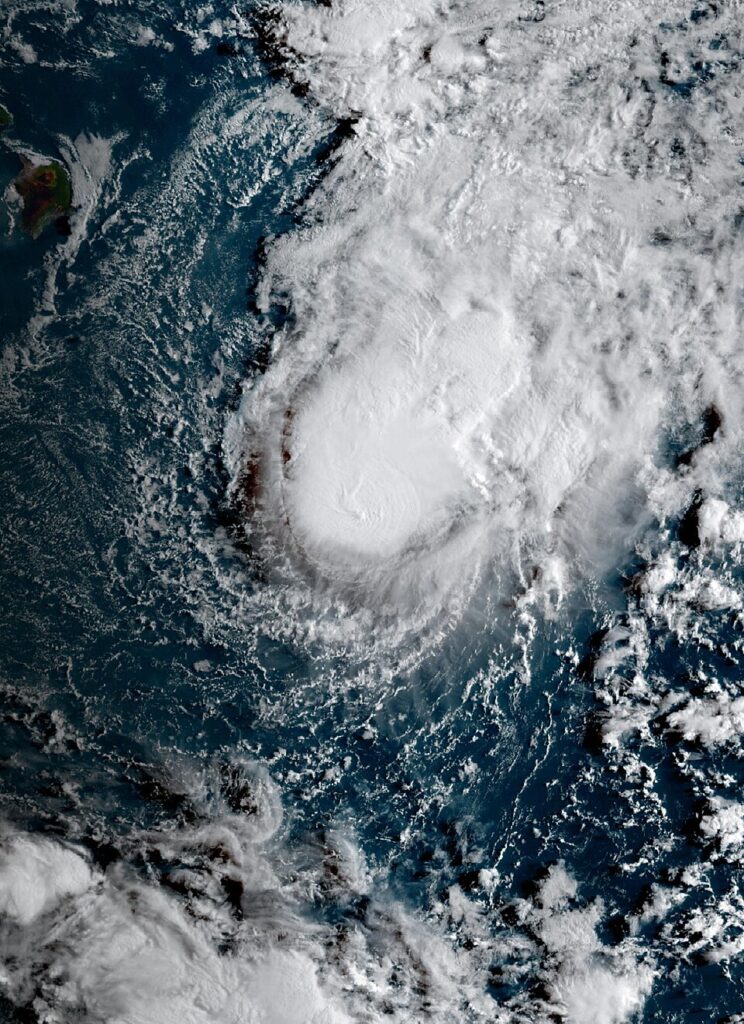
Tropical Storm Moke is advancing toward Hawaii, with NOAA warning of more than a foot of rain across the Big Island. Nevada Governor Lombardo’s emergency declaration (Hawk Fire) and Moke’s simultaneous approach represent a weekend in which federal emergency resources are being demanded from Nevada and Hawaii simultaneously — added to the Indiana flooding (Day 19 of recovery) and the Atlantic hurricane season approaching its September 10 peak.
WHY COMPOUND STORMS ARE WORSE
The specific reason Tropical Storm Moke is more dangerous to Hawaii than its own strength suggests: the Big Island’s drainage systems, soil saturation, infrastructure, and emergency response capacity are all in a compromised state from Tropical Storm Lala’s prior passage.
▸ Saturated soil: soil that absorbed 30+ inches of rainfall from Lala has limited additional absorption capacity; Moke’s rainfall will run off rather than infiltrate, producing faster and larger flood events from smaller rainfall totals
▸ Damaged drainage: culverts, drainage channels, and stormwater systems damaged by Lala may have reduced capacity for Moke’s flow
▸ Weakened slopes: rainfall-saturated hillsides are more vulnerable to landslide triggering; Moke’s rainfall arrives at slopes already destabilized by Lala
▸ Fatigue of emergency responders: personnel who worked Lala have had limited recovery time; Moke arrives before full rest and resupply
▸ Infrastructure already damaged: roads, bridges, power lines, and water systems damaged by Lala have had limited repair time; Moke’s impact will compound existing damage rather than starting from baseline
THE SPECIFIC RAINFALL WARNING
More than a foot of rain on the Big Island is a NOAA warning, not a prediction. The actual total will depend on Moke’s track, forward speed, and interaction with the Big Island’s volcanic topography — the mountain terrain that produces the island’s famous rainfall patterns also produces rainfall enhancement from orographic lift. Areas on the windward slopes of Kilauea and Mauna Kea can see multiples of the storm average total.
THE SIMULTANEOUS DISASTERS CONTEXT
Today’s FEMA resource demand picture:
▸ Nevada: Hawk Fire — federal fire suppression resources, Governor Lombardo emergency declaration, 90,000 displaced
▸ Hawaii: Tropical Storm Moke approaching — pre-positioning resources for compound storm event
▸ Indiana: Day 19 of flood recovery — tens of thousands still without power; ongoing federal assistance
▸ Atlantic: September 10 statistical peak approaching — 18 days away; FEMA pre-positioning for potential hurricane landfalls
FEMA is simultaneously managing active responses and pre-positioning for a potential major hurricane during what is objectively the most resource-intensive non-single-event period in the agency’s documented this-year history.
Moke is not as strong as Lala was. But it doesn’t need to be. The Big Island’s drainage is compromised, its hillsides are saturated, and its emergency responders are tired. The compound effect is the specific danger.
WHAT HAPPENS NEXT
▸ Moke’s track and landfall timing — forecast track and speed determine where the heaviest rainfall bands fall
▸ Flooding and landslide risk — the compound effect on saturated soils is the specific monitoring priority
▸ Federal resource coordination — whether FEMA has adequate resources for simultaneous Nevada and Hawaii responses
▸ Infrastructure damage assessment — extent of additional damage on top of Lala’s impacts
| CONFIDENCE: HIGH | Tropical Storm Moke Hawaii approach, NOAA more than a foot of rain warning, and compound storm context with Lala are from NPR confirmed reporting. Compound storm effects (soil saturation, infrastructure damage, responder fatigue) are from established emergency management documentation. |
| ⚖️ BIAS CHECK — WHO IS SAYING WHAT | |
| NOAA / National Hurricane Center | Providing objective meteorological assessment; their “more than a foot” warning is a credible upper-range estimate, not a guarantee |
| Hawaii Emergency Management | Managing compound storm event with limited recovery time between Lala and Moke; their specific response capacity is the operational constraint |
| FEMA | Managing simultaneous Nevada (fire) and Hawaii (storm) responses with a depleted DRF; resource prioritization across simultaneous events is their specific institutional challenge |
| Big Island Residents | Managing the psychological and practical stress of a second major storm event within weeks |
SOURCES
▸ NPR — Tropical Storm Moke Hawaii approach, NOAA warning, compound storm, August 24, 2026