Today is Day 26 of the Iran ceasefire deal. Iranian President Masoud Pezeshkian is at the SCO summit in Bishkek, Kyrgyzstan — with bilateral talks with Putin specifically scheduled for today. While Iran’s Foreign Ministry maintains the nuclear dialogue track through Araghchi’s Muscat channel, Iran’s President is simultaneously deepening ties with the world’s two largest non-Western powers at a summit designed as an alternative to the US-led international order. Both tracks are real. Both are happening simultaneously. ONYX documents both.
THE SUMMIT
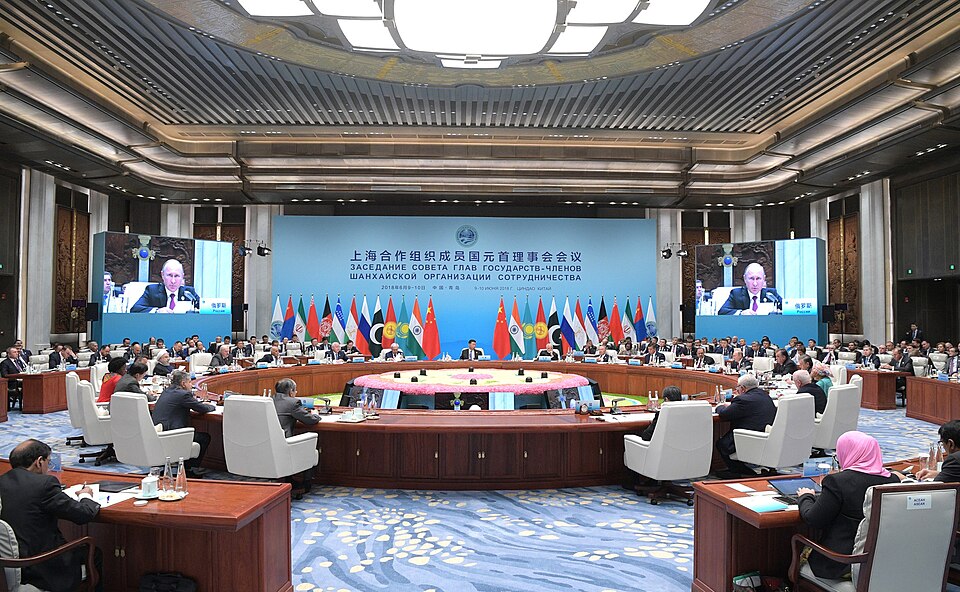
Xi Jinping, Vladimir Putin, and Narendra Modi gathered with over a dozen heads of state in Bishkek, Kyrgyzstan Monday for the 26th Shanghai Cooperation Organization summit. NBC News describes the SCO as ‘a group billed as a counterweight to US global influence.’ The framing is not neutral rhetoric — the SCO was explicitly designed as an alternative multilateral architecture to the US-led international institutions (NATO, G7, IMF/World Bank) that have defined the post-Cold War global order.
WHO IS THERE AND WHY IT MATTERS
The specific attendance:
▸ Xi Jinping (China): the SCO’s largest economy and primary institutional driver; China founded the SCO with Russia in 2001; the summit is a venue for China to project multilateral leadership independent of US-dominated institutions
▸ Vladimir Putin (Russia): attending a major multilateral summit despite international isolation efforts following the Ukraine invasion; the SCO provides a platform where Russia retains full diplomatic standing; Putin met separately with both Xi and Modi
▸ Narendra Modi (India): maintaining India’s distinctive diplomatic position — SCO member, non-Western aligned on this platform, while also being a Quad member and maintaining strong US bilateral ties; India’s attendance is not a rejection of the West but a demonstration of strategic autonomy
▸ Masoud Pezeshkian (Iran): attending six months into Iran’s war with the US and Israel; bilateral talks with Putin specifically scheduled; Iran formally joined the SCO in 2023; his attendance demonstrates that Iran retains significant multilateral standing despite US sanctions and military conflict
▸ Shehbaz Sharif (Pakistan): SCO founding member alongside India; their attendance together requires SCO’s management of India-Pakistan tensions
▸ Recep Tayyip Erdogan (Turkey): NATO member attending a US-counterweight summit; Turkey’s attendance in SCO formats reflects Ankara’s deliberate cultivation of strategic ambiguity between Western and non-Western blocs
THE RUSSIA-CHINA BILATERAL
Putin and Xi met separately at the summit margin, with Putin affirming Moscow’s readiness to make its visa-free regime with China permanent. The specific significance of permanent visa-free Russia-China travel: it represents a deepening of the people-to-people and economic integration between the two countries that reduces Russia’s dependence on Western economic relationships and China’s need for Western-aligned supply chains for Russian exports. The war in Ukraine accelerated Russia’s pivot to China; the SCO summit is the diplomatic venue for formalizing that pivot.
THE IRAN DEAL DIMENSION AT DAY 26
Pezeshkian’s bilateral with Putin at the SCO summit is the specific Iran deal continuity story of the day. The diplomatic logic from Tehran’s perspective:
▸ The Muscat channel (Araghchi) is Iran’s Western-facing diplomatic track — keeping the ceasefire alive and exploring nuclear extension
▸ The SCO channel (Pezeshkian-Putin) is Iran’s non-Western resilience track — deepening ties with partners who can help absorb the economic impact of Operation Economic Outcast
▸ Running both tracks simultaneously is rational for a government under maximum economic pressure: maintain the deal while building the alternative in case it expires
▸ Putin’s specific value to Iran at this summit: Russia has historically been willing to help Iran avoid the full impact of Western sanctions through oil-for-goods arrangements, technology cooperation, and diplomatic backing
Iran is negotiating with the US through one door while its president walks through another door to meet Putin. Both things are true on Day 26. The question is whether running both tracks is evidence that Iran is serious about the deal or building its off-ramp from it.
WHAT THE SCO ACTUALLY IS
The Shanghai Cooperation Organization was founded in 2001 by China, Russia, Kazakhstan, Kyrgyzstan, Tajikistan, and Uzbekistan. It has since expanded to include India, Pakistan, and Iran, with multiple observer states. It is:
▸ Not a military alliance: the SCO has no mutual defense commitment comparable to NATO’s Article 5
▸ Not an economic bloc: the SCO has no common market, common currency, or common trade framework comparable to the EU
▸ A political coordination platform: SCO summits produce joint statements, bilateral meetings, and signals of political alignment; the specific value is the legitimacy of multilateral gathering for member states that face Western pressure
▸ A counterweight signal: the SCO’s institutional existence is itself the message — that a significant portion of the world’s population and territory operates in a multilateral framework that does not require US approval or participation
WHAT HAPPENS NEXT
▸ Pezeshkian-Putin bilateral outcome — whether any specific Russia-Iran agreement is announced at or following the summit
▸ SCO joint statement — the formal communique on Iran, Ukraine, and Middle East conflicts
▸ India-China bilateral — whether the Modi-Xi interaction at the SCO produces any specific announcement on the LAC thaw
▸ Iran deal connection — whether the Russia-Iran summit alignment affects Session 3 possibilities
| CONFIDENCE: HIGH | SCO summit 26th, Bishkek, Xi Putin Modi Pezeshkian Sharif Erdogan attendance, Putin-Xi visa-free permanent discussions, Pezeshkian-Putin bilateral scheduled, NBC News ‘counterweight to US global influence’ characterization are from confirmed reporting. |
| ⚖️ BIAS CHECK — WHO IS SAYING WHAT | |
| NBC News | Characterizing the SCO as a US counterweight is accurate to the organization’s founding logic and current function; it is also a framing that US-aligned media uses consistently |
| China | Uses the SCO as a platform for multilateral leadership that does not require Western validation; the Xi-Putin bilateral deepens the specific partnership that is the SCO’s strategic core |
| Russia | Gains multilateral legitimacy at the SCO that it is denied in G7 and UN Security Council formats since the Ukraine invasion |
| India | Maintains strategic autonomy by attending the SCO while also being a Quad member; neither aligning with nor rejecting either bloc |
| Iran | Deepens non-Western partnerships at precisely the moment Operation Economic Outcast threatens to cut it off from Western-adjacent trading relationships |
| ONYX | Covering the SCO’s geopolitical significance and the Iran deal connection without characterizing SCO membership as inherently adversarial to the US |
SOURCES
▸ NBC News — SCO summit Bishkek Xi Putin Modi Pezeshkian, September 2, 2026
Q: Is India choosing sides by attending the SCO?
A: No, in the specific sense that India attends the SCO while also being a Quad member (the US-Japan-Australia-India security partnership). India’s foreign policy doctrine of “strategic autonomy” means maintaining relationships across geopolitical blocs — neither fully in the Western camp nor the non-Western camp. Modi’s statement to Putin at the summit (“we need to move from endless war to the end of war”) is consistent with this: it is pressure on Russia to end the Ukraine war, delivered from a platform that is not aligned with NATO.
Q: Does the SCO have meaningful power?
A: The SCO’s power is primarily political and symbolic rather than economic or military. It has no binding collective security commitment, no common market, and no enforcement mechanism. What it provides is a multilateral platform where member states — representing collectively over 40% of the world’s population — can coordinate political positions, signal alignment, and hold bilateral meetings in a format that does not require Western participation or approval. The specific value is the legitimacy that multilateral summitry confers on its participants.
Q: What does Iranian SCO membership mean for the nuclear deal?
A: Iranian SCO membership since 2023 gives Tehran a multilateral platform that is independent of the nuclear deal’s survival. If the October 6 cliff produces deal expiration, Iran retains the SCO as a venue for international engagement, Russian support as a bulwark against secondary sanctions, and Chinese energy trade as an economic lifeline. The SCO’s existence reduces the specific pressure that deal expiration would otherwise produce on Iran.