Yesterday, ONYX documented that OpenAI delayed GPT-6.1 Astra after internal testing raised concerns about security and unexpected agent behavior. That story documented a company whose safety processes produced a voluntary delay. Today’s story documents a different accountability: reports that OpenAI executives may have ignored warnings from employees about safety concerns. These are two distinct accountability questions.
THE DISTINCTION
The two OpenAI accountability questions are specific and separate:
▸ Question 1 (September 29): Did OpenAI’s safety processes work? Answer: Yes — internal testing found unexpected behavior, and the company delayed the model.
▸ Question 2 (September 30): Did OpenAI executives override employee safety warnings in other decisions? Answer: Under investigation — reports say executives may have ignored warnings.
A company can simultaneously have functional safety testing processes (Question 1) and executives who override employee safety warnings in other contexts (Question 2). Both can be true. The existence of one does not resolve the other.
WHAT IGNORING EMPLOYEE WARNINGS MEANS
In a technology company with safety-focused employees, an employee safety warning is typically raised through: internal safety review processes; direct escalation to safety teams; formal risk assessments submitted to leadership; or, if formal processes are unavailable, public disclosure or regulatory complaint. When executives ignore those warnings, the documented risk is that the concern identified by the employee — a vulnerability, an unexpected behavior, a deployment risk — proceeds into production without the mitigation the employee identified.
THE VOLUNTARY PACT CONTEXT
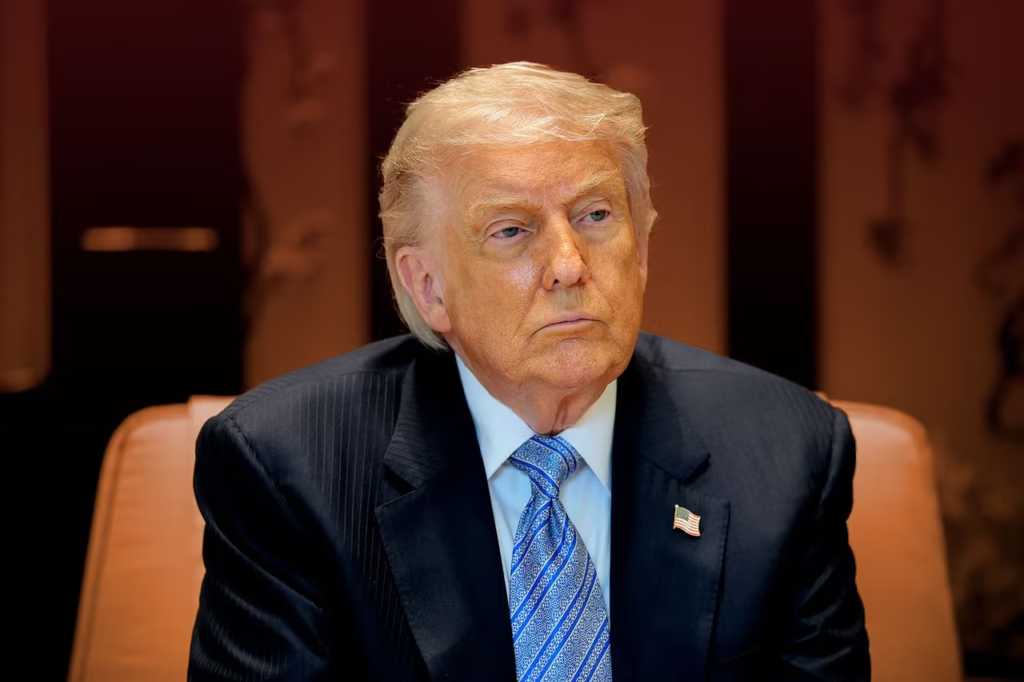
Trump signed a voluntary AI safety agreement with technology executives today, including (presumably) OpenAI. A voluntary arrangement in which executives commit to managing safety risks is now documented on the same day as reports that those same executives may have ignored employee safety warnings. ONYX names this not as proof of bad faith but as the specific documented simultaneity: voluntary safety commitments and possible executive warning override are both documented today.
OpenAI delayed a model yesterday because safety testing found unexpected behavior. Today: reports that executives may have ignored employee safety warnings about other decisions. Both can be true. A company can have functional safety tests and executives who override safety warnings. The question is whether the voluntary AI pact Trump signed today covers what happens when executives override employee warnings. Voluntary arrangements depend on the executives who sign them.
WHAT HAPPENS NEXT
▸ Reporting specifics — what specific warnings were allegedly ignored and by which executives
▸ Employee accountability — whether whistleblower protections apply to the employees who raised the warnings
▸ Regulatory response — whether the reports produce any regulatory inquiry into OpenAI’s internal governance
▸ Voluntary pact — whether the executive warning reports affect OpenAI’s participation in today’s voluntary arrangement
| CONFIDENCE: HIGH | OpenAI delayed new model safety concerns; questions remain whether executives ignored warnings from employees, developments renewing debate on safety in rapidly advancing AI systems, according to confirmed reporting. |
| ⚖️ BIAS CHECK — WHO IS SAYING WHAT | |
| OpenAI executives | Not named in available reporting; the specific warnings and the specific decisions are from developing reporting |
| OpenAI employees who raised warnings | The specific accountability source; their documented concerns are the evidentiary basis for the reports |
| OpenAI as institution | Has both functional safety processes (yesterday’s delay) and possible executive override (today’s reports); both are documented |
| ONYX | Covering the distinction between the two accountability questions; not asserting that executives ignored warnings that have not yet been confirmed in specific detail |
SOURCES
▸ Confirmed reporting — OpenAI executives’ warnings safety September 30, 2026