October 5: Pakistan, Saudi Arabia, and Turkiye held emergency defence talks in Riyadh under the Makkah Joint Defence Agreement — the framework’s first documented emergency convening. October 6: The three countries agreed to immediately implement collective-defence provisions. The Makkah Alliance has moved from consultation to formal activation.
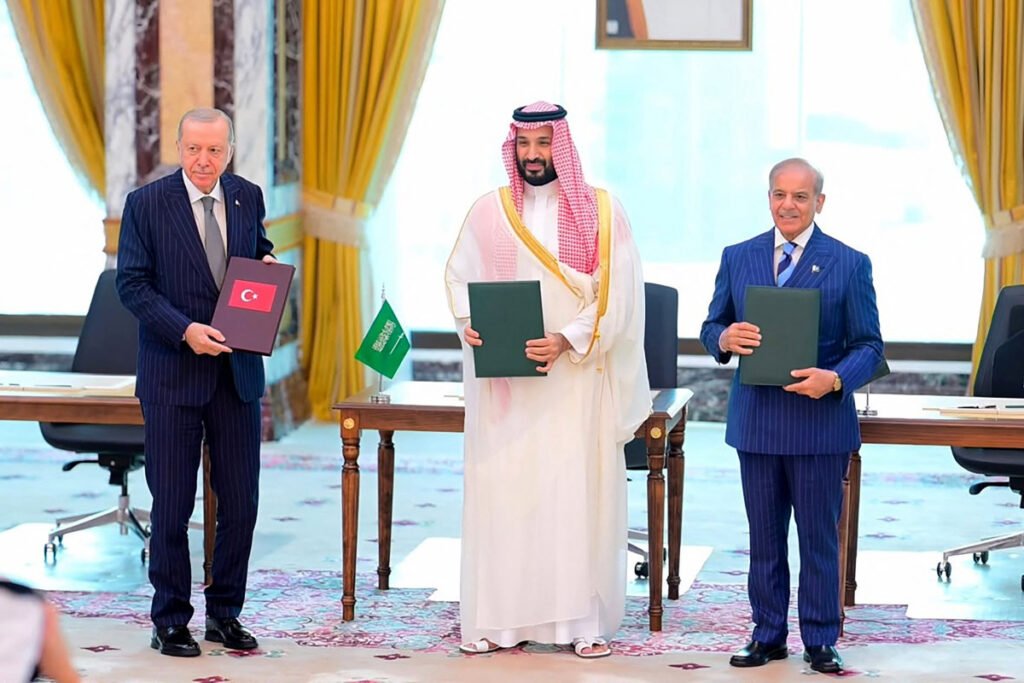
CONSULTATION TO ACTIVATION: WHAT CHANGED IN 24 HOURS
Emergency talks are consultative. Formal activation of collective-defence provisions is legally operative. The 24-hour shift from October 5 to October 6 is the arc’s most significant alliance governance development since the G7’s October 3 condemnation of Iran. The specific implications of ‘immediately implement collective-defence provisions’:
▸ Pakistan’s obligations: Pakistan has a documented history of deploying military forces to Saudi Arabia under bilateral and framework arrangements since the 1970s; formal activation may trigger those deployment obligations
▸ Turkey’s obligations: Turkiye, as a NATO member, faces a documented dual-commitment tension; its Makkah Alliance activation represents an obligation to defend Saudi Arabia from Iran-aligned attacks
▸ Saudi Arabia’s role: the Alliance’s primary defended party; the specific trigger is two consecutive Houthi Aramco Riyadh attacks and the ongoing Saudi offensive against Houthi positions
THE PAKISTAN NUCLEAR DIMENSION
Pakistan’s formal Makkah Alliance activation is the arc’s most significant nuclear-armed state engagement. The specific documented facts:
▸ Pakistan has approximately 160–170 nuclear warheads — an operational nuclear arsenal
▸ Pakistan has historically deployed military forces to Saudi Arabia — documented since the 1970s
▸ Pakistan’s Makkah Alliance commitment: to defend Saudi Arabia from Iran-aligned attacks
▸ The chain activation creates: a Pakistani military deployment to Saudi Arabia would bring a nuclear-armed state into direct operational proximity to Iran-backed Houthi forces and, by extension, into proximity to Iran’s own calculation about escalation risk
ONYX names the nuclear dimension not as a threat but as the documented strategic reality of the activation. A nuclear-armed country has formally committed to defending a country that is at war with Iran-aligned forces. This is what the arc documents.
THE TURKEY-NATO TENSION
Turkey’s simultaneous NATO membership and Makkah Alliance activation creates the arc’s most complex alliance governance question. The specific documented tension:
▸ NATO Article 5: mutual defence applies to attacks on Turkey; if Iran were to strike Turkey as retaliation for its Makkah Alliance commitment, Article 5 is triggered
▸ Makkah Alliance: Turkey has now formally committed to defending Saudi Arabia from Iran-aligned attacks
▸ US bombers withdrawn from UK base (Story 4 today): being examined for links to the Iran conflict; the NATO-Makkah Alliance tension is the specific alliance governance chain the US must manage
▸ The escalation chain: Houthi attacks on Saudi Arabia → Makkah Alliance activation → Turkey’s formal commitment to Saudi defence → potential Iranian response against Turkey → NATO Article 5 consideration → US Alliance obligations
THE HOUTHI TRIGGER: 48 HOURS
The specific trigger for Makkah Alliance activation was Iran-aligned Houthi attacks on Saudi Arabia. The documented timeline from trigger to activation was exactly 48 hours:
▸ October 4: first documented Houthi Aramco Riyadh claim (MODERATE confidence at the time)
▸ October 5: second consecutive Houthi Aramco Riyadh claim; Saudi major offensive launched; Makkah Alliance emergency talks held in Riyadh
▸ October 6: Makkah Alliance formally activates collective-defence provisions
The Makkah Alliance just activated. Pakistan has nuclear weapons. Turkey is in NATO. Saudi Arabia’s Aramco has been hit two consecutive days by Iran-aligned forces. Three countries just formally committed to defend each other against those forces. A nuclear-armed country and a NATO member are now in the same collective-defence framework as a country that just launched a major war against Iran-aligned proxies. The arc’s alliances are not abstract on October 6. They are legally operative.
WHAT HAPPENS NEXT
▸ Pakistan force deployment — whether Pakistan formally deploys military units to Saudi Arabia under the activation
▸ Turkey’s specific contribution — what Turkey provides under activation; whether its NATO obligations are briefed
▸ Iran’s response — whether Iran characterizes the Makkah Alliance activation as a threat requiring response
▸ NATO Article 5 consultation — whether the US briefs NATO allies on the Turkey-Makkah Alliance dual commitment
| CONFIDENCE: HIGH | Pakistan, Saudi Arabia, and Turkiye agreed to immediately implement collective-defence provisions under the Makkah pact following attacks by Iran-aligned Houthis, raising regional tensions, according to confirmed AA.com.tr Morning Briefing October 6 2026 reporting. |
| ⚖️ BIAS CHECK — WHO IS SAYING WHAT | |
| Saudi Arabia | The Alliance’s primary defended party; the Aramco attacks are the specific trigger; its offensive against Houthi positions is ongoing |
| Pakistan | Formally activated; its nuclear status is not a threat but a documented strategic reality of the commitment it has just made |
| Turkey | NATO member and Makkah Alliance member simultaneously; the dual commitment is the arc’s most complex single alliance governance challenge |
| Iran | The indirect target; documented as aligned with Houthis; does not control them directly, but the Makkah Alliance activation is specifically a response to Iran-aligned attacks |
| ONYX | Covering the activation at its confirmed scope; naming the NATO-Makkah tension and the Pakistan nuclear dimension as documented facts, not speculation |
SOURCES
▸ AA.com.tr — Morning Briefing October 6, 2026
▸ Open Chronicle — Global News Brief October 6, 2026