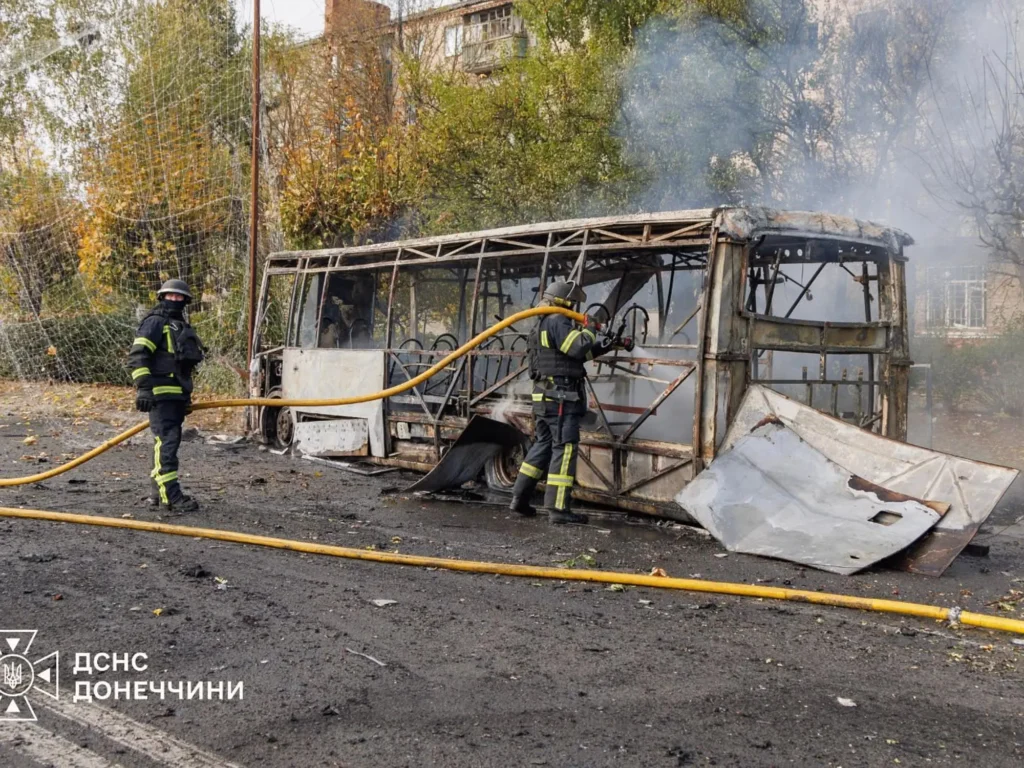
The death toll from a Russian strike on civilian buses in eastern Ukraine reached 30 to 35, pushing the two-day total above 70. Zelenskyy asked a pointed question about American resolve.
🇺🇦 UKRAINE · OCTOBER 9, 2026 · CIVILIAN MASSACRE
The buses were public transportation. They were carrying people — ordinary people, the kind who ride buses in eastern Ukrainian cities because they do not have cars, or because their cars were destroyed last year, or because the bus route still runs and the alternative is walking. A Russian strike found them. Thirty to thirty-five of those people are now dead.
The attack pushes the two-day death toll from Russian strikes on Ukrainian civilian targets above seventy. Seventy in forty-eight hours. It is a number that should be repeated until it registers with the weight it deserves.
THE ATTACK
Russian forces struck public buses in a location in eastern Ukraine that has not been fully specified in initial reporting — a standard feature of Ukrainian wartime communication, which restricts location details to protect against follow-up strikes. The casualty count of thirty to thirty-five killed represents one of the single deadliest individual attacks on Ukrainian civilians in recent months.
The buses present a target selection that defies any military logic. They are not ammunition convoys. They are not command-and-control nodes. They are not dual-use infrastructure whose destruction degrades military capability. They are people going somewhere. The targeting of civilian transportation, documented repeatedly across the conflict and the subject of formal findings by international investigators, reflects a doctrine of deliberate civilian harm — not incidental damage, but intended pressure on Ukrainian society.
ZELENSKYY’S QUESTION
Ukrainian President Volodymyr Zelenskyy appeared in his nightly address and did what he has done with increasing directness since the Iran ceasefire complicated US foreign policy attention: he asked about American help. He criticized, specifically, what he described as US willingness to continue providing further assistance, framing it as a test of stated commitments.
The criticism is calibrated. Zelenskyy is not breaking with Washington — he cannot afford to. But he is signaling, publicly and on the record, that the gap between American rhetoric about Ukrainian sovereignty and American willingness to sustain military support has become visible enough to name. With the November 3 midterms approaching and the Trump administration’s posture toward Russia under scrutiny, the timing of the criticism is deliberate.
WHAT SEVENTY DEAD IN TWO DAYS MEANS
The two-day toll of more than seventy dead is not an abstraction. It is Kramatorsk on October 8 — the bus strike that launched Section A of this edition. It is Pryluky. It is the latest residential strikes in Kyiv. Each incident has its own report, its own casualty count, its own investigation. Together they form a pattern that international courts are increasingly characterizing not as collateral damage in a military campaign but as a crime.
Ukraine has submitted evidence packages to the International Criminal Court. The ICC has issued warrants in this conflict before. The accumulation of documented strikes on civilian transportation, residential buildings, energy infrastructure, and hospitals is the evidentiary foundation of something that does not yet have a formal legal name but is moving in that direction.
“He struck buses carrying civilians. He killed thirty people going somewhere. There will be a moment when the world decides what to call this. That moment keeps getting closer.”
WHAT HAPPENS NEXT
► Casualty confirmation — full accounting from Ukrainian emergency services over the next 24 hours
► US response — whether the White House addresses Zelenskyy’s criticism specifically
► ICC documentation — whether the bus strike is formally submitted as evidentiary material
► Military aid status — Congressional action on pending Ukraine supplemental funding
| CONFIDENCE: HIGH | Washington Post, AP confirmed bus strike, 30-35 killed, two-day toll above 70, Zelenskyy criticism of US. Multiple corroborating sources. |
| BIAS CHECK | ASSESSMENT |
| Source weight | Washington Post, AP — primary wire and investigative reporting |
| Russian attribution | Strike attributed to Russia; consistent with documented conflict patterns and Ukrainian military attribution |
| Zelenskyy framing | Criticism of US accurately characterized; no editorial amplification |
| ICC framing | Court documentation noted as factual ongoing process; no prejudgment of outcome |
SOURCES
► Washington Post — Ukraine bus strike, Zelenskyy US aid criticism, October 9, 2026
► AP — eastern Ukraine civilian casualties, two-day toll, October 9, 2026