Michigan got personal. Georgia got heated. Maine stayed close. Twenty-five days out, the debates tell us less about policy than about which party has a theory of this moment.
🗳️ MIDTERMS · OCTOBER 9, 2026 · 25 DAYS OUT
Senate debates twenty-five days before an election are rarely about persuasion. The undecided voters who will decide the outcome of competitive races are, by this point, mostly decided in ways they have not yet admitted to themselves. The debates are for base activation, clip generation, and the recording of a record that can be used in the closing days of advertising. Thursday’s debates in Michigan, Georgia, and Maine were no different in that structural sense. They were very different in the specifics.
MICHIGAN: EL-SAYED VS. ROGERS
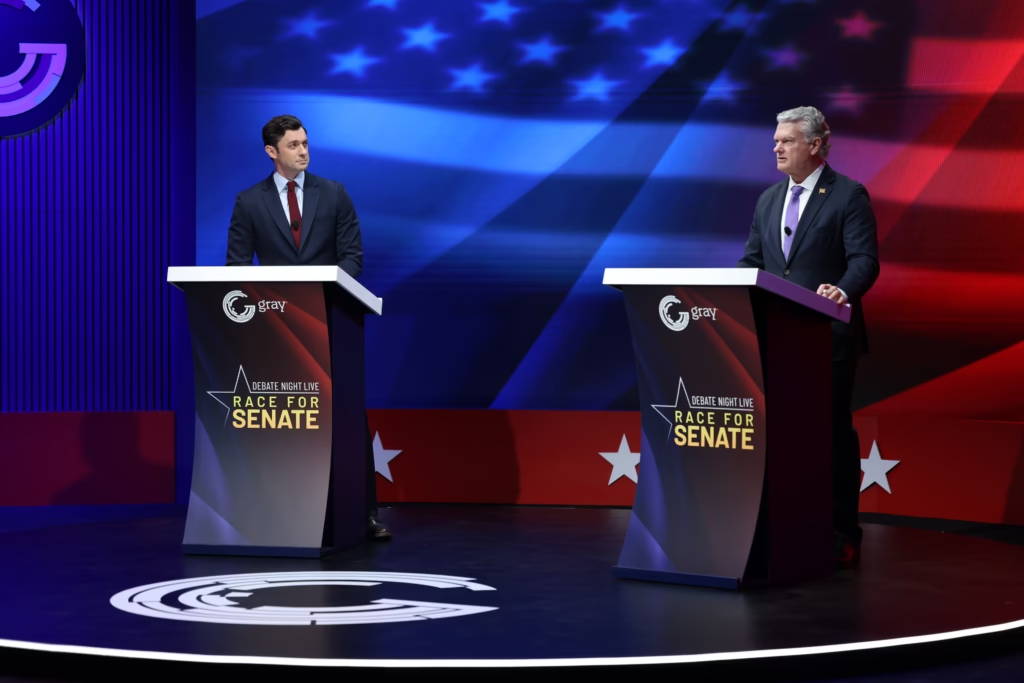
The Michigan Senate debate between Democrat Abdul El-Sayed and Republican incumbent Mike Rogers became heated in a way that Senate debates rarely do — with personal attacks that went beyond policy disagreement into character. El-Sayed, the former Detroit health commissioner and progressive candidate, pressed Rogers on his lobbying ties and his posture toward the Trump administration’s foreign policy. Rogers, a former congressman and longtime intelligence committee figure, pressed back on El-Sayed’s past statements on foreign policy and on what he characterized as positions outside the Michigan mainstream.
Michigan is a state that the Democratic Party won in 2020 and 2022 and that has been trending competitive at the statewide level since 2016. Its large Arab-American community, concentrated in Dearborn and the Metro Detroit suburbs, has been one of the most politically watched constituencies in the country since the Gaza conflict began. El-Sayed — himself of Egyptian-American heritage and vocal on Palestinian rights — represents a different bet on what that constituency wants than Michigan Democrats have typically made.
GEORGIA AND MAINE
Georgia’s debate featured the policy clashes familiar from a state that has been at the center of American electoral politics since 2020 — healthcare, economy, and the increasingly fraught terrain of election security, a topic that cuts differently in Georgia than anywhere else given the 2020 recount and its aftermath. The race remains among the closest in the country.
Maine’s debate maintained the character of its broader race: extremely competitive, ideologically adjacent candidates making fine-grained arguments to an electorate that has demonstrated, in multiple cycles, a willingness to split tickets in ways that frustrate straight-line partisan projections.
WHAT THE DEBATES COLLECTIVELY REVEAL
Across all three stages, the common thread was the absence of a unified Democratic theory of this moment. The party is running on healthcare, on reproductive rights, on economic competitiveness — all real issues, all effective in specific contexts. What it does not have, and what the debates made visible, is a single organizing argument about the country and this election that every candidate is making. The Republican candidates, by contrast, are running a coordinated message about border enforcement, foreign-worker visas, and economic nationalism that has been amplified by the White House’s messaging operation all week.
Whether a coordinated message beats distributed authenticity is the central question of November 3.
“The question isn’t who won the debate. The question is whether any of it will matter to the three percent of the electorate in each state who haven’t made up their minds.”
WHAT HAPPENS NEXT
► Polling — whether debate performances move numbers in Michigan, Georgia, or Maine
► Clip cycles — which moments generate campaign advertising in the closing 25 days
► El-Sayed and the Arab-American vote — whether his debate performance consolidates or complicates the Michigan coalition
| CONFIDENCE: HIGH | New York Times, CBS News, and CNN confirmed debates occurred; characterizations of key exchanges consistent across multiple outlets. |
| BIAS CHECK | ASSESSMENT |
| Source weight | NYT, CBS, CNN — three-outlet corroboration on debate characterizations |
| Party framing | Democratic and Republican positions described with equal specificity; no partisan lean |
| El-Sayed framing | Heritage and policy positions described factually; neither celebrated nor criticized |
| Election framing | Analysis of messaging gap offered as factual observation, not editorial judgment |
SOURCES
► New York Times — Senate debate coverage Michigan Georgia Maine, October 9, 2026
► CBS News — debate highlights and fact-check, October 9, 2026
► CNN — Senate midterm debate analysis, October 9, 2026