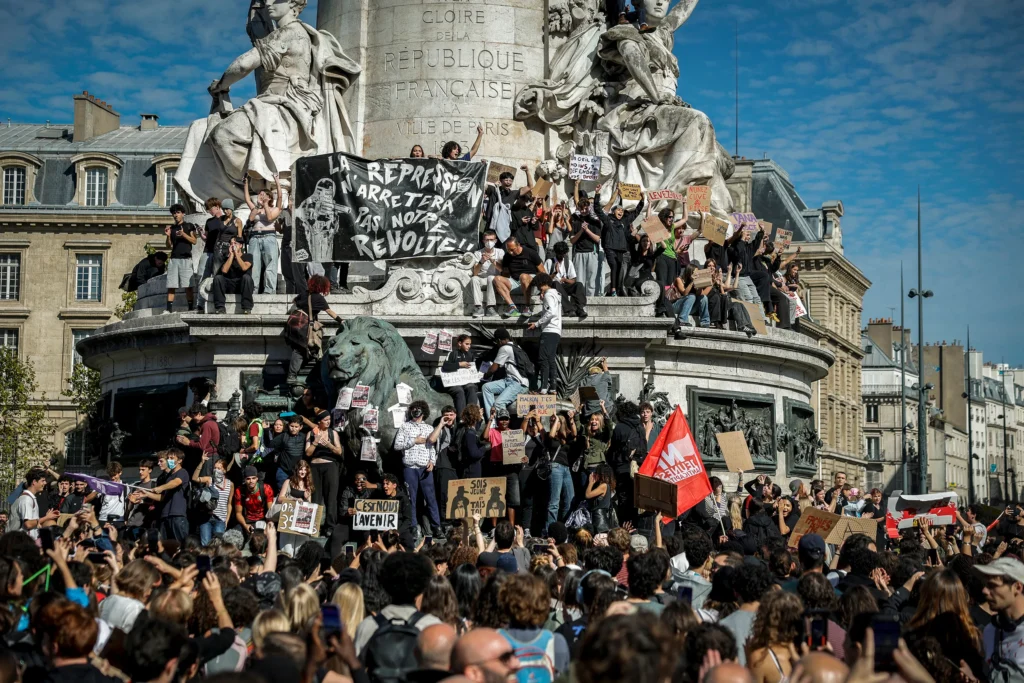
Reports of injuries during student demonstration clashes with French police drew renewed scrutiny of policing tactics. The debate is familiar. The injuries are not abstract.
🇫🇷 FRANCE · OCTOBER 10, 2026 · STUDENT PROTESTS
France has a particular relationship with the question of how its police handle demonstrations. The relationship is long, documented, and contested. It includes the gilets jaunes, in which the use of rubber bullets and LBD40 launchers left hundreds of protesters with serious injuries, including permanent vision loss. It includes a series of climate protest crackdowns that drew domestic and international criticism. It includes a pattern that French civil liberties organizations, investigative journalists, and human rights groups have documented in reports that successive governments have acknowledged, reviewed, and largely not resolved.
The injuries reported during Friday’s student demonstrations add a new data point to that pattern. Reuters confirmed reports of injuries during clashes between protesters and police, drawing scrutiny to the tactics deployed. The specific nature of the injuries, the weapons used, and the circumstances of the clashes were not fully detailed in available reporting at filing time. What was established: students were demonstrating, police were present, people were hurt, and France is having the conversation it has been having about policing at demonstrations for the better part of a decade.
WHY STUDENT PROTESTS ARE DIFFERENT
Student demonstrations carry a specific political charge in France that other forms of protest do not. The legacy of May 1968 — when student protests converged with labor strikes and nearly toppled de Gaulle’s government — has made French authorities acutely sensitive to the mobilization of young people, and has also made French police responses to student protests a perennial flashpoint. The sight of uniformed officers confronting students produces a specific kind of public reaction in a country where that image has deep historical resonance.
The substance of Friday’s demonstrations — what students were protesting and why — was not immediately detailed in available reporting. That absence is itself a kind of information: when the injuries from a demonstration receive more coverage than the demands of the demonstrators, the narrative has been captured by the confrontation rather than by the cause. Both matter. The injuries are not a reason to ignore what brought the students into the street.
“France is scrutinizing how its police treated student protesters. France has been scrutinizing this for years. The scrutiny has not yet produced a different outcome.”
WHAT HAPPENS NEXT
► Injury documentation — detailed reporting on the nature and extent of injuries
► Official inquiry — whether the French Interior Ministry opens a formal review
► Protest continuation — whether student demonstrations expand or subside
► Demand coverage — whether reporting on the students’ actual demands catches up to the injury coverage
| CONFIDENCE: MODERATE | Reuters confirmed injuries during French student protest police clashes and scrutiny of policing tactics. MODERATE: specific injury details and protest demands not fully established in available reporting. |
| BIAS CHECK | ASSESSMENT |
| Source weight | Reuters — single wire outlet; injury reports confirmed, but details limited |
| Historical framing | French policing pattern documented accurately from public record; not anti-police editorializing |
| Protest demands | Absence of demand coverage noted explicitly; not filled in with assumptions |
SOURCES
► Reuters — France student protest police injuries, scrutiny of tactics, October 10, 2026