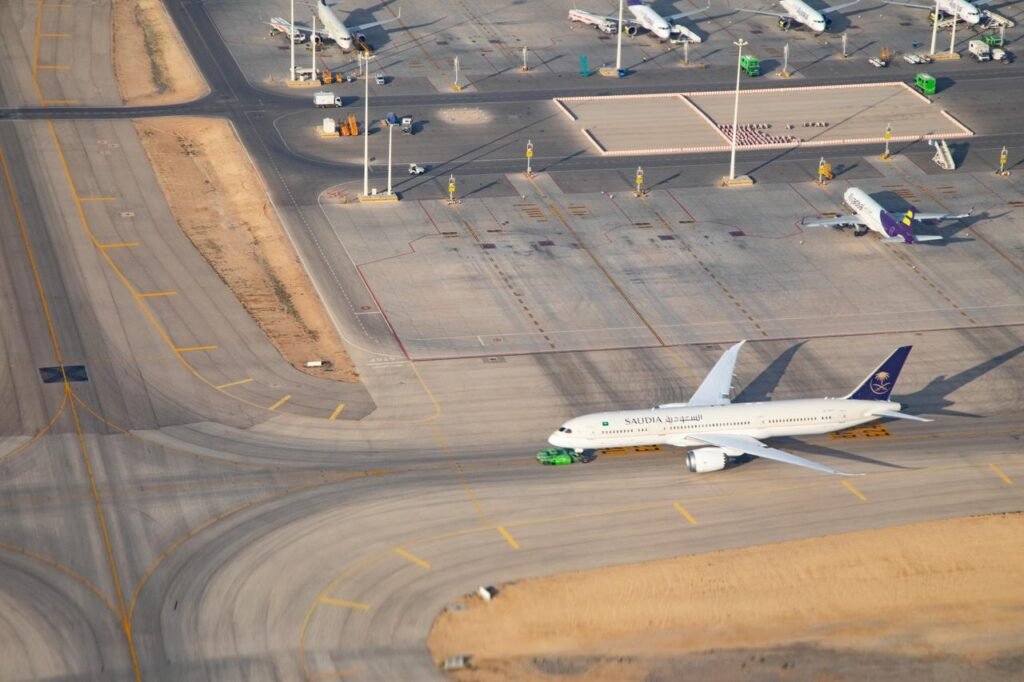
After killing twelve at King Khalid International, the Houthis issued a warning against using Saudi airports, while Saudi Arabia vowed a response. The exchanges that follow a mass-casualty airport strike are moving faster than the diplomatic channels built to slow them.
⚔️ RIYADH / SANAA · OCTOBER 11, 2026 · HOUTHI-SAUDI ESCALATION
Having killed twelve people at King Khalid International Airport in Riyadh on Saturday, the Houthi movement did something that is consistent with their communication pattern after significant strikes: they issued a warning. Saudi Arabia’s airports — not just King Khalid, but the airports of Saudi Arabia — were, the Houthis said, targets in an ongoing military campaign. The implication was direct: this was not a one-off; it was a policy, and Saudi civilians who use the airports of their own country are in that policy’s radius.
The Saudi-led coalition’s response was also direct. Retaliation was vowed. The specific form, timing, and scale of that retaliation had not been detailed in available reporting at filing time. What was established: the coalition has described itself as in a state of active military response to the Riyadh strike, and the threshold for what Saudi Arabia considers an appropriate answer to a mass-casualty strike on its capital’s primary international airport is a question that the coming days will answer.
THE AIRPORT WARNING’S SIGNIFICANCE
The Houthi warning against using Saudi airports represents an escalation in the strategic framing of the conflict beyond the immediate military exchange. Telling a civilian population to avoid their country’s airports is not simply a military threat. It is an attempt to impose a cost on ordinary Saudi civilian life that extends well beyond the strike itself — to create secondary economic disruption, psychological pressure, and a sense of vulnerability that the initial attack could not achieve alone. Airlines that operate Saudi routes are now processing a warning issued by a movement that has demonstrated, three times in one week, that it can reach Riyadh’s primary airport.
BBC, Al Jazeera, and CNN confirmed the Houthi warning and the Saudi retaliation pledge. Reports of related naval actions in the region — the broader context of Iran-linked maritime activity that has accompanied the missile campaign — suggest the military dimensions of the confrontation are not limited to the missile-airport exchange. The waters around the Arabian Peninsula have been an active operational theater throughout this conflict.
THE IRAN DIMENSION
Saudi Arabia’s attribution of the Riyadh attack to Iran-backed Houthis carries a specific diplomatic weight that the follow-up statements amplify. If the coalition characterizes the Houthi campaign as an Iranian proxy operation — which has been the consistent Saudi and American framing throughout the Yemen conflict — then a Saudi retaliation that goes beyond Houthi targets in Yemen and reaches toward Iranian interests is a scenario that the escalation logic of the current exchange makes more probable. Whether that logic is arrested by diplomatic intervention depends on conversations that were not in public view at filing time.
“The Houthis warned Saudi Arabia not to use its own airports. Saudi Arabia promised retaliation. Twelve people are dead. The next forty-eight hours will determine the shape of whatever comes after.”
WHAT HAPPENS NEXT
► Saudi retaliation — form, target, and scale of the coalition’s announced response
► Houthi follow-through — whether additional strikes materialize against Saudi airports or other infrastructure
► Naval activity — confirmation and characterization of Iran-linked maritime operations
► US posture — whether Washington seeks to constrain or enable the Saudi response
► Airline decisions — whether international carriers suspend or reroute Saudi Arabia flights
| CONFIDENCE: HIGH | BBC, Al Jazeera, CNN confirmed Houthi warning against Saudi airports, Saudi coalition retaliation pledge, ongoing exchanges, and reports of related naval activity in regional context. |
| BIAS CHECK | ASSESSMENT |
| Source weight | BBC, Al Jazeera, CNN — full international broadcast spectrum; Al Jazeera provides regional perspective |
| Houthi framing | Warning reported as Houthi communication; not editorially endorsed or condemned |
| Iran attribution | Coalition attribution to Iran reported accurately; not independently verified by ONYX as established causal fact |
SOURCES
► BBC News — Houthi warning Saudi airports, Saudi retaliation pledge, October 11, 2026
► Al Jazeera — Houthi-Saudi exchange, escalation context, October 11, 2026
► CNN — Saudi coalition vows response, naval activity reports, October 11, 2026