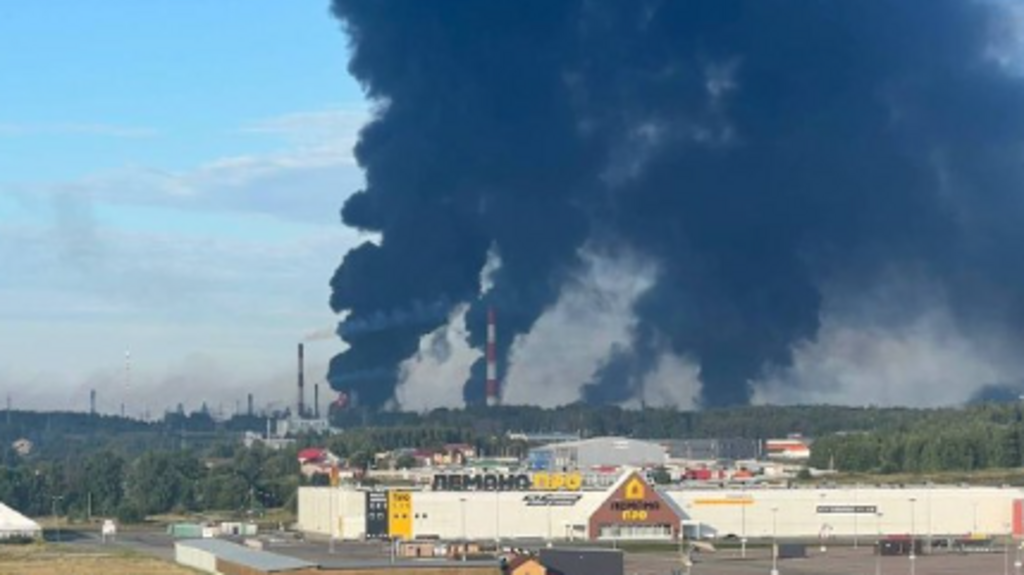
Ukraine struck a refinery in the Russian Ryazan region, ending a pause in attacks on Russian energy infrastructure that had been imposed at the Trump administration’s request. President Zelensky listed three reasons the pause is finished: Russia kept hitting Ukrainian energy sites throughout the pause, the US cut intelligence warnings before Russian ballistic missile strikes, and SpaceX restricted Starlink access. Reuters, the Financial Times, the NYT, NBC, and CNN confirmed the strike and the Zelensky statement.
🇺🇦 KYIV / RYAZAN · OCTOBER 15, 2026 · UKRAINE ENDS ENERGY CEASEFIRE PAUSE
Ukraine struck a refinery in the Ryazan region of Russia on Wednesday, ending a period of restraint on attacks against Russian energy infrastructure that had been maintained at the explicit request of the Trump administration. President Zelensky announced that Ukraine was done with the pause and enumerated the reasons: Russia had continued striking Ukrainian energy infrastructure throughout the period Ukraine held back; the United States had cut or withheld intelligence warnings before Russian ballistic missile strikes on Ukraine; and SpaceX had restricted Starlink access in ways that disrupted Ukrainian military operations. Reuters, the Financial Times, the NYT, NBC, and CNN confirmed the Ryazan refinery strike and the Zelensky statement.
The Trump administration had been asking Ukraine to stop striking Russian oil refineries and energy infrastructure as a condition of — or a confidence-building measure toward — a broader ceasefire framework. The administration’s argument was that Ukrainian refinery strikes were driving up global oil prices, feeding American inflation, and undermining the energy ceasefire narrative the White House was using diplomatically. Ukraine had complied for a period measured in days. The Ryazan strike signals that the compliance period is finished, and Zelensky’s framing makes clear that Ukraine is not simply resuming operations — it is publicly explaining why the bargain it made with Washington has been voided.
THE THREE CONDITIONS ZELENSKY CITED
Each of the three reasons Zelensky gave for ending the pause is a specific accusation against either Russia or the United States. The first — Russia kept hitting Ukrainian energy — is an accusation of bad faith against Moscow during a period when Ukraine was showing restraint. The second — the US cut intelligence warnings — is an accusation, or at minimum a documented grievance, against Washington: that the partner whose restraint request Ukraine was honoring simultaneously reduced the intelligence protection that kept Ukrainian civilians safer from the attacks Russia was continuing to conduct. The third — Starlink restrictions — is the same Washington-adjacent grievance: a US-affiliated actor reduced critical military infrastructure access while Ukraine was complying with a US request.
Together the three conditions construct a case. Zelensky is not simply saying the ceasefire failed. He is saying it failed because the conditions Ukraine accepted it under were not reciprocated — not by Moscow and not fully by Washington. That is a pointed diplomatic message, and it is designed to be read by the Trump administration as clearly as it is read by any other audience.
THE RYAZAN REFINERY
The Ryazan refinery is one of several major Russian petroleum processing facilities that Ukraine has targeted in its campaign against Russian energy infrastructure. Refinery strikes impose costs on the Russian war economy by reducing fuel availability for military operations and by forcing the government to spend on repairs and alternative supply. They also — and this is the element the Trump administration focused on — affect global oil markets by reducing Russian export capacity and putting upward pressure on crude prices. Ukraine’s argument is that those economic pressures on Russia are asymmetric warfare tools that substitute for military capabilities Ukraine lacks. The administration’s argument is that the tool has costs that fall on American consumers and on the diplomatic framework the White House is building.
The resumption of refinery strikes will be characterized by the Trump administration as a Ukrainian decision that complicates diplomacy and drives up American energy prices. It will be characterized by Ukraine as a defensive response to Russian bad faith and American unreliability. Both characterizations will be argued in public. The Ryazan strike is the opening move of the next phase of that argument.
WHAT THIS DOES TO THE CEASEFIRE FRAMEWORK
The Trump administration ceasefire framework — the energy ceasefire claim, the intelligence-sharing architecture, the Starlink access — was already under significant reporting pressure from CBS, NYT, and CNN on the intelligence gap story. The Zelensky statement and the Ryazan strike transform that reporting pressure into a diplomatic rupture. Ukraine is no longer quietly complying while grievances accumulate. It is publicly cataloguing the failures of the bargain and acting on them. The administration will need to decide whether to retaliate by further reducing support, attempt to renegotiate the terms, or accept that this phase of the ceasefire pressure campaign has ended without achieving its objective.
“Ukraine hit a Russian refinery. Zelensky said the pause is over. He gave three reasons: Russia kept bombing Ukrainian power, the US stopped sharing intelligence warnings, and Starlink was cut. He is not just resuming operations. He is explaining why the deal is void.”
WHAT HAPPENS NEXT
► Administration response — whether the Trump White House publicly addresses the Zelensky statement and the Ryazan strike
► Intelligence review — whether Congress pursues the intelligence-withholding question following the Zelensky confirmation
► Starlink restoration — whether SpaceX restores full access following the public accusation
► Additional strikes — whether Ukraine conducts further refinery strikes now the pause is declared over
► Russian retaliation — whether Moscow escalates its Ukrainian energy attacks in response
| CONFIDENCE: HIGH | Reuters, Financial Times, NYT, NBC, CNN confirmed Ukraine struck Ryazan refinery, and Zelensky declared the energy ceasefire pause over, citing Russian attacks, US intelligence gaps, and Starlink restrictions. |
| BIAS CHECK | ASSESSMENT |
| Source weight | Reuters, FT, NYT, NBC, CNN — five-outlet tier-one confirmation across wire, print, and broadcast |
| Zelensky framing | Three-reason framework quoted as his public statement; characterization as accusation is analytical, attributed clearly |
| Administration framing | Policy described as administration position; costs and benefits characterized as their own argument and Zelensky argument respectively |
| Refinery economics | Oil price and inflation effects described as documented mechanism; not used editorially against either side |
SOURCES
► Reuters — Ukraine strikes Ryazan refinery, Zelensky declares energy pause over, October 15, 2026
► Financial Times — Ukraine ends refinery strike pause, Zelensky statement, October 15, 2026
► NYT — Ukraine resumes Russian oil refinery strikes, October 15, 2026
► NBC — Zelensky: we are done, Ukraine hits Ryazan, October 15, 2026
► CNN — Ukraine refinery strike Russia, Zelensky cites intelligence Starlink, October 15, 2026