Police in Tirana used rubber bullets and made hundreds of arrests on Saturday as Albania entered a fifth consecutive day of anti-government demonstrations. The protests show no sign of collapsing, and the government shows no sign of concession. That combination, sustained over five days, is a political crisis.
BREAKING · ALBANIA · PROTESTS · TIRANA · EU
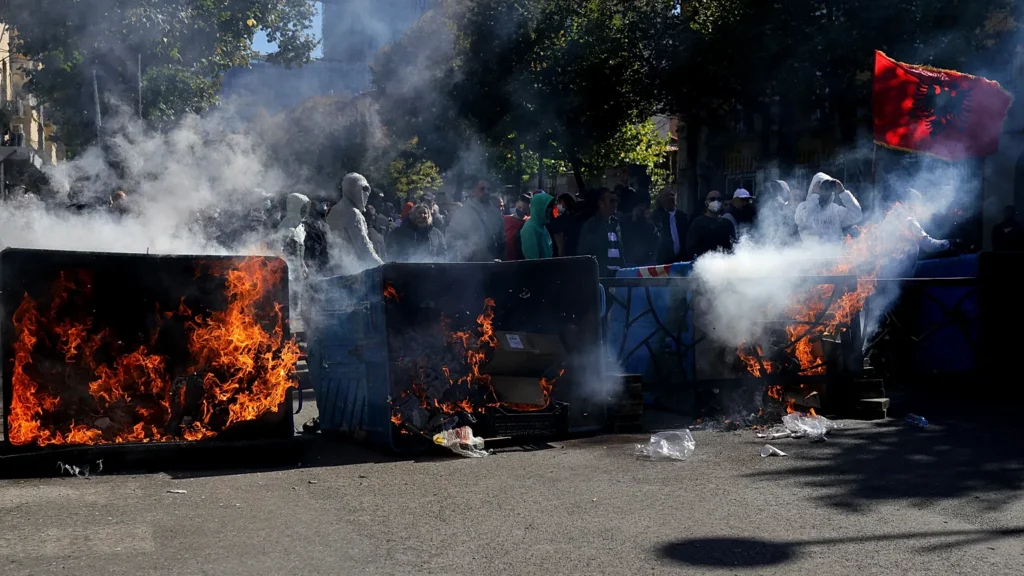
TIRANA — Albanian police used rubber bullets and made hundreds of arrests on Saturday as anti-government protests in Tirana entered their fifth consecutive day, according to Dawn and Euronews. The demonstrations, which began earlier in the week in response to grievances over governance, corruption, and economic conditions, have sustained themselves through a combination of organized opposition movement leadership and spontaneous participation from young Albanians who see the protests as a broader demand for political change.
The government of Prime Minister Edi Rama has not offered any concessions and has characterized the protests as politically motivated attempts to destabilize a democratically elected government. Opposition leaders have rejected that framing and called for early elections. The European Union, with which Albania is in accession negotiations, has issued statements calling for restraint on all sides and for dialogue.
Five Days: What Has Changed
The duration of the protests is itself significant. Most protest movements in smaller European states peak within two or three days and then either achieve their objective, dissipate, or are suppressed. Five days of sustained demonstrations with hundreds of arrests and continued crowd sizes suggests that the movement has achieved a degree of organizational resilience that the government did not anticipate. The ongoing participation despite arrests and rubber bullet use indicates that the deterrent effect of police action has been limited.
The economic and governance grievances underlying the protests are not new. Albania has struggled with corruption, judicial integrity, and organized crime influence in public institutions throughout its post-communist period. EU accession has provided both a framework and an incentive for reform, but the pace of change has frustrated significant portions of the population, particularly younger Albanians who compare conditions with neighboring countries further along the accession path.
“We are not going home. Five days, ten days — it does not matter. We will be here until something changes.” — Protester in Tirana, speaking to Euronews
The EU Dimension
Albania’s EU accession status means the protests are watched in Brussels with particular attention. The EU has leverage — accession progress is conditioned on governance standards — and the combination of protests, police use of rubber bullets, and mass arrests creates exactly the kind of political violence and governance failure that can stall or condition accession milestones. Several EU member state governments have issued their own statements urging restraint.
WHAT HAPPENS NEXT
► Day six protests expected Sunday — opposition calling for largest turnout yet.
► EU formal statement on Albanian police use of force under preparation in Brussels.
► Prime Minister Rama under increasing pressure from EU partners to open dialogue.
► Arrest total mounting — opposition lawyers filing habeas corpus challenges.
► Albania accession progress review scheduled for November — protests may factor into assessment.
| CONFIDENCE: HIGH | Fifth day of protests, rubber bullet use, and mass arrests confirmed by Dawn and Euronews. Government and opposition positions from confirmed official statements. EU statement from confirmed EU communications. Albania accession status from European Commission documentation. |
| Bias Check | ||
| Left-Lean | Center | Right-Lean |
| Frames as pro-democracy uprising against authoritarian government; demands EU intervention. | Reports the protests, the police response, and the political context as confirmed. | Some right-leaning coverage questions protest organizers and political motivation. |
| Assessment | ONYX presents confirmed facts and the EU accession context. Government characterization of protests and opposition framing are both reported as stated. | |
SOURCES
► Dawn — Albania protest coverage and police response
► Euronews — Tirana demonstrations, arrests, and EU statement