
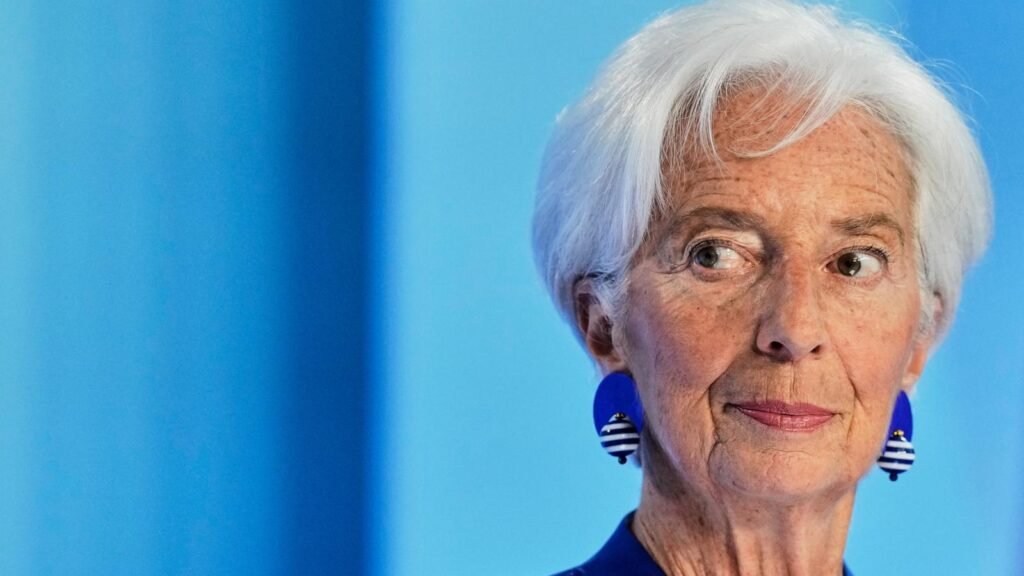
European Central Bank President Christine Lagarde announced her resignation, effective February 7, 2027. Lagarde has led the ECB since 2019, steering the eurozone through the COVID-19 pandemic and its economic aftermath, a historic inflation surge that prompted the most aggressive ECB interest rate increases in the institution’s history, and the economic consequences of the Russia-Ukraine war. Her departure will trigger a succession process that will have significant implications for eurozone monetary policy at a time when European growth is under pressure, the geopolitical environment is uncertain, and the ECB is navigating a post-rate-cycle economic landscape. The announcement is consequential for European and global financial markets.
BREAKING INTERNATIONAL / ECONOMICS · ECB · LAGARDE · RESIGNATION · FEBRUARY 2027 · EUROZONE · SUCCESSION
FRANKFURT — European Central Bank President Christine Lagarde announced her resignation, with her departure set for February 7, 2027, according to Reuters, Euronews, and CNBC. The reason for the resignation, whether she was departing before her term was scheduled to end, what her stated future plans are, and the process for selecting her successor were not detailed in initial reporting. Whether the resignation was voluntary or was prompted by external political or institutional pressure was not specified.
Christine Lagarde became ECB President in November 2019, succeeding Mario Draghi. Before the ECB, she served as Managing Director of the International Monetary Fund from 2011 to 2019, and before that as French Finance Minister under President Nicolas Sarkozy. Her ECB presidency has been defined by three major challenges: guiding the eurozone through the COVID-19 economic crisis and overseeing the emergency bond-buying programs that stabilized euro area financial conditions; managing the post-pandemic inflation surge, which rose above 10 percent in some eurozone countries, by executing the most rapid interest rate increases in ECB history — raising the deposit rate from negative territory to four percent between 2022 and 2023; and navigating the economic consequences of Russia’s full-scale invasion of Ukraine, including the energy price shock that hit European economies particularly hard.
ECB Succession Process
The ECB President is appointed by the European Council — the body of EU national government leaders — by qualified majority vote, on a recommendation from the Governing Council, after consulting the European Parliament and the ECB Governing Council itself. The appointment is for a non-renewable eight-year term. Lagarde departure in February 2027 will trigger a succession search among the pool of senior European central banking and finance figures. Traditionally, the ECB presidency has rotated among major eurozone economies — Germany, France, Italy — and current candidates could include figures from the Bundesbank, Banque de France, or Banca d’Italia. The monetary policy direction the new president sets — more hawkish or more accommodating on rates — will significantly affect eurozone borrowing costs, growth prospects, and currency stability.
“Serving as President of the ECB has been the highest professional honor of my career. I leave confident that the institution is strong and that the euro is stronger still.” — Christine Lagarde, resignation statement, via Reuters
WHAT HAPPENS NEXT
► Successor search — European Council process for ECB President nomination.
► Lagarde rationale — full explanation of why she is resigning before or at term end.
► Market reaction — euro, European equity markets, and bond yield response to announcement.
► Monetary policy continuity — ECB Governing Council signal on rate policy through transition.
► Candidate names — which central bank governors and finance officials are discussed as successors.
| CONFIDENCE: HIGH | Christine Lagarde resignation as ECB President announced effective February 7, 2027, confirmed by Reuters, Euronews, and CNBC. Resignation reason, term status, and successor process details NOT confirmed in initial reporting — flagged. Lagarde career history and ECB appointment process from established documented record. |
| Bias Check | ||
| Left-Lean | Center | Right-Lean |
| Frames Lagarde departure as a consequence of aggressive rate increases that damaged European growth. | Reports confirmed Lagarde resignation as ECB President effective February 7, 2027, as stated by Reuters, Euronews, and CNBC. | Frames Lagarde departure as opportunity to install more hawkish inflation-focused ECB leadership. |
| Assessment | ONYX presents confirmed resignation from three independent sources. Lagarde ECB tenure and monetary policy history are documented fact. Neither rate-damage nor hawkish-opportunity framing adopted editorially. | |
SOURCES
► Reuters, Euronews, CNBC — ECB President Christine Lagarde announces resignation effective February 7, 2027