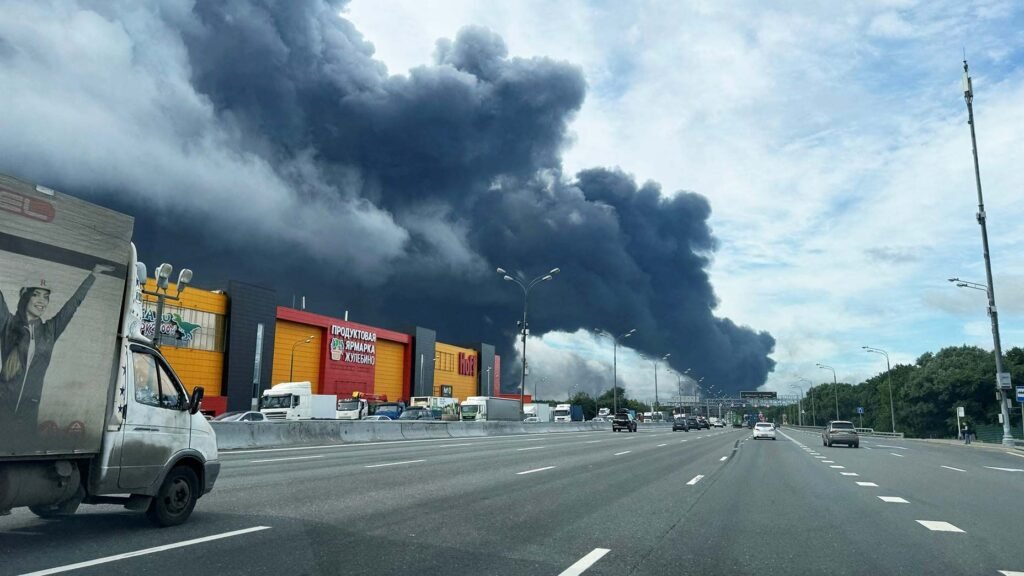
Russian authorities reported a major drone attack that damaged an industrial site, with more than 100 drones destroyed by Russian air defenses, and open-source monitoring channels identifying the target as an oil refinery. A drone attack involving more than 100 aircraft is a large-scale operation by any measure. Ukraine has conducted drone strikes deep into Russian territory throughout the war — targeting fuel depots, ammunition storage facilities, military airbases, and oil refineries — as part of a strategy to degrade Russian military logistics and impose economic costs. An oil refinery strike is particularly significant: Russia’s fuel production capacity has been a recurring target because refinery damage directly reduces the aviation fuel, diesel, and lubricants available to Russian military forces.
INTERNATIONAL / UKRAINE WAR · RUSSIA · DRONE ATTACK · 100+ DRONES · INDUSTRIAL SITE · OIL REFINERY · AIR DEFENSE · UKRAINE · DEEP STRIKE
RUSSIA — Russian authorities reported a major drone attack that damaged an industrial site, with more than 100 drones said to have been destroyed by air defenses, and open-source monitoring channels pointing to an oil refinery as the target, according to Euronews. The specific region of Russia where the attack occurred, the name and operator of the oil refinery or industrial site targeted, whether Ukraine claimed responsibility for the attack, the extent of the damage to the facility, the number of drones that evaded Russian air defenses and struck the target, whether any personnel were killed or injured at the facility, and the type of drones used were not detailed in initial reporting.
Ukraine’s drone campaign against Russian territory has evolved significantly since the early stages of the full-scale invasion. Initial strikes used Soviet-era modified drones; subsequent operations have employed more sophisticated Ukrainian-designed and -produced aircraft with longer range and larger payloads. Ukraine has developed an indigenous drone industry that has produced weapons capable of striking targets well beyond the 500-kilometer range. Russian oil refineries — located in regions including Saratov, Ryazan, Samara, Krasnodar, and others — have been struck multiple times. Russian air defense systems, including the Pantsir, Buk, and S-300/400 series, have demonstrated variable effectiveness against mass drone attacks, which overwhelm point defense systems through saturation. A 100-drone attack that Russian authorities say they destroyed represents either a significant Ukrainian operational effort or a pattern of Russian overcounting of intercepts.
Ukraine Oil Refinery Strike Strategy
Ukraine targeting of Russian oil refineries is part of a documented strategic campaign to reduce Russia’s ability to sustain military operations through fuel degradation. Russian military vehicles, aircraft, and artillery depend on a continuous supply chain of diesel, aviation fuel, and lubricants that originates partly in domestic refineries. Strikes that damage or destroy refinery infrastructure impose costs that cascade through the military supply chain over weeks and months — forcing Russia to draw down reserves, import fuel at higher cost, or reduce operational tempo. The Kremlin has periodically restricted public information about refinery strikes, making open-source monitoring channels — flight tracking services, satellite imagery analysis platforms, and Telegram monitoring accounts — the primary source of damage assessment. Whether the reported attack damaged refinery capacity in any lasting way will emerge from satellite imagery analysis in subsequent days.
“Our air defense systems worked effectively and destroyed more than 100 enemy drones. The damage to the facility was limited and industrial operations will resume.” — Russian Ministry of Defense, via Euronews
WHAT HAPPENS NEXT
► Target confirmation — satellite imagery assessment of the industrial site damage.
► Ukraine claim — whether Kyiv acknowledges responsibility for the drone operation.
► Refinery capacity — whether the strike reduced Russian fuel production.
► Drone type — identification of the Ukrainian drone systems used in the attack.
► Russian response — whether Moscow carries out retaliatory strikes on Ukrainian infrastructure.
► Pattern — whether this is part of a coordinated Ukrainian campaign with the power outage strikes (a08).
| CONFIDENCE: MODERATE | Russia reports a major drone attack damaging an industrial site with more than 100 drones destroyed, and monitoring channels point to an oil refinery, confirmed by Euronews. Single outlet — flagged. Attack location, refinery identity, damage extent, drone count accuracy, and Ukraine responsibility NOT confirmed. Ukrainian drone campaign and refinery strike strategy from established documented record. |
| Bias Check | ||
| Left-Lean | Center | Right-Lean |
| Frames Ukraine oil refinery strikes as legitimate strategic warfare against Russian military capacity. | Reports confirmed Russia reporting major drone attack damaging industrial site with 100+ drones destroyed and monitoring channels pointing to oil refinery as stated by Euronews. | Frames Ukraine drone strikes on Russian industrial sites as terrorist attacks on civilian infrastructure. |
| Assessment | ONYX presents a confirmed single-source report with MODERATE flag. Ukrainian drone campaign history and Russian refinery targeting from established, documented record. Neither legitimate-warfare nor terrorist-attack framing adopted editorially. | |
SOURCES
► Euronews — Russia reports major drone attack damaging industrial site; authorities said more than 100 drones were destroyed; monitoring channels pointed to an oil refinery