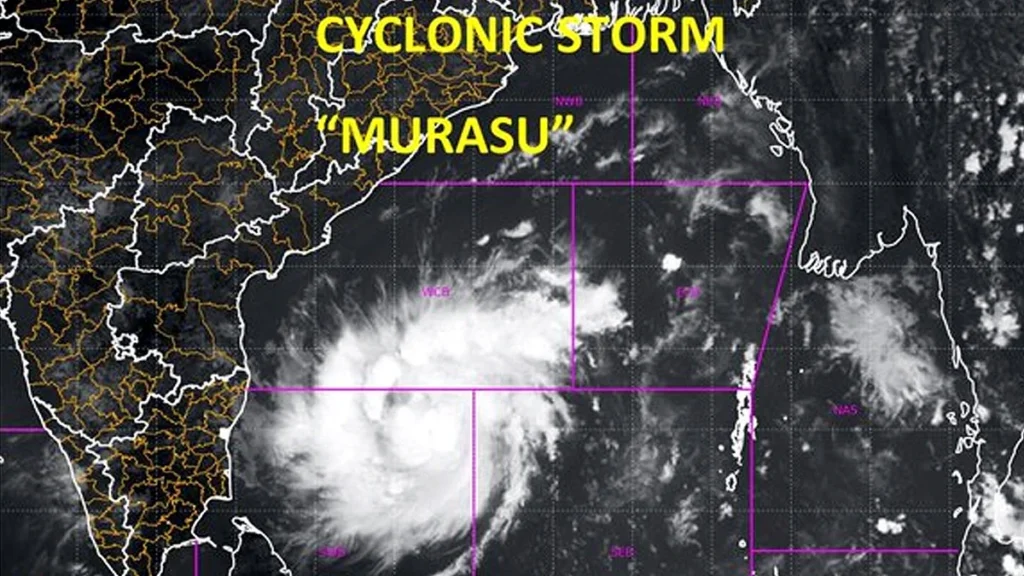
Cyclone Murasu approached the Andhra Pradesh coast in India with sustained winds of 100-110 kilometers per hour, prompting weather alerts across Andhra Pradesh, Tamil Nadu, and Odisha and school closures in affected areas. A cyclone making landfall on the Andhra coast is a recurring weather event in the Bay of Bengal cyclone season, which runs from April through December with peak activity in October and November — precisely the current season. The Andhra coast and the adjoining Bay of Bengal coastlines of Tamil Nadu and Odisha are densely populated and economically productive; a major cyclone landfall in this region can cause widespread casualties, agricultural damage, and infrastructure destruction. Indian meteorological and disaster management systems have improved significantly in recent decades, reducing cyclone fatality rates even as the storms themselves remain powerful.
INTERNATIONAL / SOUTH ASIA / NATURAL DISASTER · CYCLONE MURASU · ANDHRA PRADESH · TAMIL NADU · ODISHA · BAY OF BENGAL · 100-110 KM/H · SCHOOLS CLOSED · ALERTS
ANDHRA PRADESH / BAY OF BENGAL — Cyclone Murasu approached the Andhra Pradesh coast with sustained winds of 100-110 kilometers per hour, triggering weather alerts across Andhra Pradesh, Tamil Nadu, and Odisha, with schools closed in some affected areas, according to local Indian reporting. The expected landfall time and location, the number of people evacuated, which specific districts in Andhra Pradesh, Tamil Nadu, and Odisha are under the highest-level alert, whether the cyclone is expected to intensify before landfall, the India Meteorological Department official cyclone category classification, whether the Indian Navy or Coast Guard has been deployed, and casualty figures, if any, were not detailed in initial reporting.
The Bay of Bengal is one of the most cyclone-prone bodies of water in the world. Cyclones originating in the Bay of Bengal historically account for a disproportionate share of global tropical cyclone fatalities due to the low-lying, densely populated coastlines of India and Bangladesh and the storm surge potential in the funnel-shaped northern Bay. Andhra Pradesh has experienced devastating cyclones including the 1977 Andhra cyclone — which killed approximately 10,000 people — and successive storms in the 1990s and 2000s. The Indian National Disaster Response Force has become one of the most effective disaster response organizations in the region; cyclone early warning systems now provide 72-hour advance notice with high accuracy, enabling mass evacuations that have dramatically reduced mortality rates.
India Meteorological and Disaster Response Capacity
India Meteorological Department issues cyclone watches, alerts, and warnings on a graduated scale during the Bay of Bengal Cyclone season. Sustained winds of 100-110 km/h classify a cyclone as a severe cyclonic storm on the Indian scale — below the Very Severe, Extremely Severe, and Super Cyclonic Storm categories. While Cyclone Murasu at this intensity would not be in the most destructive category, its landfall path across densely populated Andhra coast zones still presents significant risk from storm surge, heavy rainfall, and infrastructure damage. The involvement of three states — Andhra Pradesh, Tamil Nadu, and Odisha — in alert issuance and school closures indicates a storm system with a wide area of impact extending well beyond the direct landfall zone.
“All coastal districts are on high alert. We have pre-positioned NDRF teams and opened relief centers. Residents in low-lying areas must evacuate immediately.” — Andhra Pradesh Chief Minister, via local Indian reporting
WHAT HAPPENS NEXT
► Landfall — time and precise location of Cyclone Murasu landfall on the Andhra coast.
► Intensification — whether Murasu strengthens before landfall.
► Casualties — initial casualty and displacement figures after landfall.
► Evacuations — how many people were moved from coastal areas.
► Agricultural damage — impact on the Andhra Pradesh and Tamil Nadu rice harvest.
► Infrastructure — port and power grid damage along the affected coastline.
| CONFIDENCE: MODERATE | Cyclone Murasu is approaching the Andhra coast with 100-110 km/h winds, and alerts have been issued for Andhra Pradesh, Tamil Nadu, and Odisha, with school closures confirmed by local Indian reporting. Regional outlet sourcing — flagged. Landfall time and location, cyclone intensity classification, evacuation numbers, and casualty figures NOT confirmed. Bay of Bengal cyclone history and India disaster response capacity from established documented record. |
| Bias Check | ||
| Left-Lean | Center | Right-Lean |
| No significant left-lean framing dimension in this natural disaster story. | Reports confirmed Cyclone Murasu approaching Andhra coast with 100-110 km/h winds and alerts for three states as stated by local Indian reporting. | No significant right-lean framing dimension in this natural disaster story. |
| Assessment | ONYX presents a confirmed regional-source report with a MODERATE flag. Bay of Bengal cyclone history and India’s meteorological and disaster response capacity from established documented record. | |
SOURCES
► Local Indian reporting — Cyclone Murasu approaches Andhra coast with 100-110 km/h winds; alerts issued for Andhra Pradesh, Tamil Nadu, and Odisha; schools closed in some areas