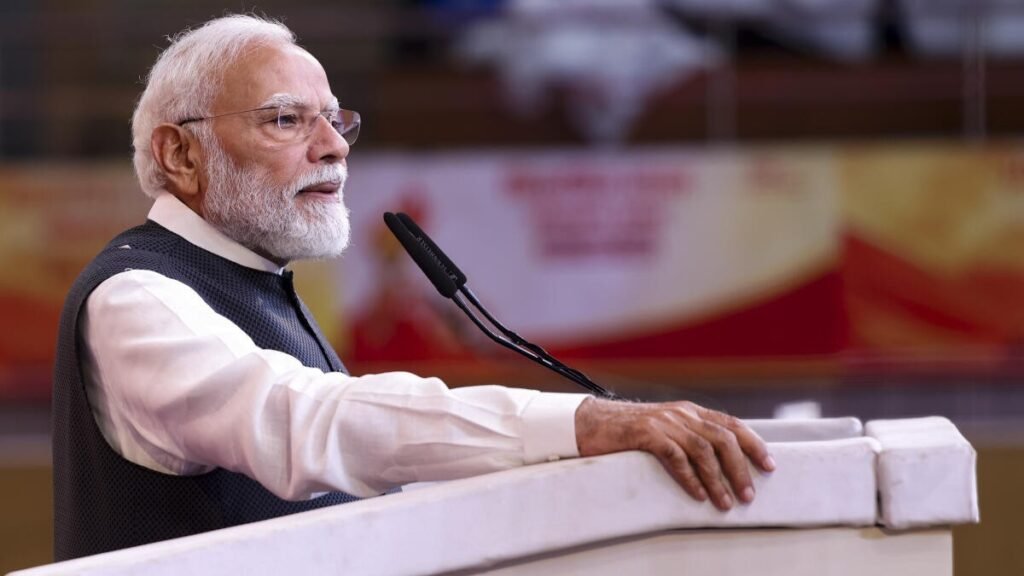
Indian Prime Minister Narendra Modi highlighted India’s renewable energy progress at an international summit, stating that the country ranks among the top three globally in solar and renewables despite significant global challenges. India’s claim to a top-three global ranking in renewables is substantively credible. India is one of the largest solar energy markets in the world, with installed capacity that ranks among the global leaders after China and, in some categories, the United States. India International Solar Alliance — co-founded by Modi and former French President Hollande — has positioned India as a diplomatic leader in global solar expansion. Modi presentation at a summit on election eve in India’s regional context reflects the dual role of renewable energy in Indian politics: both a genuine national infrastructure priority and a tool of international diplomacy.
INTERNATIONAL / SOUTH ASIA / ENERGY · INDIA · PM MODI · RENEWABLES · SOLAR · TOP THREE GLOBAL · SUMMIT · CLIMATE · ENERGY TRANSITION
NEW DELHI — Indian Prime Minister Narendra Modi highlighted India’s renewable energy progress at a summit, stating the country ranks among the top three globally in solar and renewables despite global challenges, according to News9live and PTI. The specific summit where Modi made the remarks, the complete data Modi cited for the top-three ranking, which renewables categories India leads in and which it trails, specific installed capacity and growth rate figures, the full context of the remarks including what global challenges Modi referenced, and whether any specific policy announcements accompanied the statement were not detailed in initial reporting.
India’s renewable energy capacity has grown dramatically under the Modi government. The National Solar Mission, launched under the previous government and expanded by Modi, set a target of 100 GW of solar capacity by 2022 — a target India approached but did not fully meet on schedule. India expanded its ambition to 500 GW of non-fossil fuel capacity by 2030. As of 2024-2025, India’s total installed renewable energy capacity — including solar, wind, hydropower, and biomass — was among the highest in the world by total installed gigawatts, though on a per-capita basis India remains far below developed-economy peers. The solar sector specifically has seen rapid growth driven by declining panel costs, government incentives, and large utility-scale project development in Rajasthan, Gujarat, and other high-irradiance states.
India Global Renewable Leadership and Climate Diplomacy
India’s role in global climate diplomacy has evolved from a developing-country stance that prioritized development rights over emissions cuts to a position that embraces both development and clean energy transition — framed as compatible rather than contradictory. Modi led the International Solar Alliance and the India National Action Plan on Climate Change. India’s formal climate commitment under the Paris Agreement pledges 500 GW of non-fossil capacity by 2030 and a 45% reduction in emissions intensity relative to GDP. Whether India achieves these targets will be a central question at future COP meetings. The top-three renewable ranking cited by Modi, while broadly credible, competes with more granular measures — percentage of total electricity from renewables, annual renewable capacity additions, grid integration success — on which India’s performance is more mixed.
“India stands proud as one of the top three nations in solar and renewable energy. We made this progress not despite our challenges but because of our determination to meet them.” — PM Narendra Modi at summit, via News9live / PTI
WHAT HAPPENS NEXT
► Summit — identification of the specific summit and full text of Modi remarks.
► Capacity data — latest installed renewable capacity figures for India and global ranking verification.
► Policy — whether any new government targets or incentives were announced alongside the statement.
► COP context — whether the statement was timed for any international climate meeting.
► Grid progress — whether India’s renewable capacity additions are keeping pace with demand growth.
► 2030 targets — India’s trajectory toward its 500 GW non-fossil capacity commitment.
| CONFIDENCE: MODERATE | PM Modi highlighting India’s renewable energy progress and top-three global ranking at a summit confirmed by News9live and PTI. Regional and national Indian wire sourcing. Summit identity, full data cited, category-specific rankings, and policy announcements NOT confirmed. India renewable capacity, International Solar Alliance, and climate diplomacy from established documented record. |
| Bias Check | ||
| Left-Lean | Center | Right-Lean |
| Frames Modi renewables claim as exaggerated BJP election-eve spin on real but incomplete progress. | Reports confirmed PM Modi saying India ranks among the top three globally in solar and renewables at a summit, as stated by News9live and PTI. | Frames Modi renewables achievement as vindication of India development-first approach to climate transition. |
| Assessment | ONYX presents confirmed two-source regional report with MODERATE flag. India renewable capacity history and climate diplomacy from established documented record. Neither exaggerated-spin nor vindication framing adopted editorially. | |
SOURCES
► News9live, PTI — PM Modi highlights India’s renewable energy progress at summit; he said the country ranks among the top three in solar and renewables despite global challenges