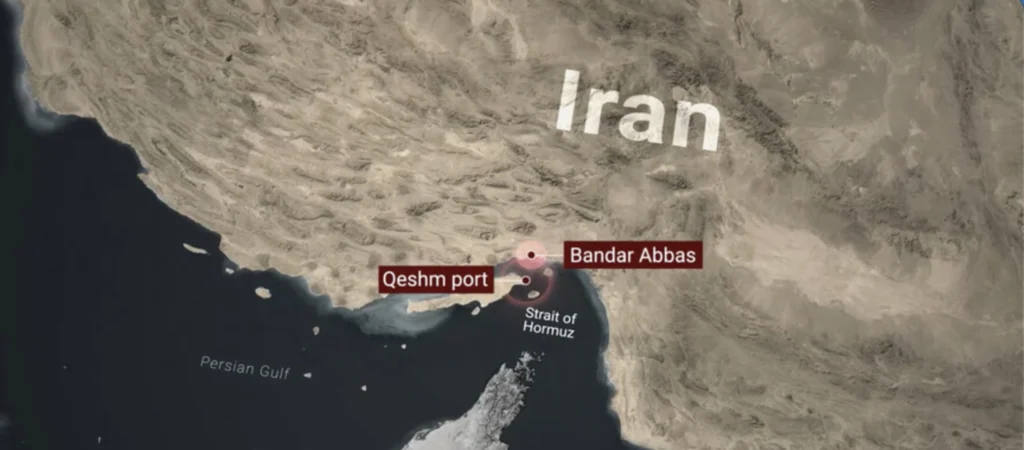
The United States carried out military strikes on Iran’s Qeshm Island, with officials describing the attacks as part of a series of secret recent operations conducted amid ongoing negotiations at Hormuz and continued tensions. Qeshm Island is the largest island in Iran, located in the Strait of Hormuz — the critical chokepoint through which roughly 20 percent of the world’s oil supply passes. US strikes on Qeshm Island would represent a significant escalation from earlier documented operations: the US-Iran Qatar talks (November 2) and the Iran Supreme Leader authorization for negotiations (November 2) were occurring alongside these military operations, a pattern of simultaneous diplomacy and military pressure that carries significant escalation risk.
BREAKING INTERNATIONAL / MIDDLE EAST / US-IRAN WAR · US STRIKES · IRAN · QESHM ISLAND · HORMUZ · SECRET OPERATIONS · ESCALATION · ARC
QESHM ISLAND / WASHINGTON — The United States carried out strikes on Iran’s Qeshm Island, with officials describing the attacks as part of secret recent operations amid ongoing Hormuz talks and tensions, according to The Wall Street Journal, Euronews, and Just Security. The specific targets struck on Qeshm Island, the weapons systems used, the number of strikes, whether any Iranian casualties resulted, the Iranian government response, whether the strikes were disclosed to Congress, what the “secret recent operations” were that the Qeshm strikes are described as part of, and whether the Qatar negotiation track was suspended or continued after the strikes were not detailed in initial reporting.
Qeshm Island sits at the entrance to the Strait of Hormuz and hosts significant Iranian military, energy, and civilian infrastructure. The island has a civilian population and serves as a major transit and logistics hub. Iranian military installations on Qeshm include facilities associated with the Islamic Revolutionary Guard Corps Navy, which has a dominant role in controlling Hormuz. US strikes on Qeshm — even limited ones — would signal a willingness to strike targets within the strategic perimeter of the Strait itself, not merely on Iranian mainland or peripheral targets. The simultaneous existence of a Qatar negotiation track (documented November 2 a05, with a draft framework reportedly in progress) and US military strikes on Iranian soil represents a dual-track approach that carries inherent instability: a strike that kills Iranian personnel or civilians could collapse the negotiation track or trigger Iranian retaliation at Hormuz.
Arc Connection — Iran Negotiations and Military Pressure
The Iran arc in ONYX coverage has developed across three November editions. November 2: Iran Supreme Leader authorized negotiations with the United States — a significant diplomatic opening. November 2: US-Iran talks in Qatar produced a draft framework — the most detailed diplomatic progress in years. November 3: US strikes on Qeshm Island — military pressure continuing alongside the diplomatic track. This pattern — negotiating while striking, or striking while negotiating — is a defined American strategic approach used with North Korea, Afghanistan, and other adversaries. Its risks are asymmetric: a successful strike raises American leverage, but each strike also risks triggering a response that destroys the negotiating channel. The Hormuz talks and the Qeshm strikes are happening simultaneously, and each affects the other.
“These operations were conducted in coordination with our allies and as part of our broader strategy to prevent Iran from threatening the free flow of commerce through the Strait of Hormuz.” — Senior US official, via Wall Street Journal / Just Security
WHAT HAPPENS NEXT
► Iranian response — whether Iran retaliates militarily or at the negotiating table.
► Qatar talks — whether the Qeshm strikes cause the Qatar negotiation track to collapse or accelerate.
► Targets — what was struck on Qeshm and whether it included IRGC or civilian infrastructure.
► Congressional disclosure — whether the strikes were reported to Congress under the War Powers Act.
► Hormuz — whether Iran threatens or acts to restrict Hormuz transit following the strikes.
► Escalation ladder — whether the strikes represent a ceiling or a floor for US military pressure on Iran.
| CONFIDENCE: HIGH | US carrying out strikes on Iran’s Qeshm Island described by officials as part of secret recent operations amid Hormuz talks confirmed by Wall Street Journal, Euronews, and Just Security. Three-outlet confirmation, including a leading national security journalism outlet. Specific targets, weapons, casualties, Iranian response, and Congressional disclosure NOT confirmed. Iran arc context from Nov 2 and from established documented record. |
| Bias Check | ||
| Left-Lean | Center | Right-Lean |
| Frames US strikes on Iranian territory as illegal escalation undermining diplomatic progress and risking catastrophic war. | Reports confirmed US carrying out strikes on Iran’s Qeshm Island, described as part of secret operations amid Hormuz talks, as stated by WSJ, Euronews, and Just Security. | Frames US strikes as necessary pressure that strengthens the American negotiating position and demonstrates credible military deterrence. |
| Assessment | ONYX presents a confirmed three-source report. Arc connection to Nov 2 Iran negotiations authorization and Qatar talks documented. Neither illegal-escalation nor necessary-pressure framing adopted editorially. | |
SOURCES
► Wall Street Journal, Euronews, Just Security — US carries out strikes on Iran’s Qeshm Island; officials described the attacks as part of secret recent operations amid ongoing Hormuz talks and tensions