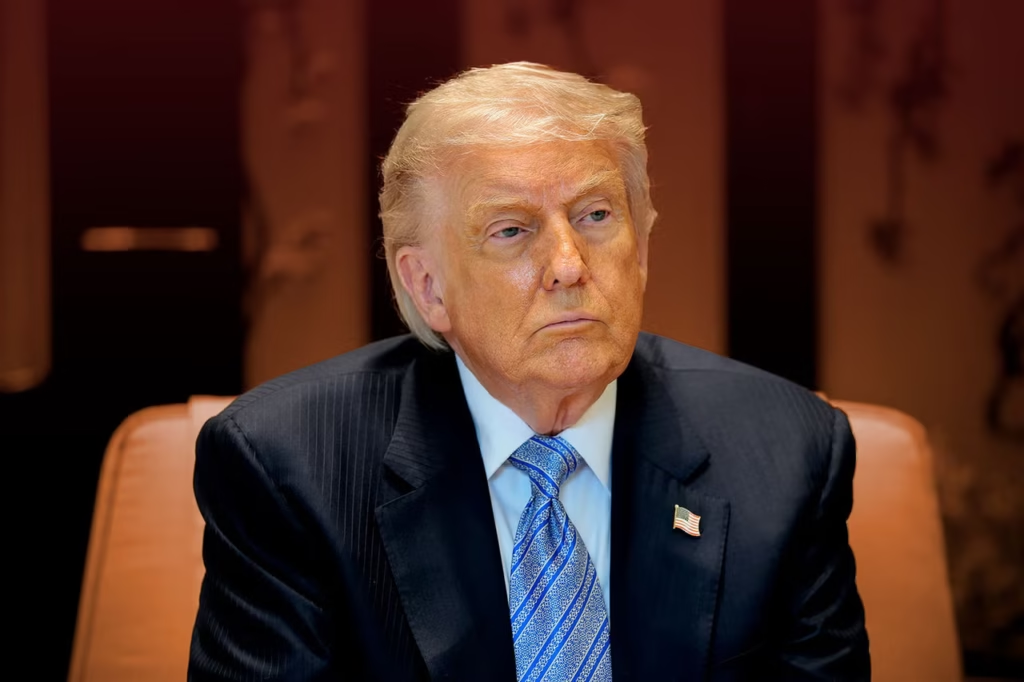
US District Judge Amit Mehta reluctantly dismissed the seditious conspiracy case against Oath Keepers founder Stewart Rhodes and several other key members Wednesday, after the Trump Justice Department moved to wipe away their January 6th convictions entirely. Juries had convicted Rhodes and five others after deliberating on evidence that they had conspired to use force to prevent the transfer of presidential power. Mehta himself, when Trump pardoned Rhodes earlier, had warned that doing so was “frightening and ought to be frightening to anyone who cares about democracy in this country.” Former prosecutor Michael Romano called January 6th “not something that members of either party should have trouble with.” Former prosecutor Brendan Ballou issued a specific, chilling warning about what happens next.
2-MINUTE CONTEXT — WHAT WAS THE OATH KEEPERS CASE?
Stewart Rhodes founded the Oath Keepers in 2009 as a paramilitary organization that recruited former military and law enforcement personnel and styled itself as defenders of the Constitution. In the weeks before January 6, 2021, Rhodes and other leaders organized members into “quick reaction forces” positioned outside Washington D.C. with weapons, prepared what prosecutors described as a cache of firearms in hotel rooms across the Potomac in Virginia, and coordinated via encrypted messaging to be ready to enter the Capitol if called upon.
The Justice Department, under Biden, pursued seditious conspiracy charges — a serious felony requiring proof of a conspiracy to use force against the United States government. The legal bar is high: prosecutors must prove not just participation in a riot but a coordinated plan to use force to prevent a lawful government function.
On November 29, 2022, a jury convicted Rhodes and four co-defendants of seditious conspiracy. Rhodes was sentenced to 18 years in prison — the longest sentence handed down in any January 6th prosecution. The jury’s verdict was specific and factual: it found, beyond reasonable doubt, that Rhodes had conspired to use force to stop the certification of the 2020 presidential election.
Trump pardoned Rhodes on his first day back in office. The case before Judge Mehta this week is the DOJ’s formal legal motion to dismiss the case entirely — not just release Rhodes from prison, but erase the conviction from the record.
JUDGE MEHTA’S ROLE — AND HIS RELUCTANCE
Judge Mehta is a federal district judge appointed by President Obama in 2014. He has presided over multiple major January 6th cases and has been notably careful and deliberate in his judicial conduct throughout. When Trump pardoned Rhodes, Mehta did not simply accept the pardon and move on. He expressed, on the record, that pardoning Rhodes was “frightening and ought to be frightening to anyone who cares about democracy in this country.”
This week’s dismissal is legally distinct from the pardon. A pardon releases someone from punishment but does not erase the conviction — the legal record of guilt remains. The DOJ’s motion to dismiss asks the court to vacate the conviction entirely, as if the trial never happened. Mehta is described as “reluctantly” complying — which means he followed the law and the government’s motion, but made his own view of the situation clear.
“Frightening, and ought to be frightening to anyone who cares about democracy in this country.”
— Judge Amit Mehta — on the pardoning of Stewart Rhodes
A federal judge using the word “frightening” in relation to a presidential action is not routine judicial language. Federal judges are trained to express disagreement in measured, procedural terms. “Frightening” is a departure from that tradition — it signals that Mehta viewed the pardon, and by extension the dismissal, as genuinely threatening to the legal order he is sworn to uphold.
WHAT BALLOU AND ROMANO SAID — THE FORMER PROSECUTOR WARNINGS
Former federal prosecutor Michael Romano’s statement — that January 6th is “not something that members of either party should have trouble with” — is a direct rebuttal to the normalization argument that partisan framing of the January 6th prosecutions is what drove them. Romano is arguing that prosecuting people who were convicted by juries of seditious conspiracy is not a partisan act. It is the application of law.
Former prosecutor Brendan Ballou’s warning is more specific and more alarming for the future: he warned about judicial nominees who “deny the reality of January 6th” potentially deciding future election disputes from the bench.
This is the specific danger Ballou is naming: if the courts are eventually staffed by judges who have been confirmed after expressing skepticism about January 6th’s characterization, those judges will be the ones deciding the next disputed election. The people who were convicted of conspiring to stop the last certification process have been released. Some of the people who might do the same thing next time may be deciding whether it worked.
“When the next disputed election lands in court, the judges deciding it may have been confirmed after expressing skepticism about January 6th.”
— ONYX analysis of former prosecutor Brendan Ballou’s warning
| 🔍 ONYX REALITY CHECK VERDICT: TRUE WHY? The dismissal of the Oath Keepers seditious conspiracy case is documented court record. Judge Mehta’s “frightening” statement is on the record. The jury convictions of Rhodes and five co-defendants on seditious conspiracy are established legal history. Romano and Ballou’s quotes are on the record. The DOJ’s role in moving to dismiss is documented. ONYX rates the core factual claims TRUE. The forward-looking analysis of implications is editorial, clearly labeled. |
WHY THIS MATTERS
The specific legal significance: seditious conspiracy is one of the most serious charges in federal criminal law, requiring proof of an agreement to use force against the United States government. A jury of ordinary Americans, after hearing months of evidence, found that proof existed beyond reasonable doubt. The executive branch, under a new president, has now instructed the judicial branch to act as if that finding never happened.
The institutional significance: the Justice Department’s willingness to use its prosecutorial power to erase convictions obtained by the previous DOJ — convictions of people who tried to stop that previous administration’s leader from losing power — represents a use of prosecutorial discretion that goes beyond normal policy disagreement between administrations.
The political significance: 93 days before midterm elections, the Republican Party has now formally, legally completed the recharacterization of January 6th from a violent insurrection to, at most, a political protest. The mechanism it used was not legislation or constitutional amendment — it was the prosecutorial power of the Justice Department.
The future-risk significance: Ballou’s warning about judicial nominees is not hypothetical. Federal judges are being confirmed now. Cases involving future elections will come before them. The judges who decide those cases will have been evaluated, in part, on their views about January 6th.
POLITICAL IMPACT
| WHO BENEFITS | WHO FACES LONG-TERM RISK |
| Stewart Rhodes — free, conviction erased, political rehabilitated | Rule of law advocates — a jury verdict overturned by executive action |
| Trump — completes the narrative rehabilitation of January 6th | Future election integrity — judges being confirmed with January 6th skepticism |
| Oath Keepers as organization — leaders free; organization politically rehabilitated | Former prosecutors — their work of years erased by administrative motion |
| Far-right political movement — legal victory signals future impunity | Democratic Party — loses the legal predicate of January 6th as a sustained accountability story |
WHAT HAPPENS NEXT
▸ Other January 6th convictions are likely to follow the same dismissal path — watch for a systematic DOJ motion pattern
▸ Judicial nominee hearings will increasingly feature questions about January 6th — Ballou’s warning will become a Senate Judiciary Committee talking point
▸ Civil suits by Capitol Police officers and congressional staff who were attacked may now be the only remaining legal accountability mechanism
▸ Historical documentation — the conviction record, even if legally erased, remains in journalistic and historical archives — is a long-term contested terrain
▸ Stewart Rhodes will almost certainly return to public political activity — watch for organizational rebuilding
| CONFIDENCE: HIGH | All core facts are documented: conviction, sentence, pardon, dismissal, Mehta’s statements, Romano and Ballou quotes. The Oath Keepers’ specific pre-January 6th preparations (QRF, weapons cache) are from trial record. Forward-looking analysis is ONYX editorial, clearly labeled. |
| ⚖️ BIAS CHECK — WHO IS SAYING WHAT | |
| Trump DOJ | Framing as correcting a politically motivated prosecution; pursuing “justice” for those unjustly charged |
| Judge Mehta | Complying with law while making his personal assessment clear — “frightening” quote stands in the record |
| Former Prosecutors (Romano, Ballou) | Treating the dismissal as a genuine institutional failure; Romano using bipartisan framing deliberately |
| Democrats | Using the dismissal as a midterm warning about democratic backsliding; Ballou’s judicial nominee point is a Senate campaign message |
| Republicans (mainstream) | Quiet; most prefer not to address the substance; can support the “political prosecution” framing without engaging with trial evidence |
| Conservative Media | Framing as exoneration of political prisoners; not engaging with jury verdict specifics |
| Mainstream Legal Community | Alarmed; noting that executive dismissal of jury convictions via DOJ motion is a historically unusual use of prosecutorial power |
📅 NEWS EVOLUTION
Jan 6, 2021: Capitol breach; Oath Keepers participate in coordinated action; Rhodes commands from outside
Nov 29, 2022: Jury convicts Rhodes and four co-defendants of seditious conspiracy
May 2023: Rhodes sentenced to 18 years — longest January 6th sentence
Jan 20, 2025: Trump pardons Rhodes on first day back in office
Aug 6, 2026: DOJ moves to dismiss; Judge Mehta “reluctantly” complies; case erased from legal record
Ongoing: Ballou warning: judicial nominees being confirmed who “deny the reality of January 6th”
SOURCES
▸ US District Court — dismissal order, August 6, 2026
▸ Judge Amit Mehta — “frightening” quote, documented in prior pardon proceedings
▸ Michael Romano — former prosecutor, on-record NPR statement
▸ Brendan Ballou — former prosecutor, judicial nominees warning
▸ Trial record — Oath Keepers QRF, weapons cache, encrypted communications evidence
▸ Rhodes sentence — 18 years, documented sentencing record
QUESTIONS YOU MAY STILL HAVE
Q: What is the difference between a pardon and a dismissal?
A: A presidential pardon releases someone from punishment but does not erase the conviction — the person remains legally guilty, they just don’t serve the sentence. A dismissal vacates the conviction itself — it is legally erased, as if the trial never happened. This is why the DOJ’s motion this week is a further step beyond the earlier pardon.
Q: Can the conviction ever be reinstated?
A: Under double jeopardy protections, once a conviction is vacated on these grounds, the defendants cannot be tried again for the same offenses. The legal erasure is permanent absent extraordinary circumstances.
Q: What were the specific charges?
A: Seditious conspiracy under 18 U.S.C. § 2384 — conspiring to use force to prevent, hinder, or delay the execution of any law of the United States, or by force to seize, take, or possess any property of the United States. This is one of the most serious charges in federal criminal law short of treason.
Q: Who else was convicted in this case?
A: Five co-defendants were convicted alongside Rhodes. The specific individuals and their sentences have been part of the broader January 6th prosecution record — all are subject to the same dismissal motion.