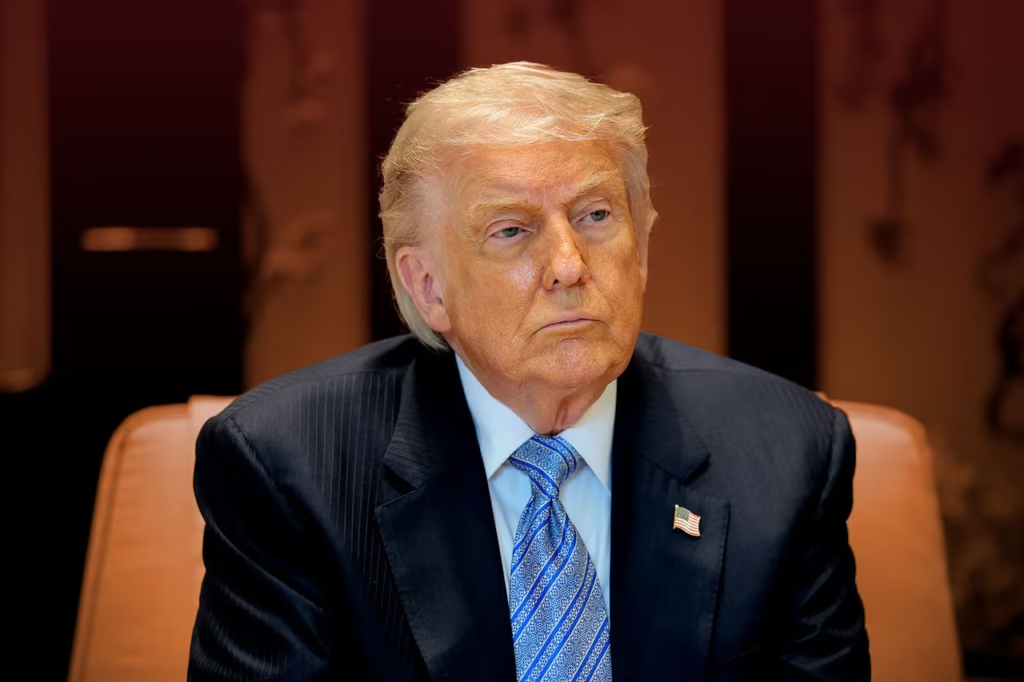
A highly unusual Census Bureau report Trump is using to revive false 2020 noncitizen voting claims has direct ties to the America First Policy Institute, a Trump-aligned think tank founded by officials from his first administration, according to NPR. Trump claimed the bureau’s analysis of 128 million voter records ‘proves that over 24,000 noncitizens voted illegally’ and that the number would ‘explode’ as 32 million more records are checked. Data and election experts call the seven-page, unauthored report methodologically questionable. The analysis was not conducted by career Census civil servants — it was conducted by a team that included AFPI-affiliated individuals. Commerce Secretary Howard Lutnick oversees the Census Bureau. Spokespeople for the bureau, AFPI, and the White House all declined to comment, as Trump simultaneously pushes Congress to pass sweeping new voting restrictions ahead of the fall midterms.
2-MINUTE CONTEXT — WHY THIS REPORT IS UNUSUAL
Census Bureau reports follow a specific institutional process: they are authored by career civil servants; they are peer-reviewed internally before publication; they carry identifying information including the names or office designations of the analysts who prepared them; and they are published through the bureau’s established research pipeline, which includes methodology documentation.
The report Trump is citing has none of these standard features. It is seven pages, unauthored, and was apparently not prepared through the bureau’s normal research pipeline. Its connection to AFPI — a think tank whose leadership includes former Trump administration officials — and the fact that the analysis was conducted by AFPI-affiliated individuals rather than career civil servants is the specific institutional problem NPR has identified.
The Commerce Secretary’s oversight of the Census Bureau is the governance link: Howard Lutnick heads Commerce; Commerce oversees Census; the inclusion of AFPI-affiliated analysts in what is presented as a Census Bureau report represents a blurring of the line between a federal statistical agency and a political advocacy organization.
THE METHODOLOGY PROBLEMS
Data and election experts have identified specific methodological concerns with the report’s claims:
▸ The matching methodology: linking voter rolls to noncitizen databases requires careful data matching; false positives — US citizens incorrectly flagged as noncitizens because of name similarities, data entry errors, or database inconsistencies — are a documented and serious problem in this type of analysis
▸ The database sources: noncitizen databases are incomplete; DACA recipients, legal permanent residents, and other legal immigrants appear in various federal databases; a noncitizen who became a citizen and then registered to vote could appear as a ‘noncitizen voter’ if the citizenship data is lagged
▸ The 24,000 figure: this represents those found in the 128 million records checked; the report’s extrapolation that the number will ‘explode’ to cover 32 million more records is not a finding — it is speculation presented as an implication
▸ The peer review absence: election data analyses of this scale and consequence normally go through extensive peer review; an unauthored seven-page report without methodology documentation cannot be evaluated for its analytical validity
THE AFPI CONNECTION
The America First Policy Institute was founded by officials from Trump’s first administration and operates as a policy development and advocacy organization aligned with Trump’s political agenda. It has published extensive work on election integrity, immigration enforcement, and related policy areas. The involvement of AFPI-affiliated individuals in preparing an analysis presented as a Census Bureau report is a specific conflict of interest: AFPI has an advocacy interest in the conclusion that noncitizen voting is a significant problem; the Census Bureau is supposed to produce objective statistical analysis independent of advocacy interests.
The Census Bureau is supposed to produce objective statistical analysis. AFPI is supposed to produce advocacy for Trump’s policy positions. NPR found the report doing one of those things was produced by people doing the other.
THE VOTING RESTRICTION CONTEXT
Trump is simultaneously pushing Congress to pass sweeping new voting restrictions ahead of the November 3 midterms. The 24,000 noncitizen voting claim provides the specific empirical justification for those restrictions: if 24,000 noncitizens voted illegally (and the number will ‘explode’), then stricter identity verification, reduced voter rolls, and other restrictive measures are necessary responses. The report’s claimed authority — ‘Census Bureau analysis’ — gives those restrictions a data-grounded justification that partisan advocacy alone could not provide.
ONYX covered the federal judge’s block of Trump’s mail-in voting executive order (August 14, 16, 19 coverage). The Census report claim and the voting restriction push are part of the same pre-midterm election integrity framing effort. ONYX covers them as connected.
THE ORC
| 🔍 ONYX REALITY CHECK VERDICT: MISLEADING CONTEXT WHY? Trump’s claim that a Census Bureau report ‘proves’ 24,000 noncitizens voted illegally is MISLEADING CONTEXT on multiple grounds: (1) the report was not produced by career Census civil servants but by AFPI-affiliated individuals; (2) the methodology is disputed by data and election experts; (3) the matching methodology used to identify ‘noncitizen voters’ produces false positives that could account for a significant portion of the 24,000 figure; (4) the extrapolation that the number will ‘explode’ is speculation, not a finding; and (5) presenting AFPI-influenced analysis as a Census Bureau report misrepresents its institutional provenance and independence. ONYX rates the claim as MISLEADING CONTEXT rather than FALSE because the analysis did use voter records matched to noncitizen databases; the specific findings are disputed, not fabricated from nothing. |
WHAT HAPPENS NEXT
▸ Congressional use of the report — Republican members will cite the 24,000 figure as justification for voting restriction legislation; Democrats will cite NPR’s reporting to challenge the report’s provenance
▸ GAO or IG investigation — whether the use of AFPI-affiliated analysts in Census report preparation triggers a formal inspector general review
▸ Election security advocacy response — voting rights and election security organizations will publish their own methodological critiques
▸ Midterm voting restriction legislation — whether the report provides sufficient political cover for specific restriction measures to advance
▸ 75 days to November 3 midterms
| CONFIDENCE: HIGH | NPR reporting on AFPI connection, unauthored seven-page report, AFPI-affiliated analysts conducting the analysis, Commerce Secretary Lutnick oversight link, and all spokesperson declinations are from NPR confirmed investigation. Expert methodological concerns are from NPR reporting on data and election expert assessments. ORC is ONYX editorial, clearly labeled. |
| ⚖️ BIAS CHECK — WHO IS SAYING WHAT | |
| Trump / White House | Using the report as the empirical foundation for voting restriction advocacy; declined to comment on its provenance |
| Census Bureau | Declined to comment; the institution’s integrity is the specific thing at stake if the report misrepresents its origins |
| AFPI | Declined to comment; the think tank has an advocacy interest in the report’s conclusions and an institutional interest in not highlighting its involvement |
| NPR Investigative Journalism | Located the AFPI connection through documented research; the public interest function of this reporting is direct |
| Data and Election Experts | Identified the methodological problems; their critiques are based on established statistical analysis standards, not political preference |
SOURCES
▸ NPR investigation — Census AFPI noncitizen voting report, AFPI-affiliated analysts, August 20, 2026
Q: Is noncitizen voting actually a significant problem?
A: Established research consistently finds that noncitizen voting is extremely rare. Multiple studies examining voter rolls against noncitizen databases using rigorous methodology have found rates of noncitizen voting in the range of a few hundred cases nationally in any given election — orders of magnitude below 24,000. The specific problem with the Census report is that its methodology appears to produce false positives that inflate the number significantly.
Q: Why does the methodology matter so much?
A: Voter database matching is technically difficult because it relies on name, date of birth, and address matches across databases that are maintained independently, update at different rates, and have different accuracy standards. A person whose citizenship status changed between when they appear in a noncitizen database and when they registered to vote can appear as a “noncitizen voter” in a flawed analysis. The 24,000 figure may represent primarily database artifacts rather than actual noncitizen voters.
Q: What authority does Commerce have over the Census Bureau?
A: The Census Bureau is an agency within the Department of Commerce. The Commerce Secretary has administrative oversight including the ability to set policy priorities and approve major analytical projects. The specific governance question NPR raises is whether AFPI-affiliated analysts were given access to voter data through the Commerce Department’s oversight authority.