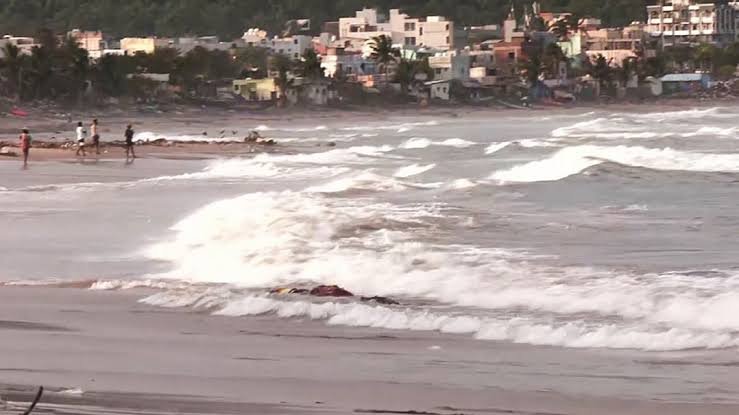
Cyclone Murasu made landfall on the Andhra Pradesh coast near Ongole with sustained winds of 110-120 kilometers per hour, exceeding its pre-landfall intensity of 100-110 km/h documented in Section B on November 2, before beginning to weaken after making landfall. The landfall near Ongole — a coastal city in Prakasam district, Andhra Pradesh — confirms the track forecast that placed the cyclone on a direct path toward the densely populated central Andhra coast. Strengthening from 100-110 km/h to 110-120 km/h before landfall indicates the cyclone drew additional energy from the warm Bay of Bengal waters. The rapid weakening post-landfall is typical of cyclones once they move over land and lose their oceanic energy source.
INTERNATIONAL / SOUTH ASIA / NATURAL DISASTER · CYCLONE MURASU · LANDFALL · ANDHRA PRADESH · ONGOLE · 110-120 KM/H · SEVERE CYCLONIC STORM · WEAKENING · ARC: NOV 2 B14
ONGOLE, ANDHRA PRADESH — Cyclone Murasu made landfall near Ongole, Andhra Pradesh, as a severe cyclonic storm with winds of 110-120 km/h before weakening, according to The Hindu. Casualty figures, the extent of infrastructure damage, the number of people displaced by the landfall, which specific areas around Ongole sustained the heaviest damage, the storm surge height at the point of landfall, whether the National Disaster Response Force teams pre-positioned before landfall were able to respond effectively, and the current status and trajectory of the weakened storm system after landfall were not detailed in initial reporting.
The landfall of Cyclone Murasu continues the arc from ONYX November 2, where the cyclone was documented approaching the Andhra coast with 100-110 km/h winds, and alerts were issued for Andhra Pradesh, Tamil Nadu, and Odisha with school closures. The strengthening from 100-110 km/h to 110-120 km/h between November 2 and landfall on November 3 is notable — late intensification before landfall is a well-documented cyclone behavior pattern in the Bay of Bengal, where warm sea surface temperatures close to the coast can allow a storm to gain strength even as it approaches land. Ongole is the administrative headquarters of Prakasam district, with a population of approximately 200,000 in the urban area and a coastal exposure that makes it vulnerable to both storm surge and high winds.
Bay of Bengal Landfall and Post-Storm Assessment
Cyclone landfalls on the Andhra Pradesh coast follow a pattern that Indian meteorologists and disaster management officials have developed significant expertise in managing. The NDRF, state disaster response forces, and local emergency management systems in Andhra Pradesh have been refined through decades of cyclone response. The pre-positioning of teams before landfall — documented in the November 2 reporting — reflects the improvement in India’s cyclone preparedness since earlier catastrophic events. The key post-landfall assessment variables for Cyclone Murasu will be: storm surge height along the coast between Ongole and adjacent districts (which can drive the highest casualty figures in low-lying coastal areas), rainfall totals from the cyclonic system as it moves inland and weakens (which can cause flooding well beyond the immediate landfall zone), and the condition of the power and communications infrastructure in Prakasam district.
“Cyclone Murasu made landfall near Ongole as a severe cyclonic storm with wind speeds of 110-120 km/h. It is now weakening rapidly over land. Rescue and relief operations are underway.” — India Meteorological Department, via The Hindu
WHAT HAPPENS NEXT
► Casualty figures — deaths, injuries, and displacement from the Murasu landfall.
► Storm surge — extent of coastal flooding around Ongole and adjacent districts.
► Infrastructure damage — roads, power, communications, and port facilities along the Andhra coast.
► Inland rainfall — whether the weakened cyclone system causes flooding as it moves inland.
► Agricultural damage — impact on Andhra Pradesh crop season.
► NDRF response — effectiveness of pre-positioned disaster response teams.
| CONFIDENCE: MODERATE | Cyclone Murasu making landfall in Andhra Pradesh near Ongole as a severe cyclonic storm with 110-120 km/h winds before weakening, confirmed by The Hindu. Single outlet — flagged; arc continuation from Nov 2 (approach reported) adds context credibility. Casualty figures, infrastructure damage, storm surge, and displacement numbers NOT confirmed. Bay of Bengal cyclone behavior, Ongole geography, and India disaster response from established documented record. |
| Bias Check | ||
| Left-Lean | Center | Right-Lean |
| No significant political framing dimension in this natural disaster story. | Reports confirmed Cyclone Murasu making landfall near Ongole, Andhra Pradesh, with 110-120 km/h winds before weakening, as stated by The Hindu. | No significant political framing dimension in this natural disaster story. |
| Assessment | ONYX presents a confirmed single-source report with MODERATE flag. Arc continuation from Nov 2 documented. Bay of Bengal cyclone behavior, Ongole geography, and India disaster response from established documented record. | |
SOURCES
► The Hindu — Cyclone Murasu makes landfall in Andhra Pradesh near Ongole with winds of 110-120 km/h; the severe cyclonic storm hit the coast before weakening