
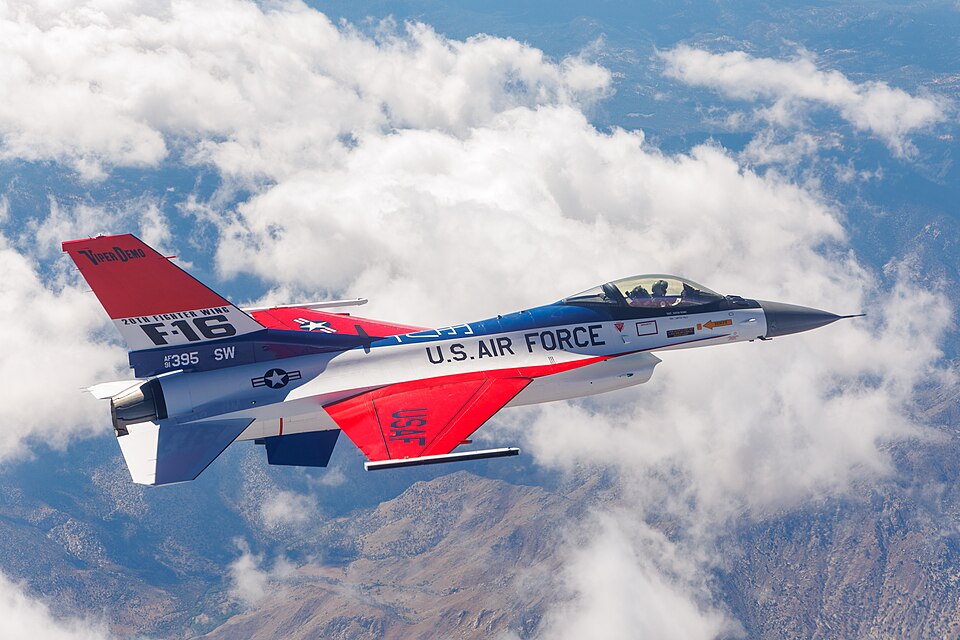
DARPA has completed the first real-world flight of an F-16 fighter jet fully controlled by artificial intelligence, marking a milestone in autonomous combat aviation. The flight was conducted under DARPA’s Air Combat Evolution (ACE) program, which has been developing AI systems capable of controlling fighter aircraft in contested airspace. The flight is not an end point — it is a demonstration that the AI control architecture is ready for expanded testing in more complex scenarios, including simulated aerial combat.
2-MINUTE CONTEXT — WHAT THE ACE PROGRAM IS
DARPA’s Air Combat Evolution program has been developing AI combat aviation systems since 2019. The program specifically focuses on autonomous air-to-air combat — dogfighting — because that is the most complex, rapidly-evolving aerial combat scenario, requiring split-second decisions at closing speeds that exceed human reaction time limits.
Earlier milestones in the ACE program included: simulated AI vs. AI dogfighting tournaments (2020); AI defeating a human F-16 pilot in simulated combat (2021, generating significant attention); and increasingly complex flight testing using X-62A VISTA (Variable In-flight Simulator Test Aircraft), a highly modified F-16 used as the ACE test platform. This week’s real-world F-16 flight is the program’s most public and operationally significant demonstration.
The AI system controlling the F-16 is not the same as consumer AI applications or large language models. It is a specialized control system trained through reinforcement learning — the same general approach that DeepMind’s AlphaGo used to master the game of Go, applied to three-dimensional aerial maneuvering at combat speeds.
WHAT THE FLIGHT ACTUALLY DEMONSTRATED
The demonstration flight showed: the AI can take off, navigate, and land the F-16 without human intervention; it can execute flight maneuvers within the aircraft’s operating envelope; and it can respond to changing flight conditions in real time. What it did not demonstrate (and what the ACE program has not yet fully demonstrated in real-world conditions): autonomous aerial combat against a real adversary aircraft; the ability to make weapons employment decisions; and performance in contested electronic warfare environments where adversaries are actively trying to disrupt the AI’s sensors.
The gap between “can fly the plane” and “can fight with the plane” is substantial. But “can fly the plane” was the necessary prerequisite for everything that follows.
An AI flying an F-16 in a demo flight is impressive. An AI fighting an F-16 at Mach 1.6 against a human pilot in the Taiwan Strait is a different category of capability. Both matter. They are not the same thing.
THE IMPLICATIONS — NEAR TERM AND LONG TERM
Near term (2-5 years): the ACE program is likely to produce AI “wingman” aircraft that fly alongside human-piloted jets, extending the sensor envelope and weapons carriage capacity of human-piloted formations. These are “loyal wingman” concepts — AI-controlled aircraft that follow human direction at a formation level, not at a split-second tactical level.
Medium term (5-15 years): fully autonomous combat aircraft operating without human pilots in specific scenarios — suppression of enemy air defenses (where the mission is well-defined and the cost of losing the aircraft is acceptable). Cruise missiles are already autonomous in this sense; AI fighters are an extension of that logic.
Long term (15-30 years): the question of whether AI systems can outperform human pilots in contested air combat at operational scale — not just in specific scenarios but generally — is the genuine long-term question. The ACE program’s progress moves the answer’s arrival date forward.
THE GEOPOLITICAL DIMENSION
China and Russia are both pursuing autonomous combat aviation programs. China’s Wing Loong and Hongdu programs have demonstrated drone combat capability. Russia has been developing its S-70 Okhotnik unmanned heavy combat drone. The US ACE program must be understood in the context of a three-way autonomous combat aviation competition in which the first mover advantage is real: whoever can demonstrate reliable autonomous combat capability first shapes the tactical context that others must respond to.
In the context of this week’s news — the Iran ceasefire deal, depleted US missile stockpiles, Patriot interceptor shortages — the ACE demonstration is a specific kind of strategic signal: the US is investing in military technologies that may be decisive in future conflicts even as current weapons stockpiles are being depleted.
WHAT HAPPENS NEXT
▸ Expanded testing against AI adversary aircraft in simulated combat scenarios
▸ Classified ACE program milestones that won’t be publicly disclosed until after completion
▸ International reaction: China and Russia will update their own AI combat aviation timelines in response to this demonstration
▸ Congressional defense committee briefings on ACE program progress and future funding requirements
▸ DoD policy review on autonomous weapons systems authority — the question of who authorizes weapons release in an autonomous aircraft remains the central policy debate
| CONFIDENCE: HIGH | DARPA ACE program F-16 autonomous flight is confirmed from AI News Weekly and aviation reporting. ACE program history (2019 launch, 2020-2021 simulated combat milestones) is from established DARPA public documentation. Technical characterization of what was and was not demonstrated is ONYX editorial analysis based on established aerospace knowledge. |
| ⚖️ BIAS CHECK — WHO IS SAYING WHAT | |
| DARPA | Framing as a program milestone; careful not to overstate operational capability; program still in testing phase |
| Air Force | Supportive; the ACE program is aligned with Air Force’s Next Generation Air Dominance (NGAD) concept |
| Autonomous Weapons Skeptics | Will cite this as evidence of urgency for international laws of war updates on autonomous weapons decision-making |
| Defense Industry | Boeing (X-62A operator), Lockheed, Northrop (unmanned systems programs) all have stakes in the ACE program’s trajectory |
| China | Will update its own program timelines; will not publicly acknowledge the US demonstration creates pressure on their own efforts |
SOURCES
▸ DARPA / AI News Weekly — ACE program F-16 autonomous flight, August 2026
▸ DARPA ACE program history — 2019 launch, 2020 simulation, 2021 human pilot defeat (documented)
▸ DoD autonomous weapons policy — established regulatory framework documentation
QUESTIONS YOU MAY STILL HAVE
Q: Does this mean human pilots will be replaced?
A: Not in the near term. The “loyal wingman” concept keeps human pilots in the loop as commanders of AI aircraft formations. The scenario in which AI fully replaces human pilots in contested combat is decades away and depends on political as well as technical decisions about autonomous weapons.
Q: What prevents enemies from hacking the AI?
A: This is the contested electronic warfare question ONYX mentioned above. AI control systems are vulnerable to sensor disruption, GPS jamming, and potentially adversarial attacks on their training data. The ACE program is testing these vulnerabilities; their solutions are classified. It is a genuine, active research area.