The Category 2 hurricane that made landfall near Destin delivered on every major forecast: deaths from falling trees and carbon monoxide poisoning from generators, widespread outages across four states, and the slow inland weakening that keeps the storm dangerous after the wind stops.
🌀 FLORIDA PANHANDLE · OCTOBER 11, 2026 · ISAIAS AFTERMATH
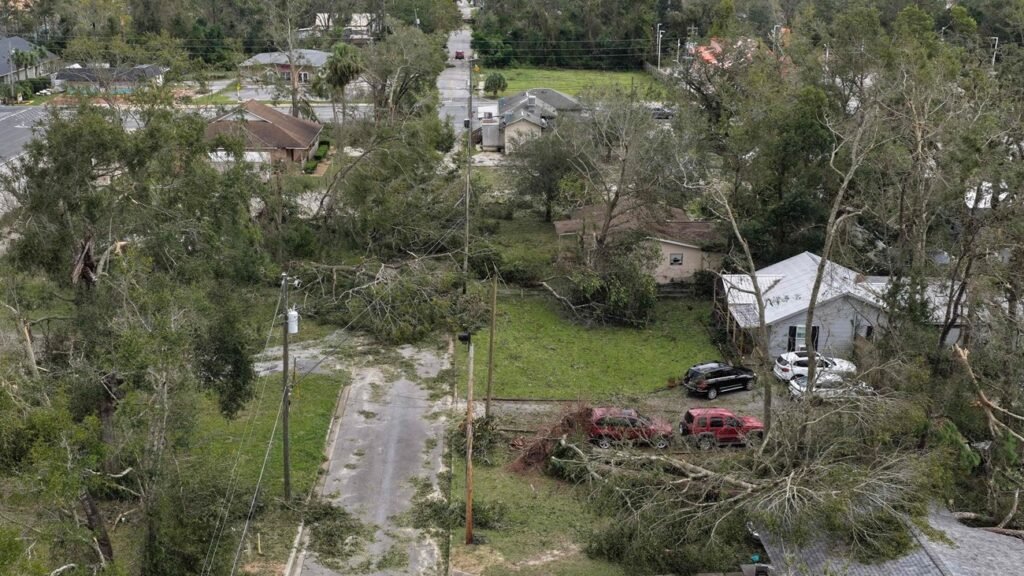
Hurricane Isaias made landfall as a Category 2 storm near Destin, Florida, and did what Category 2 hurricanes do: it broke things, took power, killed people, and moved inland slowly enough to keep raining on everyone for longer than the wind headline suggests. Four deaths have been confirmed. Two people died from falling trees — the category of hurricane fatality that the forecasters and emergency managers always put first in their briefings, because it kills people who stay indoors thinking they are safe. Two others died from carbon monoxide poisoning from generators — the category that kills people after the storm, when they run gas-powered equipment inside enclosed spaces.
Hundreds of thousands of customers lost power across Florida, Alabama, Georgia, and Mississippi. The phrase “hundreds of thousands” appears in enough storm coverage that it has become abstracted — a large number that suggests inconvenience. It is worth pausing on what it actually means: refrigerated medications spoiling, medical equipment running on battery backups, elderly residents in summer heat without air conditioning, small businesses losing inventory, people whose work depends on electricity and connectivity losing income for days or weeks. The footprint of a power outage at this scale is not resolved when the lights come back on.
WHAT THE TORNADO THREAT ADDED
As Isaias moved inland and weakened below hurricane strength, it generated secondary tornado threats — the phenomenon by which a decaying tropical system’s outer bands and rotational dynamics can spin up tornadoes well after landfall, often in areas that received less preparation time because they were not in the “direct impact” zone. This is the part of hurricane aftermath that tends to generate casualties in communities that let their guard down after the main event. Reuters, BBC, and CNN confirmed the tornado threat was active as Isaias moved inland.
Flooding was also ongoing. A storm that produces significant rainfall over terrain that was already saturated from earlier rain events — the Florida Panhandle had been tracking Isaias for days — can produce river flooding and flash flooding that continues for twelve to twenty-four hours after the surface wind speed drops below the newsworthy threshold. The storm being “gone” in the headline sense does not mean the danger is over.
THE CARBON MONOXIDE PROBLEM
Two of the four deaths confirmed after Isaias were from generator carbon monoxide poisoning. This is documented in the public health literature as one of the leading causes of post-storm death in the United States, across storms of every size. Emergency managers put it in every briefing. The CDC issues guidance on it before every storm season. It continues to kill people, reliably, after every major hurricane. The gap between the availability of the safety information and its uptake is a persistent public health failure that no individual storm fully closes.
“Isaias killed four people. Two from falling trees during the storm. Two from generator exhaust after it. The deaths after the storm ended are part of the storm’s story.”
WHAT HAPPENS NEXT
► Power restoration — timeline for restoring hundreds of thousands of outages across four states
► Flood peak — river flooding cresting in the days following landfall
► FEMA assessment — federal disaster declaration process for affected counties
► Economic damage — insurance and agricultural loss estimates in the Panhandle
| CONFIDENCE: HIGH | Reuters, BBC, CNN, CBC confirmed 4 deaths (falling trees, CO poisoning), widespread multi-state outages, tornado threat, continued flooding, and inland weakening. |
| BIAS CHECK | ASSESSMENT |
| Source weight | Reuters, BBC, CNN, CBC — multi-outlet international and domestic confirmation |
| Death framing | Causes of death stated factually; generator risk noted as documented recurring problem, not one-off tragedy |
| Outage framing | Scale of outages contextualized accurately; human impact noted without dramatization |
SOURCES
► Reuters — Isaias aftermath: 4 dead, hundreds of thousands without power, October 11, 2026
► BBC News — Hurricane Isaias inland weakening, tornado and flood threats, October 11, 2026
► CNN — Carbon monoxide deaths, generator safety, Isaias aftermath, October 11, 2026
► CBC — Multi-state power outages, Isaias impact summary, October 11, 2026