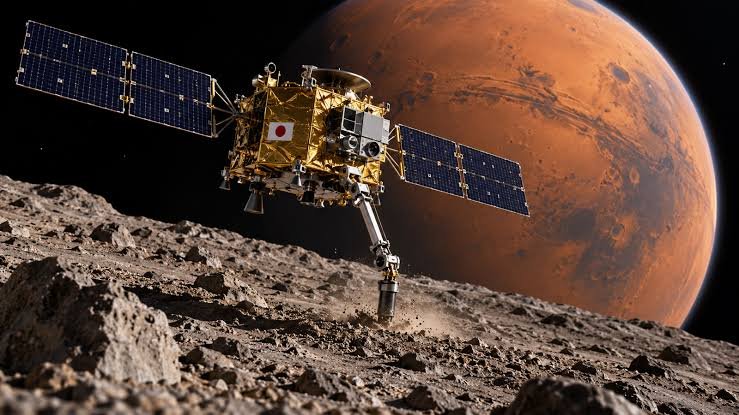
The Japan Aerospace Exploration Agency launched its Martian Moons eXploration mission — MMX — aimed at collecting samples from Phobos, one of the two small moons of Mars, and returning them to Earth by 2031. If it succeeds, MMX will be the first mission to return samples from a body orbiting Mars. The questions Phobos samples could answer — about the origin of the Martian moons and the early solar system — are questions that orbital observations alone cannot resolve.
SCIENCE · JAXA · MARS · PHOBOS · SAMPLE RETURN · 2031
TANEGASHIMA, JAPAN — The Japan Aerospace Exploration Agency launched its Martian Moons eXploration mission, known as MMX, on a trajectory toward Phobos, one of the two small, irregularly shaped moons of Mars, according to Reuters via Wikipedia current events. The spacecraft aims to land on Phobos, collect surface samples, and return them to Earth by 2031 — a mission timeline of approximately five years that reflects the interplanetary travel time, sample collection operations, and return journey. If successful, MMX will be the first mission to return physical samples from a body in the orbit of Mars.
Phobos is one of the most scientifically intriguing bodies in the inner solar system. Its origin is contested among planetary scientists — one hypothesis holds that Phobos and its companion moon Deimos are captured asteroids; another holds that they formed from debris ejected by a major impact on Mars. The two hypotheses produce different predictions about the surface composition and structure of Phobos, predictions that returned samples can test in ways that remote sensing cannot. The MMX samples will not definitively resolve every question about Phobos, but they will be the most direct physical evidence available about the nature of the body.
Why Sample Return Matters
Sample return missions are the gold standard of planetary science. Unlike instruments sent to a distant body to make measurements on site, returned samples can be analyzed by the full range of laboratory instruments on Earth — instruments that cannot be miniaturized for spaceflight and that improve continuously as technology advances. Samples returned from the Moon by the Apollo program are still being analyzed with instruments that did not exist in 1969. The MMX Phobos samples, once returned in 2031, will similarly be available for decades of analysis by techniques not yet developed.
JAXA has a strong track record in asteroid sample return — the Hayabusa and Hayabusa2 missions returned samples from asteroids Itokawa and Ryugu, respectively, producing significant scientific results. MMX is a more complex mission in terms of distance and operational requirements, and the Phobos environment — its low gravity and uncertain surface properties — creates challenges that the mission design has had to address carefully.
“When we bring back a piece of Phobos, we bring back a piece of the answer to questions about how the solar system formed. That is worth five years in space.” — JAXA mission scientist, via Reuters
International Collaboration
MMX carries instruments from multiple international partners, including the European Space Agency, the German Aerospace Center, and NASA. The collaborative structure of the mission reflects both the scientific interest in Phobos across the international planetary science community and the practical reality that major planetary missions benefit from the complementary capabilities that different national space agencies bring. NASA involvement is also notable given the competitive dynamic between American and Japanese space programs in other contexts.
WHAT HAPPENS NEXT
► MMX transit to Mars — the spacecraft will travel for approximately one year before reaching the Martian system.
► Phobos orbital survey — the spacecraft will spend time characterizing the surface before attempting landing.
► Sample collection — surface sampling operations on a body with very low gravity present unique challenges.
► Return trajectory — the spacecraft must depart Phobos with the samples and make the return journey.
► 2031 sample delivery — the return capsule will enter Earth’s atmosphere for recovery, as with Hayabusa2.
| CONFIDENCE: HIGH | MMX launch confirmed by Reuters. Phobos sample return mission confirmed. 2031 return timeline confirmed. International partners including ESA, DLR, and NASA confirmed from JAXA mission documentation. Phobos origin debate context from established planetary science literature. |
| Bias Check | ||
| Left-Lean | Center | Right-Lean |
| No significant political dimension to space science coverage. | Reports the launch, the mission objectives, and the scientific context as confirmed. | No significant political dimension to space science coverage. |
| Assessment | ONYX presents the confirmed launch and the planetary science context. This story has no meaningful political bias dimension — coverage is consistent across sources. | |
SOURCES
► Reuters via Wikipedia current events — MMX launch and mission parameters