
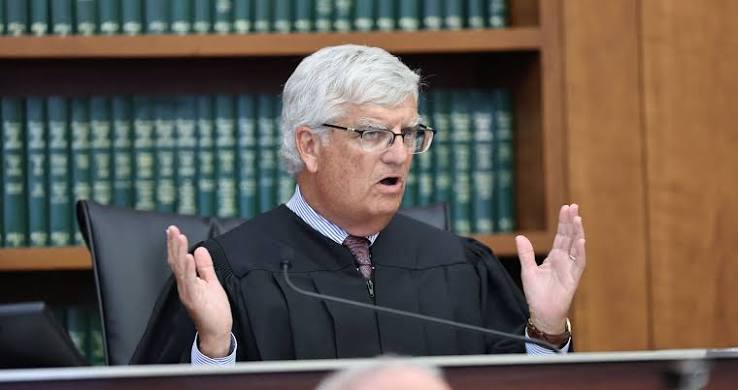
Judge Sullivan concluded that the jury was genuinely deadlocked after six days and twice notifying him of their inability to reach a verdict. He prepared to declare a mistrial. Before doing so, defense attorney Kevin Reddington made an emergency motion requesting time to seek a stay from the Supreme Judicial Court of Massachusetts — the state’s highest court. Judge Sullivan granted Reddington’s request, halting the mistrial declaration pending the SJC’s response.
WHY GO TO THE SJC
The defense’s emergency application to the Supreme Judicial Court is not a routine procedural move. The SJC is an appellate court, not a trial court; it does not normally intervene in active trials. An emergency stay application to the SJC in the middle of a trial means the defense believes there is a specific legal error or constitutional issue in the trial proceedings that warrants immediate appellate attention, before the trial concludes. The specific grounds for the emergency stay are not confirmed in available NPR reporting as of this publication.
THE MISTRIAL MECHANICS
If the SJC denies the emergency stay, Judge Sullivan can proceed with the mistrial declaration. A mistrial does not acquit Clancy; it ends the current trial without a verdict. The prosecution can retry the case. In a high-profile case involving serious charges (murder of three children) where the defense has mounted a postpartum psychosis defense that has clearly divided the jury, the decision about whether to retry is a significant prosecutorial judgment: a second jury might convict or acquit, but the hung jury is itself evidence that the postpartum psychosis defense has traction with at least some jurors.
The judge was about to declare a mistrial after six days and two deadlock reports. The defense lawyer went to the state’s highest court instead. That is a dramatic last-minute move that only makes sense if the defense believes there is a specific legal error that needs to be corrected before the trial ends — or before a retrial begins.
WHAT HAPPENS NEXT
▸ SJC response — whether the Supreme Judicial Court grants or denies the emergency stay
▸ Mistrial or verdict — if SJC denies, Sullivan declares mistrial; if SJC grants, proceedings resume with specific SJC instruction
▸ Retrial decision — if mistrial declared, whether prosecutors retry
▸ Defense legal theory — what specific legal error the defense is asking the SJC to address
| CONFIDENCE: HIGH | Judge Sullivan on verge of declaring mistrial, defense attorney Kevin Reddington emergency stay request to SJC, Judge Sullivan granting time pending SJC response are from NPR confirmed reporting. |
| ⚖️ BIAS CHECK — WHO IS SAYING WHAT | |
| Defense (Reddington) | Going to the SJC is an aggressive move that signals confidence the defense has a specific legal argument; it may also be a delay tactic if a new jury is considered more favorable than this deadlocked one |
| Prosecution | Must decide whether to oppose the SJC stay and proceed to mistrial/retrial or accept any SJC intervention |
| Judge Sullivan | Has been managing a complex, high-profile trial; his decision to grant the defense time reflects appropriate judicial caution before a mistrial declaration |
| Clancy | A mistrial means possible retrial; an SJC intervention means possible verdict under different instructions; her fate is now partly in the SJC’s hands |
SOURCES
▸ NPR — Lindsay Clancy SJC emergency stay mistrial, September 5, 2026