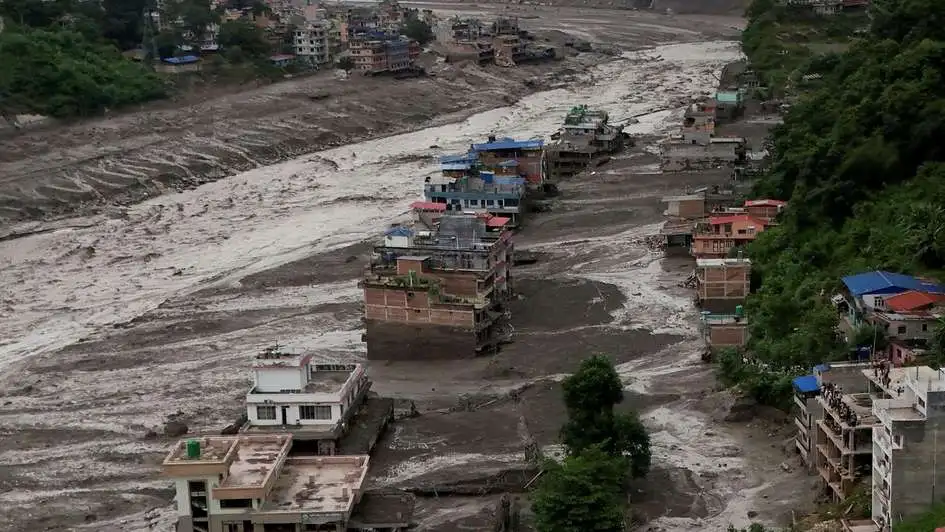
Torrential rainfall triggered a flash flood in Nepal’s Gorkha District, sweeping away houses and bridges and leaving an unconfirmed number of people missing. The event arrived in a week already defined by extreme weather on multiple continents.
🇳🇵 NEPAL · OCTOBER 11, 2026 · FLASH FLOOD
A flash flood struck Nepal’s Gorkha District, the mountainous region northwest of Kathmandu that was also the epicenter of the catastrophic 2015 earthquake that killed more than nine thousand people. Houses were swept away. Bridges were destroyed. An unconfirmed number of people are missing. The specifics of the event — how many missing, what the current death toll is, which specific communities in Gorkha were affected — were not established in available reporting at filing time, which relied primarily on wire aggregation and local news reporting via ANI and Gulf News.
Nepal’s geography makes it among the most flash-flood-vulnerable countries on earth. The Himalayas and their foothills intercept monsoon moisture from the Bay of Bengal and generate extreme rainfall events over terrain that channels water into rivers and valleys with catastrophic speed. Gorkha District’s topography — deep river gorges, steep slopes, limited road and bridge infrastructure — means that flood events tend to cut communities off from rescue and relief for days or weeks while the water subsides and damage assessment becomes possible.
THE REPORTING GAP
ONYX News is including this story at a relatively low vitality score because the sourcing at filing time is thin: ANI, Gulf News aggregation, and local reports. These are not unreliable — ANI is a major Indian wire service with Nepal coverage — but the specifics of casualties and damage have not been confirmed by major international outlets at filing time. This is a common pattern with Nepal disaster coverage: events that would receive immediate saturation coverage if they occurred in Western Europe or North America take longer to generate major-outlet reporting because foreign correspondents are not pre-positioned in Nepal’s mountain districts.
The event matters beyond its body count. Communities in Gorkha that lose bridges lose access to markets, healthcare, and supply chains that run on those bridges. In a remote mountain district, a destroyed bridge can mean a community is functionally inaccessible for months while reconstruction proceeds — if it proceeds. The human cost of that isolation is real and rarely appears in the single-paragraph wire dispatches that constitute most international coverage of Nepal flood events.
“A flash flood hit Gorkha. People are missing. The bridges are gone. The major international outlets have not fully caught up yet. Nepal flood events tend to be bigger than their first-day coverage suggests.”
WHAT HAPPENS NEXT
► Casualty count — official Nepali government accounting of missing and dead
► Search and rescue — accessibility of affected communities for emergency teams
► Infrastructure damage — bridge and road assessment and reconstruction timeline
► International response — UNOCHA or Red Cross deployment to Gorkha
| CONFIDENCE: MODERATE | Wikipedia current-events aggregation via ANI and Gulf News confirmed a flash flood in Nepal’s Gorkha District, with missing persons, houses, and bridges swept away. MODERATE: thin sourcing at filing time; major outlet confirmation pending. |
| BIAS CHECK | ASSESSMENT |
| Source weight | ANI via aggregation, Gulf News — credible regional sources; single-tier confirmation only at filing |
| Sourcing transparency | Thin sourcing explicitly acknowledged; vitality score reflects this, not diminishment of human impact |
| Coverage gap | International reporting lag noted as structural pattern, not criticism of specific outlets |
SOURCES
► ANI via news aggregation — Nepal flash flood Gorkha District, missing persons, October 11, 2026
► Gulf News aggregation — Nepal flood houses bridges destroyed, October 11, 2026