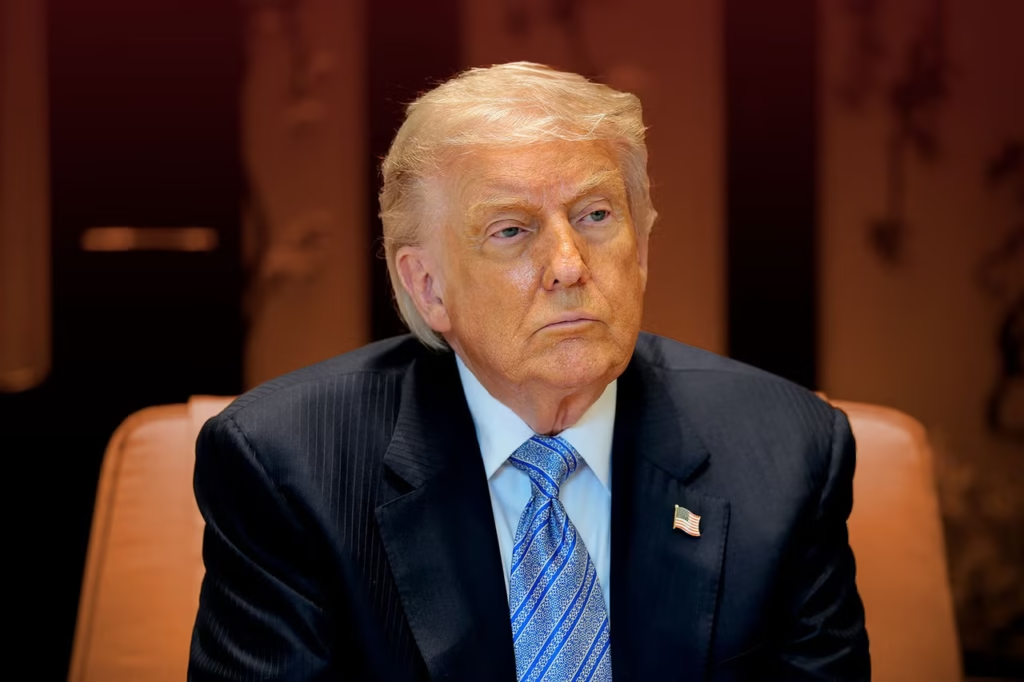
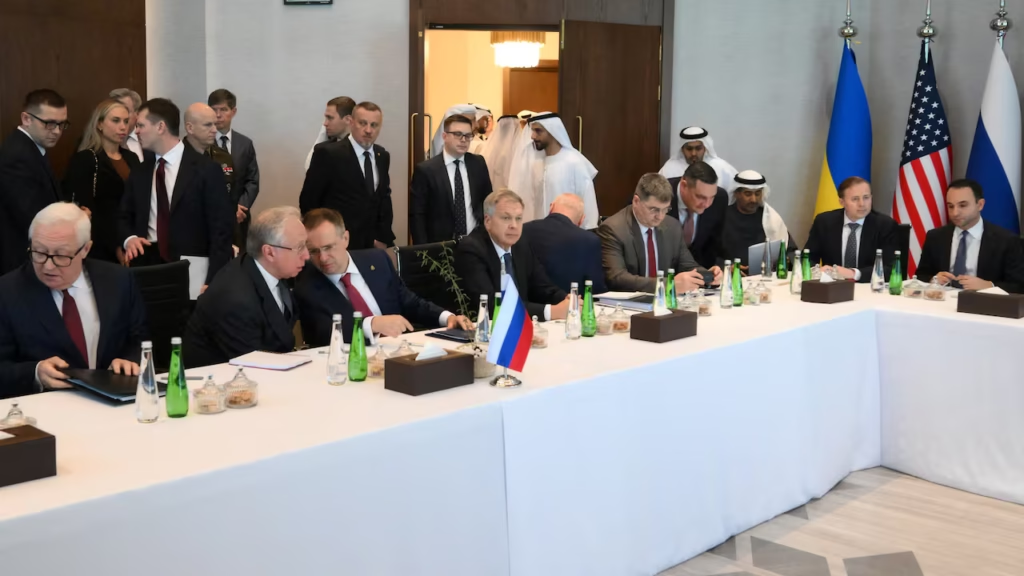
The first trilateral talks in months opened with both sides far apart on territory and security guarantees; the US is pushing for a framework resolution while Ukraine insists on sovereignty and Russia on territorial gains.
DIPLOMACY · UKRAINE · RUSSIA · ABU DHABI · ARC: NOV 8 TALKS SCHEDULED
The US-mediated trilateral peace talks between Russia, Ukraine, and the United States opened in Abu Dhabi on Monday, with the delegations meeting for the first formal session since the talks were scheduled following the third round of discussions, AP, The Guardian, NPR, and CNN all confirmed. Both sides were described by all reporting outlets as far apart on the core issues: Ukraine insists on the restoration of its internationally recognized territorial borders as a starting condition for any peace framework, while Russia demands recognition of its territorial gains — including the four oblasts it has purported to annex — as a prerequisite for any ceasefire. The gap between these positions has not narrowed in the prior rounds.
The United States delegation, led by the Special Envoy appointed by Trump, opened the Abu Dhabi session with what AP described as a framework proposal designed to create a path to a ceasefire without resolving the territorial questions immediately — a sequencing approach in which a cessation of hostilities would precede negotiation of the ultimate political settlement. This approach is consistent with other frozen-conflict frameworks in which military activity has been suspended while political questions remain unresolved, most famously the Korean armistice model. Ukraine has previously resisted the frozen-conflict framework, arguing that it would lock in Russian territorial gains without a binding resolution.
The Opening Session Dynamics
CNN reported on the specific dynamics of the opening session, noting that the Ukrainian delegation opened with a formal presentation of the November 8 aid center death toll (55 dead) and the drone strike on emergency workers as evidence of Russian bad-faith conduct during the negotiating period. The Russian delegation responded by characterizing the Ukrainian presentation as a disruption tactic and by presenting its own account of Ukrainian military actions during the same period. The US delegation attempted to redirect both sides toward the framework proposal, with limited initial success.
The Guardian reported that European observers monitoring the Abu Dhabi talks — not full participants given the European pushback reported on November 7 — characterized the opening session as more procedurally structured than prior rounds but substantively no closer to a resolution. The specific European concern, articulated by diplomatic sources The Guardian cited, was that the US framework proposal of a ceasefire-first sequencing creates a situation in which Russia achieves a de facto recognition of its territorial position through the cessation of active conflict, without any binding commitment to a political resolution timeline.
“We are here. We are talking. That is nothing, but it is not enough. Peace requires more than presence at a table.” — Ukrainian delegation statement, cited by AP
Trump Iran War Declaration Context
The Abu Dhabi talks opened on the same day that Trump declared the Iran war militarily effective over (article a04 in this edition), and NPR noted that the Iran declaration shifted some diplomatic bandwidth and attention away from the Ukraine talks at a moment when the US mediation role requires sustained focus. The convergence of the Iran war wind-down and the Abu Dhabi opening suggests the administration is attempting to claim two diplomatic achievements simultaneously, but the actual substance of the Abu Dhabi session — described as far apart on core issues — does not yet support a parallel declaration of success on Ukraine.
WHAT HAPPENS NEXT
► Abu Dhabi talks to continue through multi-day session; second-day agenda to focus on framework proposal
► Ukraine to present formal security guarantee demands as condition for ceasefire-first sequencing
► European allies to request formal briefing on US framework proposal content
► Massie impeachment articles (article a01) to affect US negotiating credibility if Hegseth is removed
| CONFIDENCE: HIGH | AP, The Guardian, NPR, and CNN all confirmed the opening of the Abu Dhabi talks, the far-apart positions, and the US framework proposal. Four-source convergence on a confirmed and publicly acknowledged diplomatic event. |
| Bias Check | ||
| Left-Lean | Center | Right-Lean |
| Talks framed as Trump deal-seeking that legitimizes Russian aggression; Ukraine sovereignty non-negotiable. | Reports opening dynamics, far-apart positions, and framework proposal factually; notes European concerns. | Talks framed as Trump diplomatic achievement; getting Russia to the table as itself a significant outcome. |
SOURCES
► AP — Abu Dhabi talks open, far-apart positions, US framework proposal, ceasefire-first sequencing, November 10, 2026
► The Guardian — European observer concerns, frozen-conflict framework risks, territorial recognition implications
► NPR — Iran war declaration convergence, diplomatic bandwidth, administration dual-achievement framing
► CNN — Opening session dynamics, Ukrainian aid center presentation, Russian response, US redirection