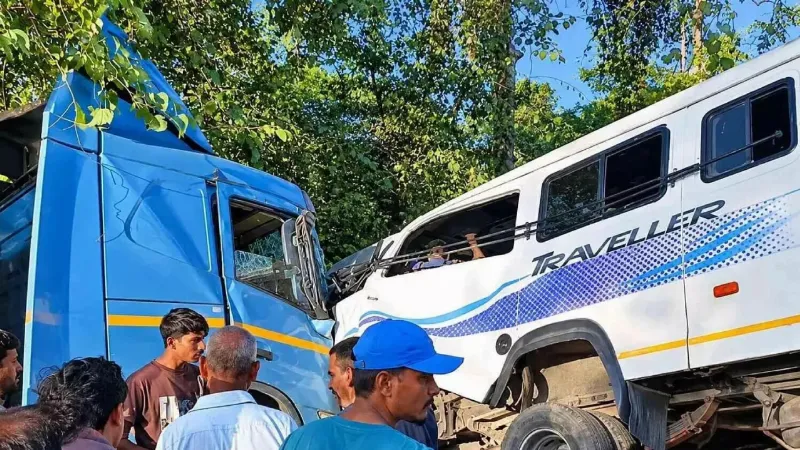
A minibus and a container truck collided head-on near Kaziranga National Park, killing at least 23 people and injuring approximately 20 others; the crash is among the deadliest road accidents in Assam in recent years.
BREAKING · INDIA · ASSAM · ROAD ACCIDENT · MASS CASUALTY
A head-on collision between a minibus and a container truck on a highway near Kaziranga National Park in Assam, northeastern India, killed at least 23 people and injured approximately 20 others, the Associated Press, The Hindu, and Reuters all confirmed on Friday. The crash, which occurred on a national highway in the Kaziranga area, involved the full-impact collision of a loaded minibus with a container truck traveling in the opposite direction, producing a casualty scale consistent with a high-speed frontal collision between a vehicle carrying passengers and a heavy goods vehicle. Emergency response teams from local police, medical services, and state disaster management were deployed to the crash site. The injured were transported to hospitals in the area, and the death toll was described as potentially rising based on the condition of some of the hospitalized victims.
Reuters provided details on the specific location context of the crash. The national highway near Kaziranga — the area that is home to the UNESCO World Heritage Site Kaziranga National Park and its famous Indian one-horned rhinoceros population — is a major transit corridor for the northeastern Indian states that connects to the broader national highway network. The highway passes through terrain that creates specific driving challenges: narrow road widths relative to traffic volume, frequent wildlife crossing activity, and the mix of heavy goods vehicles serving the northeastern region with passenger vehicles and minibuses serving local and long-distance passenger transport needs. Reuters noted that this stretch of highway has been the site of prior fatal accidents given these conditions.
The Indian Road Safety Context
The Hindu provided context on the Indian road safety record in which the Assam crash is situated. India has one of the highest road fatality rates in the world on an absolute basis, with approximately 150,000 people dying in road accidents annually — a figure that has been a persistent policy concern for successive Indian governments. The northeastern states have accident rates that are proportionally higher than the national average, partly due to challenging terrain, partly due to road quality and width limitations, and partly due to enforcement challenges on highways that cross state boundaries and pass through areas with limited police presence. The Hindu noted that the Kaziranga crash follows the Kolkata-Sairang Express derailment in Assam in a week that has seen two major mass-casualty transportation accidents in the same state.
The Associated Press provided details on the rescue and medical response. The scale of the casualty count — 23 dead and approximately 20 injured — required the deployment of multiple ambulances and the activation of the nearest district hospital emergency protocol to handle the volume of critically injured patients arriving simultaneously. AP noted that the medical capacity available in the Kaziranga area for mass casualty events is limited relative to major urban centers, and that the most seriously injured victims required transport over longer distances to facilities with specialized surgical capacity, creating a time-to-care challenge in the critical post-injury period.
“Twenty-three families received the worst news today. This road has taken too many lives. Something must change.” — Assam state transport official cited by The Hindu
The Highway Safety Investment Gap
Reuters analyzed the broader highway safety investment gap that the Assam crash illustrates. The northeastern Indian highway network — including the stretch near Kaziranga — has been the subject of investment commitments from successive National Highways Authority of India programs, but the gap between committed investment and actual road widening, divider installation, and safety infrastructure remains significant. The specific risk factor of head-on collisions between heavy goods vehicles and passenger vehicles on undivided highways is one that road safety engineers have documented extensively and that physical road design interventions — central dividers, rumble strips, and passing lane restrictions — can substantially reduce. The rate at which these interventions are being implemented on northeastern Indian highways has not kept pace with the documented risk.
WHAT HAPPENS NEXT
► Assam state authorities to confirm final death toll as injured patients are assessed
► Police to investigate cause of head-on collision; driver conduct and mechanical failure to be assessed
► NHAI to review safety conditions on Kaziranga highway stretch; divider installation to be prioritized
► Victims’ families to receive state compensation; hospital costs for injured to be covered by state
| CONFIDENCE: HIGH | AP, The Hindu, and Reuters all confirmed the crash, the death toll of at least 23, the approximately 20 injured, the Kaziranga location, and the head-on collision mechanism. Three-source convergence on a confirmed mass-casualty road accident. |
| Bias Check | ||
| Left-Lean | Center | Right-Lean |
| Crash framed as preventable consequence of chronic underinvestment in northeastern Indian highway safety. | Reports death toll, crash mechanism, rescue response, and Indian road safety context factually. | Crash framed as tragic accident; infrastructure investment is happening but takes time to reach all corridors. |
SOURCES
► Associated Press — Crash confirmation, casualty figures, rescue response, hospital capacity context, November 13, 2026
► The Hindu — Assam road safety record, northeastern accident rate, Kaziranga accident history, transportation arc
► Reuters — Location context, Kaziranga highway conditions, NHAI investment gap analysis