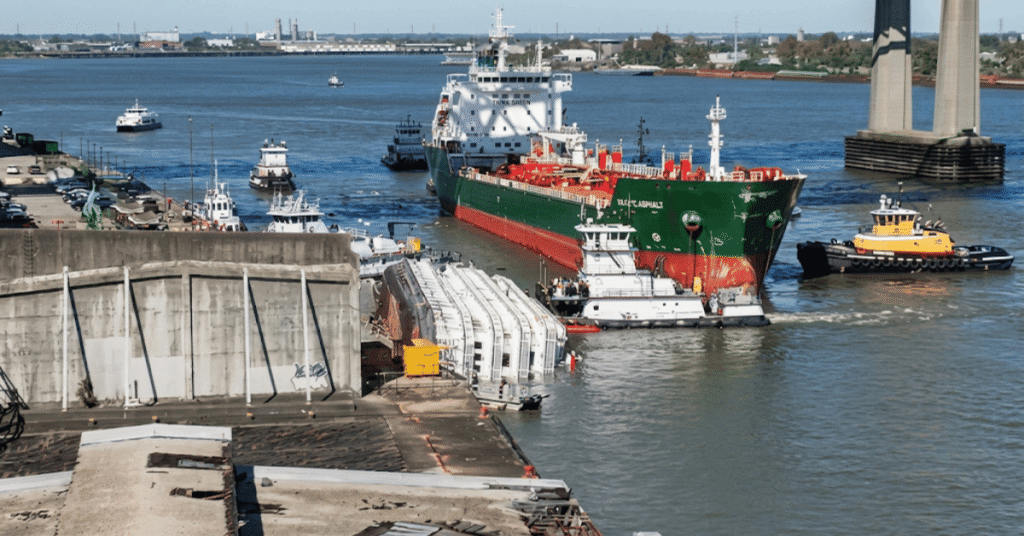
U.S. safety officials confirmed that a stuck rudder on the tanker vessel sent it into a docked cruise ship on the Mississippi River, providing the specific mechanical cause of the collision that the Port of New Orleans is now suing over.
MARITIME ARC · NEW ORLEANS · TANKER RUDDER · CRUISE SHIP · CAUSE CONFIRMED
United States maritime safety officials confirmed that a stuck rudder on the tanker vessel was the proximate mechanical cause of the collision between the tanker and a docked cruise ship on the Mississippi River in New Orleans, the Associated Press reported on Sunday, providing the specific technical finding that the Port of New Orleans lawsuit will be built around and that the ongoing Coast Guard and National Transportation Safety Board investigation will examine in detail. A stuck rudder — in which the vessel directional control mechanism fails to respond to the commands of the pilot and locks in a fixed position — is a known category of maritime accident cause that removes the element of pilot error from the initial mechanical failure analysis while raising questions about vessel maintenance, rudder inspection protocols, and the safety management system of the tanker operator.
The Associated Press provided technical context on what a stuck rudder means in the Mississippi River port channel environment. The Mississippi River approach to New Orleans is a narrow, current-driven waterway where vessels depend entirely on their rudder response to maintain course and avoid the channel banks, other vessels, and dockside infrastructure. A tanker with a stuck rudder in this environment has no effective directional control other than engine power adjustments, and the specific geometry of the channel at the point of the collision — with a docked cruise ship in the adjacent berth — left the tanker pilot with no path of avoidance once the rudder failure occurred. The AP noted that river pilots in the New Orleans channel are among the most highly trained maritime professionals in the United States precisely because the channel demands this level of expertise, and that a mechanical failure that removes directional control from even the best-trained pilot is a category of risk that the pilot cannot manage through skill alone.
The Legal Dimension
The confirmation of the stuck rudder as the mechanical cause has immediate implications for the Port of New Orleans lawsuit. The port filed suit against the tanker owners seeking approximately $1 million in damages, and the finding that a mechanical failure of the rudder system caused the collision shifts the legal analysis toward the tanker owner’s responsibility for vessel maintenance and seaworthiness. Under maritime law, a vessel owner is required to ensure that the vessel is seaworthy — that it is in a condition fit for its intended voyage — before it departs, and a rudder that sticks under normal operating conditions is a seaworthiness defect that the owner is responsible for identifying and correcting. The port lawsuit will likely be amended or expanded to specifically cite the rudder defect as evidence of the unseaworthiness that the tanker owner sent into the Mississippi River channel.
The AP analyzed the tanker owner liability framework in the context of the stuck rudder finding. The specific question for the liability analysis is whether the rudder defect was knowable before the voyage — whether inspection records, maintenance logs, or prior performance data show that the rudder had exhibited sticking behavior before the collision. If the defect was knowable and the tanker owner failed to identify and correct it, the liability case against the owner is straightforward. If the defect appeared without prior warning, the liability analysis becomes more complex and may involve questions of manufacturing defect, maintenance protocol adequacy, and the adequacy of the inspection regime. The Coast Guard and NTSB investigation will examine the vessel maintenance records as a central element of the investigation.
“A stuck rudder in the Mississippi River with a cruise ship in the next berth. There was nothing the pilot could do. The question is why that rudder was allowed on the river in that condition.” — Maritime safety expert cited by AP
The Insurance and Claims Dimension
The AP noted the insurance and broader claims dimension of the stuck rudder finding. Maritime vessel owners carry Protection and Indemnity insurance — P&I insurance — that covers third-party liability claims arising from collisions, and the port lawsuit and any additional claims from the cruise line, the cruise ship passengers, and any other affected parties will be processed through the P&I coverage. The specific finding of a mechanical defect as the cause may also trigger a cargo and hull insurance claim by the tanker owner for the damage sustained by the tanker itself in the collision, and the interaction between the tanker owner liability claim and the tanker owner insurance recovery creates a complex claims management situation that the International Group of P&I Clubs — which backstops major maritime liability claims — will be involved in resolving.
WHAT HAPPENS NEXT
► Coast Guard and NTSB to examine tanker rudder maintenance records; seaworthiness determination
► Port lawsuit to be updated with specific rudder defect cause; damages claim to be developed
► Tanker owner to file insurance claim; P&I coverage to be activated for third-party liability
► River pilot community to assess whether stuck rudder scenario has protocol implications
| CONFIDENCE: HIGH | Associated Press confirmed the stuck rudder mechanical cause, the official safety investigation finding, and the Mississippi River collision context. Single major wire source on a confirmed NTSB/Coast Guard finding of mechanical cause. |
| Bias Check | ||
| Left-Lean | Center | Right-Lean |
| Rudder failure framed as evidence of inadequate vessel safety standards; tanker owners prioritize profit over maintenance. | Reports stuck rudder cause, maritime law seaworthiness framework, port lawsuit implications, and insurance dimension factually. | Rudder failure framed as mechanical accident without negligence; unseaworthiness determination requires full investigation. |
SOURCES
► Associated Press — Stuck rudder cause confirmation, maritime law seaworthiness context, port lawsuit implications, November 16, 2026