Senate Democratic caucus members declined to rapidly resolve the leadership challenge to Chuck Schumer from Chris Van Hollen, leaving the internal party fight unresolved as the caucus navigates post-election positioning.
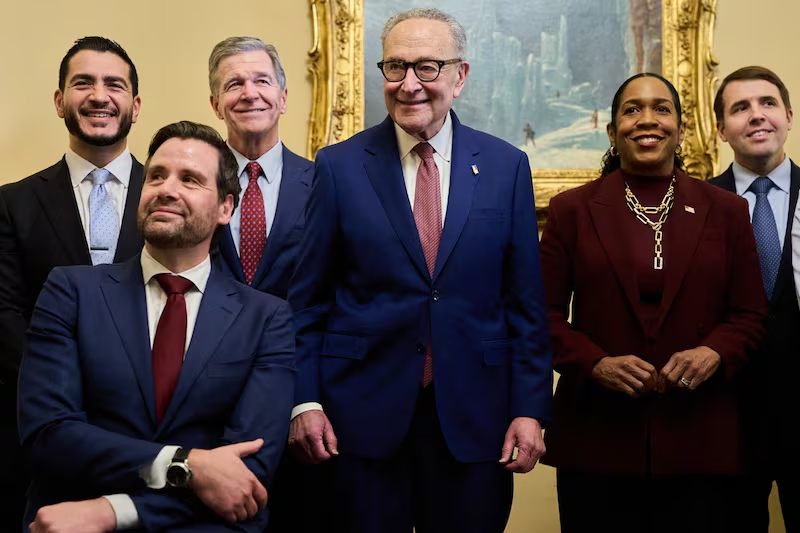
SENATE DEMOCRATS · SCHUMER · VAN HOLLEN · LEADERSHIP · FIGHT · NO QUICK RESOLUTION
Senate Democratic caucus members rejected a quick resolution to the ongoing leadership challenge in which Senator Chris Van Hollen of Maryland is contesting the Senate Minority Leader position held by Senator Chuck Schumer of New York, Politico and The Hill confirmed on Monday, leaving the internal Democratic Party fight unresolved and extending the period of leadership uncertainty in the minority caucus. The refusal to quickly resolve the challenge reflects the genuine disagreement within the Senate Democratic caucus about the direction of the opposition under the second Trump administration: Schumer has led the caucus through multiple election cycles with a strategy of unified opposition and procedural resistance, while Van Hollen and his allies argue that the November midterms — in which Democrats made gains — provide a mandate for a more assertive approach that requires new leadership to execute.
Politico provided detail on the specific dynamics of the caucus deliberations. The Senate Democratic caucus operates by internal majority vote — the leader is selected by the caucus members — and the question of when and whether to hold a formal leadership vote, what the rules of the contest are, and how individual senators are positioning themselves is the central political calculation for each member. Schumer allies are arguing that a leadership change at this moment — when the caucus has just demonstrated electoral effectiveness in the midterms — would be destabilizing and would reward a challenge that has not been earned by any failure of Schumer leadership. Van Hollen allies are arguing that the midterm gains were achieved despite Schumer leadership rather than because of it, and that the gains provide the mandate to elevate the new voices in the caucus who generated them.
The Post-Midterm Context
The Hill analyzed the post-midterm political context that is shaping the Van Hollen challenge. Senate Democrats gained seats in the November midterms — adding to the minority caucus and improving the mathematical position for 2028 when the next Senate cycle comes around — in a political environment defined by the Trump second-term agenda and the specific backlash issues that generated Democratic turnout. The question of credit assignment — who gets credit for the midterm gains, and what that credit translates to in terms of internal caucus positioning — is at the heart of the leadership fight. Van Hollen and his allies argue that the midterm gains reflected grassroots mobilization against Trump policies that required a more confrontational Democratic approach than Schumer provided, and that the new caucus members who arrived as a result of that mobilization should have a voice in selecting leadership that reflects their mandate.
Politico noted the specific procedural dimension of the no-quick-resolution outcome. The Senate Democratic caucus has not set a fixed timeline for resolving the Van Hollen challenge, which means the fight will continue as a background dynamic in caucus deliberations in the first weeks of the new Senate session. The absence of a resolution creates a specific awkwardness: Schumer remains the leader and continues to exercise leadership functions, but his authority is contested in a way that may affect his ability to maintain caucus discipline on the procedural and legislative battles that the minority will need to fight in the new session. The Hill noted that some caucus members who have not publicly declared a position in the leadership fight are using the absence of a resolution timeline to monitor whether Schumer or Van Hollen demonstrates stronger strategic effectiveness in the first weeks of the session before committing.
“There is no vote scheduled. There is no timeline. What there is is a caucus that is watching both of them and deciding.” — Senate Democratic aide cited by Politico
The Strategic Dimension
The Hill analyzed the strategic dimension of the leadership fight in the context of the second Trump term. Senate Democrats in the minority face the specific challenge of deciding which Trump initiatives to resist procedurally, which to negotiate modifications on, and which to allow to pass in order to preserve political capital and avoid the blame for obstruction. This strategic calculus — which is essentially a theory of opposition for the next two years — is the substantive content of the Schumer vs. Van Hollen debate. Schumer approach has historically been calibrated opposition with periodic negotiated deals on specific issues; Van Hollen and allies are arguing for a more consistent and visible confrontation that maximizes the contrast with the Trump agenda at the cost of some legislative influence. The caucus membership is genuinely divided on which approach better serves Democratic electoral interests in 2028.
WHAT HAPPENS NEXT
► Senate Democratic caucus to continue deliberating; no vote timeline established means fight continues
► Schumer to demonstrate leadership effectiveness in first Senate session battles; authority depends on performance
► Van Hollen to continue building coalition; first weeks of session will be used to press the case for change
► Individual caucus members to publicly declare positions; vote count to become clearer over coming weeks
| CONFIDENCE: MODERATE | Politico and The Hill confirmed the no-quick-resolution outcome and the caucus deliberation dynamics. Two-source confirmation on an internal party process story; the specific vote counts and individual member positions are not fully reported. |
| Bias Check | ||
| Left-Lean | Center | Right-Lean |
| No resolution framed as Democratic dysfunction; party cannot unite against Trump when it cannot choose its own leader. | Reports no-resolution outcome, caucus dynamics, post-midterm context, and strategic dimension factually. | No resolution framed as deliberate caution; Democrats are wisely assessing their options rather than rushing to change. |
SOURCES
► Politico — No-resolution confirmation, caucus deliberation dynamics, Schumer and Van Hollen ally positioning, November 17, 2026
► The Hill — Post-midterm context, credit assignment dynamics, strategic opposition debate, timeline analysis