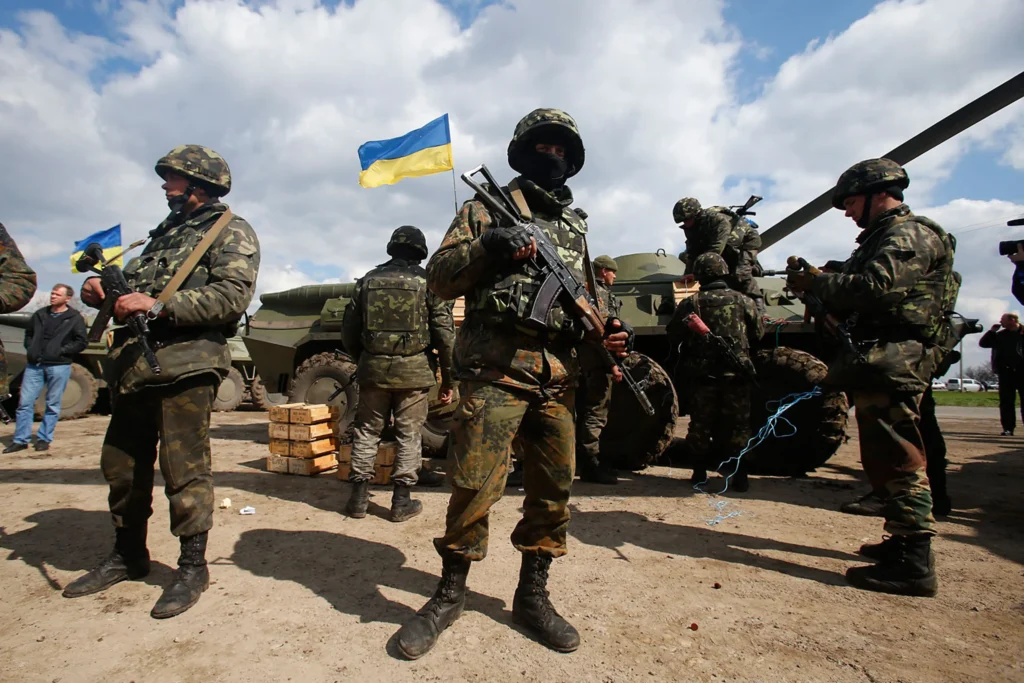
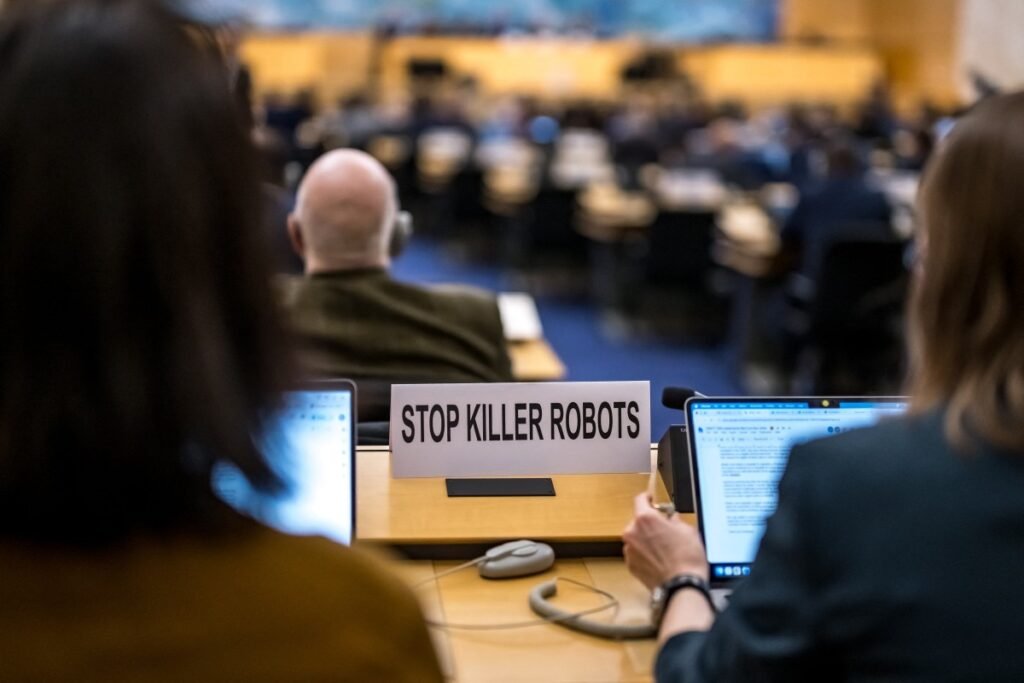
Nations gathered for United Nations talks on autonomous weapons systems agreed only to continue talking, failing to establish any firm limits on the development or deployment of lethal autonomous weapons despite years of international advocacy for binding controls on so-called killer robots.
UN · AI WEAPONS · KILLER ROBOTS · AUTONOMOUS · NO LIMITS · TALKS STALL · GOVERNANCE
Nations gathered for United Nations talks on lethal autonomous weapons systems — systems that can select and engage targets without meaningful human control, commonly referred to as killer robots — agreed only to continue their discussions, failing to establish any firm limits on the development or deployment of such systems despite years of international advocacy for binding controls, the Associated Press reported on Friday. The talks, which have been conducted under the Convention on Certain Conventional Weapons framework, have been a recurring element of the international arms control agenda for more than a decade, and the November 21 outcome — more process, no substance — is consistent with the pattern of a negotiation track that has produced consistent advocacy, annual meetings, and no binding commitments. The AP noted that the specific obstacle to any agreement is the same obstacle that has blocked progress for ten years: the major military powers, including the United States, Russia, China, and others, are unwilling to accept binding limits on weapons technologies that they are actively developing and in some cases deploying.
The AP provided detail on the specific dynamic of the November 21 talks. The talks included advocates from the Campaign to Stop Killer Robots — a coalition of non-governmental organizations that has been pressing for a preemptive ban on lethal autonomous weapons since 2013 — alongside government delegations representing the full range of UN member states. The advocates argued that the development of weapons systems that can select and kill human targets without meaningful human review crosses a fundamental ethical line that existing international humanitarian law was not designed to address, and that a preemptive ban before such systems are widely deployed is both achievable and necessary. The government delegations of the major military powers did not accept the ban framing, and the specific outcome — agreement to continue meeting — reflects the structural inability of a consensus-based multilateral process to produce a binding outcome when the most powerful states oppose one.
The AI Connection
The AP analyzed the connection between the UN killer robots talks and the broader AI governance moment. The November 21 AI weapons talks occur in the same week as the Anthropic IPO, the AI market selloff, the Riemann hypothesis claim (B11 of this edition), and the broader AI governance conversation that the AI arc of this edition represents. The specific question of autonomous weapons — AI systems that can make lethal targeting decisions — is the most consequential governance question in the AI policy space, because it involves not just economic or regulatory frameworks but the fundamental question of whether AI systems should be authorized to make decisions that result in human death without human review. The AP noted that the same advances in AI capability that produced the Anthropic IPO at $2 trillion also accelerate the development of autonomous weapons systems, and that the governance frameworks for the two applications of AI are both lagging behind the technology.
The AP noted that the Ukraine war has added concrete urgency to the killer robots talks. Ukraine and Russia have both deployed increasingly autonomous drone systems in the conflict — systems that can identify, track, and attack targets with decreasing levels of human control — and the specific weapons technologies being tested in the Ukraine conflict are the prototype systems that the killer robots talks are attempting to address. AP noted that several delegations in the UN talks explicitly referenced the Ukraine conflict as evidence that the development timeline for autonomous weapons is shorter than the international community has been treating it, and that the failure to agree on any limits in November 2026 means that the next time the international community assembles for killer robots talks, the technology will be more advanced, more deployed, and harder to constrain.
“We agreed to talk more. We have been talking for twelve years. The robots are not waiting for us.” — Campaign to Stop Killer Robots representative cited by AP
The Path Forward
The AP analyzed the path forward from the November 21 impasse. The specific options available to the advocates for binding limits are limited by the consensus requirement of the CCW process: they can continue to press for a ban within that process, knowing it requires major military power consent that is not forthcoming; they can attempt to create an alternative treaty process outside the CCW framework, as the landmines and cluster munitions bans were negotiated outside the standard UN framework when the major powers blocked consensus; or they can focus on developing voluntary guidelines and norms that do not require formal binding agreement but that establish a normative baseline for responsible autonomous weapons development. The AP noted that the advocates are increasingly focused on the alternative treaty option, but that such a treaty would not bind the United States, Russia, or China — the countries whose autonomous weapons programs are the primary concern.
WHAT HAPPENS NEXT
► UN talks to continue on the standard annual schedule; no binding outcome expected at the next session
► Campaign to Stop Killer Robots to pursue alternative treaty track; whether a CCW-external process can be organized
► Major military powers to continue autonomous weapons development without binding constraints
► Ukraine conflict to continue demonstrating autonomous weapons capabilities; real-world precedents accumulating
► AI governance advocates to connect autonomous weapons to broader AI safety frameworks; policy linkage to be attempted
| CONFIDENCE: HIGH | Associated Press confirmed the talks outcome, the consensus failure, the AI connection, and the Ukraine conflict relevance. Single wire source with comprehensive diplomatic and policy context on a confirmed UN negotiating outcome with significant AI governance implications. |
| Bias Check | ||
| Left-Lean | Center | Right-Lean |
| Talks framed as systemic failure; major military powers are actively developing the weapons they refuse to constrain, and the UN process is providing cover for continued development. | Reports talks outcome, consensus failure dynamics, AI connection, Ukraine conflict relevance, and path forward factually. | No limits framed as appropriate restraint; unilateral disarmament on autonomous weapons would disadvantage the United States relative to Russia and China. |
SOURCES
► Associated Press — Talks outcome, consensus failure, advocate positions, Ukraine conflict connection, AI arc linkage, path forward analysis, November 21, 2026