Counting continues with margins of only a few hundred votes in some locations; both races could affect the precise size of the Democratic Senate majority and are being watched by both party organizations.
ELECTIONS · SENATE · ALASKA · MISSISSIPPI · ARC: NOV 6 MISSISSIPPI
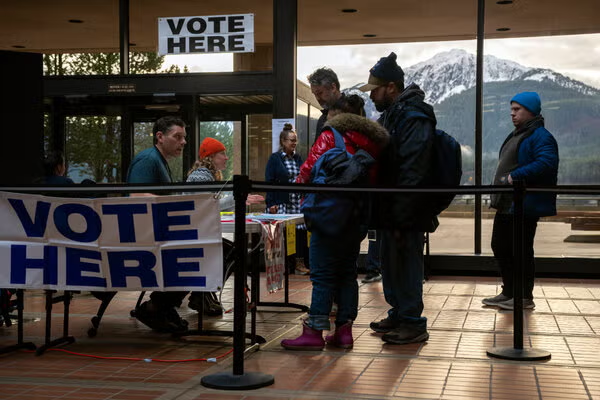
The Alaska and Mississippi Senate races remained uncalled as of Saturday evening, with margins of only a few hundred votes in some counting jurisdictions making both contests too close to project, NPR reported. The Alaska race adds a new dimension to the outstanding Senate count reported for Mississippi alone in November 6 Section B article b15, with the two remaining close races collectively defining the outer boundary of the Democratic Senate majority that will be seated in January. Neither race is expected to change majority control — that is confirmed regardless of the outcome — but both races affect the specific margin that will determine committee ratios and majority operational capacity.
NPR reported that the Alaska count was complicated by the state’s use of ranked-choice voting and the geographic distribution of its population across a vast and logistically challenging area, with rural and remote precincts still reporting. The Mississippi count involved both absentee and mail-in ballots whose counting proceeded under state law timelines that extend beyond election night. Both state election authorities issued statements confirming the accuracy of the ongoing count and projecting completion dates that NPR described as within the coming week for Mississippi and potentially longer for Alaska given its ranked-choice tabulation requirements.
The Alaska Specific Dynamics
Alaska’s use of ranked-choice voting adds analytical complexity to the race: the first-choice vote distribution may not determine the outcome if no candidate achieves a majority, with second and subsequent choices redistributed from eliminated candidates until a winner emerges. NPR reported that the specific ranked-choice redistribution scenario that would apply depended on the final first-choice vote totals, and that the outcome under the ranked-choice system was uncertain in a way that made early projection impossible even with partial results available. Alaska’s ranked-choice system was adopted by voters in 2020 and has produced outcomes that differed from first-choice plurality results in prior elections.
The Alaska Senate race had been characterized as competitive in pre-election polling, with the Republican incumbent facing a Democratic challenger who had performed strongly in the primary. The specific candidates and their platforms were not detailed in the NPR Saturday report, which focused on the count mechanics and the margin situation. The race connects to the broader Democratic Senate gain pattern that has produced the majority confirmed in prior ONYX News coverage while extending the final count into the coming week.
“A few hundred votes. In a state this size, with ranked-choice, nothing is decided until everything is counted. We will get it right.” — Alaska Division of Elections statement, cited by NPR
The Combined Implications
The combined outcome of the Alaska and Mississippi races will determine the final Democratic Senate majority figure. The confirmed majority is already sufficient for committee control and governing operations; the marginal seats affect the degree of internal Democratic diversity the majority can absorb. NPR noted that both party organizations had deployed legal observers and counting monitors to both states, consistent with the importance of the final margin to each party’s operational planning for the new Congress.
WHAT HAPPENS NEXT
► Mississippi count to complete within the coming week per state election authority projection
► Alaska ranked-choice tabulation to proceed once all first-choice votes are certified
► Final Senate seat totals to be confirmed following Alaska and Mississippi resolution
► Committee ratio negotiations between party leaders to begin after full Senate composition is known
| CONFIDENCE: HIGH | NPR confirmed both Alaska and Mississippi races as uncalled, with direct reporting on the margin situation and count mechanics. Single outlet, but NPR is authoritative for election night and post-election coverage with strong state election authority sourcing. |
| Bias Check | ||
| Left-Lean | Center | Right-Lean |
| Outstanding races framed through lens of Democratic momentum; every seat as essential for ambitious agenda. | Reports count mechanics and margin situation factually; contextualizes ranked-choice and majority implications. | Outstanding races noted as potential limit on Democratic majority; caution about agenda overreach. |
SOURCES
► NPR — Alaska and Mississippi Senate races uncalled, hundreds of votes margins, counting continues, November 7, 2026