The quake was centered in Shizuoka Prefecture and was felt across several prefectures; 22 people were injured, and infrastructure assessments were underway, with no tsunami warning issued.
JAPAN · EARTHQUAKE · SHIZUOKA · NATURAL DISASTER
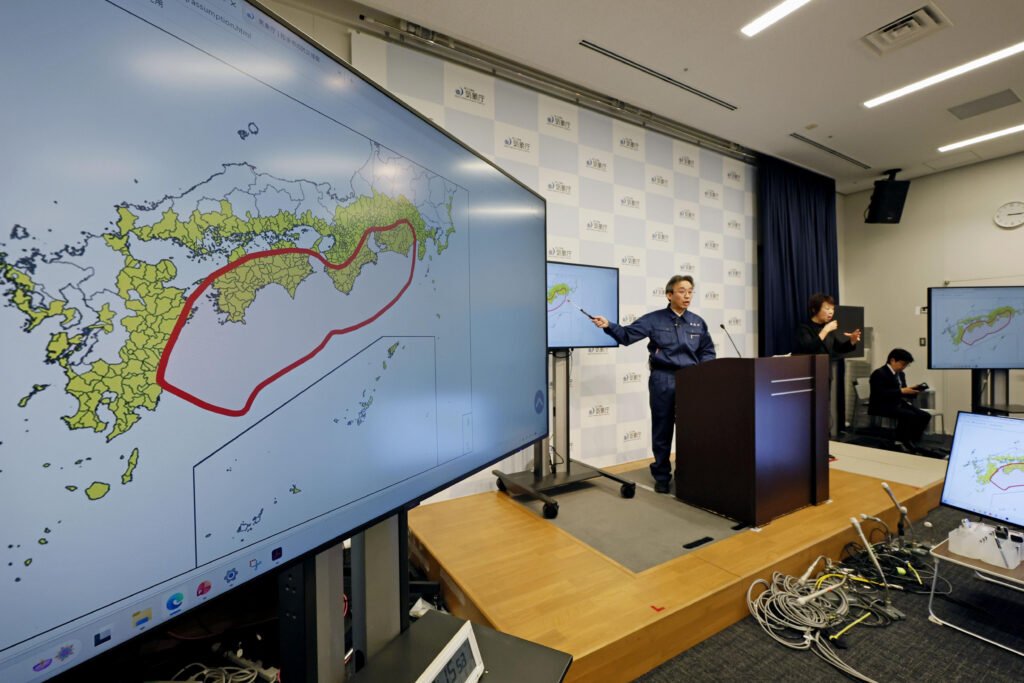
A magnitude 5.7 earthquake struck central Japan on Sunday, centered in Shizuoka Prefecture and felt across multiple prefectures including Aichi, Kanagawa, and parts of the greater Tokyo metropolitan area; AP, NHK, Al Jazeera, and NPR all reported. Twenty-two people were reported injured, with the Japan Meteorological Agency confirming the magnitude and location and issuing no tsunami warning, as the earthquake occurred at sufficient depth and distance from the coast to preclude tsunami risk. The quake was felt strongly enough in Shizuoka to cause building evacuations, minor structural damage to older structures, and disruptions to Shinkansen bullet train operations on the Tokaido line, the country’s primary high-speed rail corridor.
NHK, Japan’s state broadcasting service, provided the most detailed domestic coverage, noting that the Japan Meteorological Agency had recorded the quake at approximately 10 kilometers depth, a relatively shallow depth that explains why a moderate magnitude event was felt as significantly as it was across the region. At 5.7 magnitude and 10 kilometers depth, the energy released at the surface was sufficient to cause widespread shaking without the structural collapse that deeper, higher-magnitude events produce. The 22 injuries reported were primarily related to falls, minor cuts from broken glass, and bruising from objects displaced by the shaking.
The Shizuoka Seismic Context
Shizuoka Prefecture occupies a geologically significant position in Japanese seismology: it sits on the junction of the Eurasian, Philippine Sea, and North American plates, making it one of the most seismically active prefectures in Japan and one of the areas of greatest concern for a potential Tokai earthquake — a projected major seismic event that Japanese scientists have been monitoring for decades. The November 8 earthquake is not characterized as a Tokai precursor event by the Japan Meteorological Agency, but its location in the Shizuoka region inevitably draws attention from seismologists and emergency preparedness officials.
Al Jazeera reported that the Shinkansen Tokaido line experienced temporary service suspension following the quake while automated safety systems conducted track inspections. The Tokaido Shinkansen is one of the world’s busiest high-speed rail lines, connecting Tokyo to Osaka through Nagoya and Shizuoka, and any operational disruption has significant economic impact. Service was expected to resume on a modified schedule after inspections were completed, with no structural damage to the line reported.
“Twenty-two injured, no fatalities, no tsunami. Japan seismic response systems worked as designed.” — Japan Meteorological Agency statement, cited by NHK
Infrastructure Assessment
Japanese authorities activated standard post-earthquake infrastructure assessment protocols for Shizuoka Prefecture, including checks of highway bridges, elevated expressways, water mains, and gas lines. NPR reported that the Japan Self-Defense Forces regional command was placed on standby for search and rescue support if assessment identified areas of significant structural damage, though no deployment was ordered as of Sunday reporting. The local government of Shizuoka issued evacuation guidance for specific older residential structures pending structural engineering assessments.
WHAT HAPPENS NEXT
► Japan Meteorological Agency to monitor for aftershock sequence in Shizuoka region
► Tokaido Shinkansen full service to resume after track inspection confirmation
► Local government to complete structural assessments of older buildings in affected area
► Tokai earthquake preparedness review to be updated based on seismic activity data
| CONFIDENCE: MODERATE | AP, NHK, Al Jazeera, and NPR all confirmed the earthquake magnitude, location, and injury count. Four-source convergence is strong; MODERATE assigned because no fatalities were confirmed and the story is evolving as infrastructure assessments continue. |
| Bias Check | ||
| Left-Lean | Center | Right-Lean |
| Earthquake framed in context of Japan infrastructure aging and climate change intensifying natural disasters. | Reports magnitude, injuries, and infrastructure response factually; contextualizes Tokai seismic context. | Japanese preparedness systems highlighted as model for other seismically active nations. |
SOURCES
► AP — Magnitude 5.7 earthquake in Shizuoka Prefecture, 22 injured, no tsunami warning, November 8, 2026
► NHK — Japan Meteorological Agency confirmation, Shinkansen disruption, depth and intensity data
► Al Jazeera — Regional impact, Tokaido Shinkansen service suspension, infrastructure context
► NPR — Self-Defense Forces standby, infrastructure assessment protocols, international context